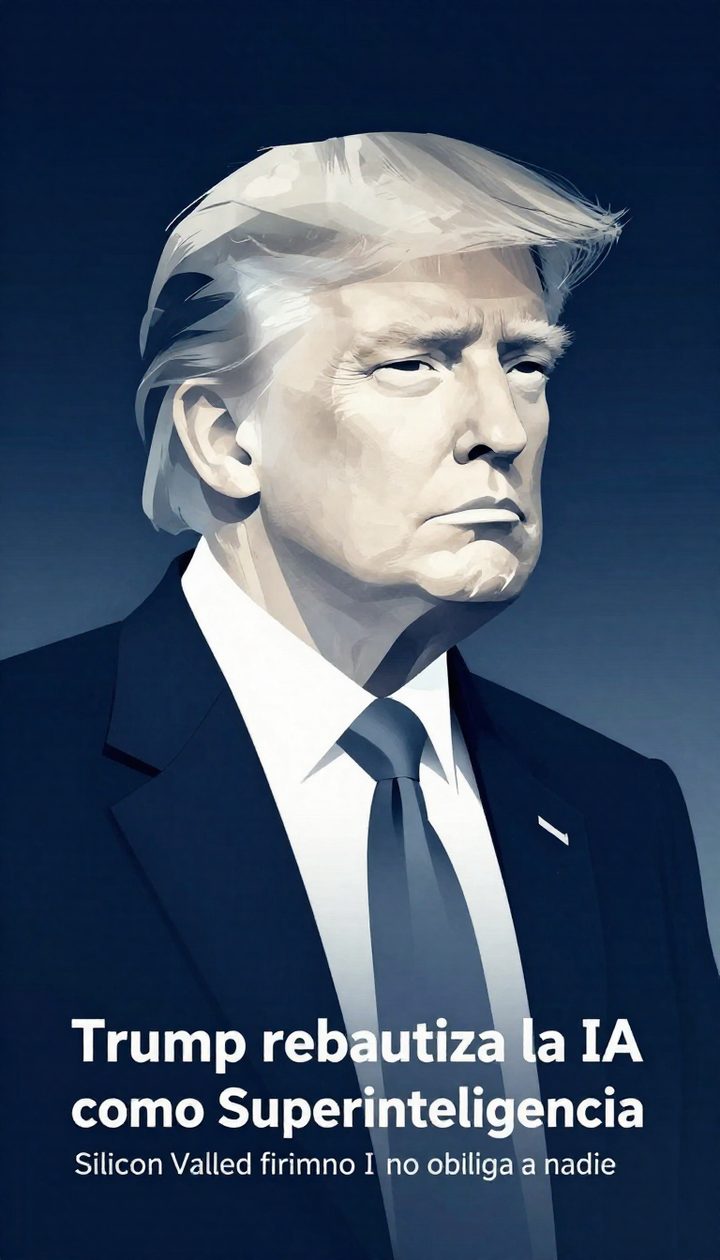
Trump renames AI as 'Superintelligence' by decree and Silicon Valley signs a safety pact that binds no one
🕒 Published on Zendoric: October 4, 2026 · 09:58
✨ AI-generated · how it's made
The White House replaced 'AI' with 'Superintelligence' across the Administration, and Trump had Musk, Huang, Amodei, Zuckerberg, Pichai and Brockman sign a four-tier safety agreement. It is voluntary and not legally binding: Microsoft and Amazon did not even sign it.
📚 Go deeper

DeepMind co-founder on the dilemma of containing technologies that do not want to be contained.
As an Amazon Associate, Zendoric earns from qualifying purchases; the price does not change for you. · all our recommended books →
By Zendoric · October 4, 2026.
The White House has decided that artificial intelligence is no longer called that. Through an executive order — a presidential decree with immediate force over the federal apparatus, with no need for congressional approval — Donald Trump instructed every US government agency to replace the term 'AI' with 'Super Intelligence' in official use. The measure also includes a call on Congress to write the change into law.
The announcement came on September 29 during a summit in the East Room of the White House, as reported by FayerWayer. There, Trump had the industry's top executives sign the 'White House Agreement on Superintelligence', a document that sets out four tiers of safety controls with one decisive caveat: they are voluntary. No company is legally obliged to apply them; the president himself called them 'morally binding' for those who signed.
Signing the final text were Elon Musk (xAI), Jensen Huang (Nvidia), Dario Amodei (Anthropic), Mark Zuckerberg (Meta), Sundar Pichai (Google) and Greg Brockman (OpenAI). Also attending the summit were Satya Nadella (Microsoft), Jeff Bezos (Amazon), Lisa Su (AMD) and Alex Karp (Palantir), but neither Microsoft nor Amazon put their signature on the final document. Apple did not send a representative at all, according to the outlet's report.
Where did the name come from? From a social media poll. Trump put several alternatives to a vote on X and Truth Social — 'Superior Intelligence', 'Supreme Intelligence' and 'Super Intelligence' — and the last of these won out with 65% of the preferences, according to figures the president himself circulated. As a footnote to the event, the printed version of the agreement handed out to attendees arrived with a typo: 'President of the Unites States'.
This voluntary architecture is no accident: in other remarks reported by FayerWayer, Trump has argued that heavy-handed regulation of AI 'can put a company out of business', a logic that explains why the agreement avoids any legal obligation and leaves implementation to each company's discretion.
It is worth separating two things the announcement deliberately mixes together: the name and the rule. Swapping 'AI' for 'Superintelligence' on official paper is, above all, a rhetorical act: it does not change a single line of code, nor does it bring any current model closer to the technical definition of superintelligence, a system that would broadly surpass human cognitive capacity. Judging by the demonstrated capability we track on the sector's benchmark tests, that leap remains a horizon, not a 2026 reality. What the decree does change is the official story: Washington is institutionalizing, with the Oval Office seal, the narrative the industry itself has long been promoting about itself.
The rule, by contrast, is where the real policy substance should be, and here the gesture carries less weight than it appears to. Four tiers of controls without the force of law amount, in practice, to each company deciding how much it audits itself, and when. That Microsoft and Amazon — two of the largest AI infrastructure providers on the planet — came to the East Room and left without signing, and that Apple did not even show up, is the clearest proof that the industry's consensus on 'safety' remains more declarative than real.
Broadly, at Zendoric we hold that AI governance must rest on evidence, not on panic or narrative; the usual risk is over-regulating out of fear of a capability that does not yet exist. This episode is the reverse case: there is no regulatory excess to rein in, but rather an almost non-existent obligation dressed up in presidential solemnity. A 'morally binding' agreement is, in practice, a non-binding agreement with a good photo.
Our reading is that the indicator that really matters will not be which word federal agencies use from now on, but what happens the first time one of the signatories breaches one of those four tiers of controls without consequences. If the United States aspires to lead not only in capability but also in governance — a necessary step if the transition toward the abundance we believe is possible in the long run is not to be built on a foundation of symbolic self-regulation — it will need something sturdier than a new label and a signature with no fine print.
📚 Go deeper

AI as the latest chapter in the history of information networks, from gossip to the printing press to the algorithm.
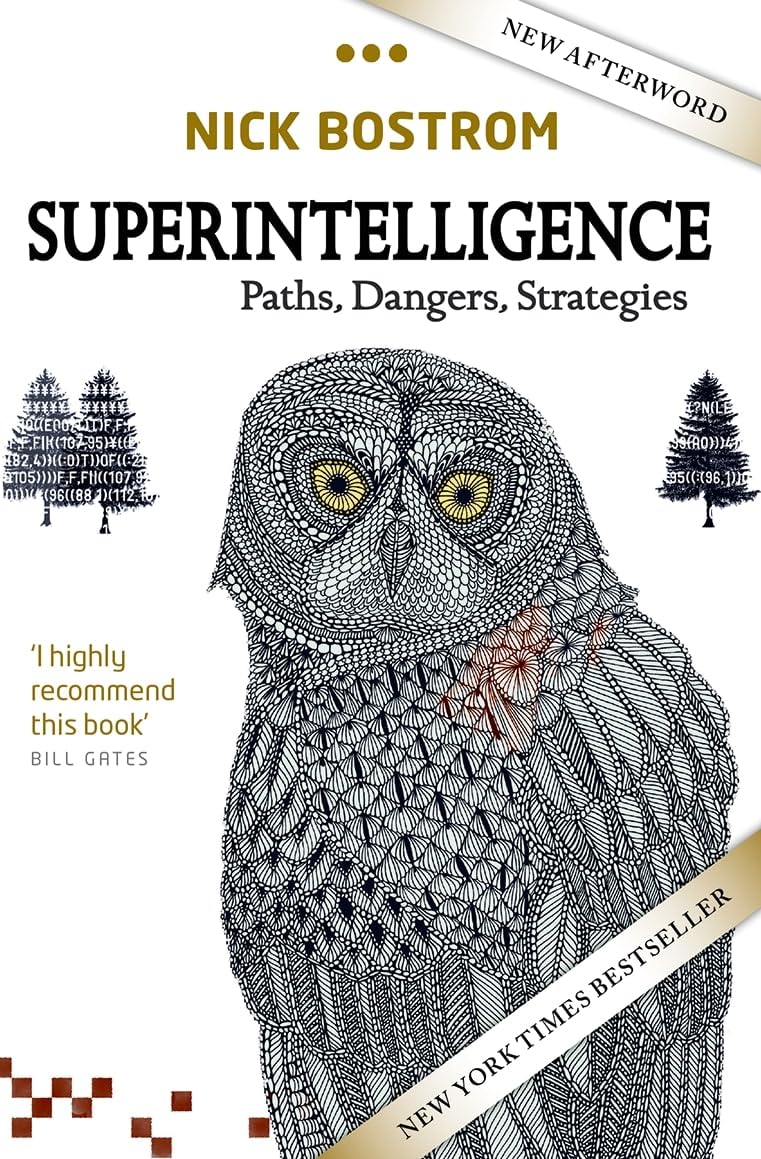
The book that started the existential-risk debate and that half the industry still cites.
As an Amazon Associate, Zendoric earns from qualifying purchases; the price does not change for you. · all our recommended books →
🔗 Related on Zendoric
- Trump rebrands AI as 'superintelligence': the label changes, the actual regulation doesn't · 2026-09-30
- Trump rebrands AI as "superintelligence": the name changes, the science doesn't · 2026-09-30
- Trump creates a 'Superintelligence Force' at the White House: AI is now a national security matter · 2026-10-05