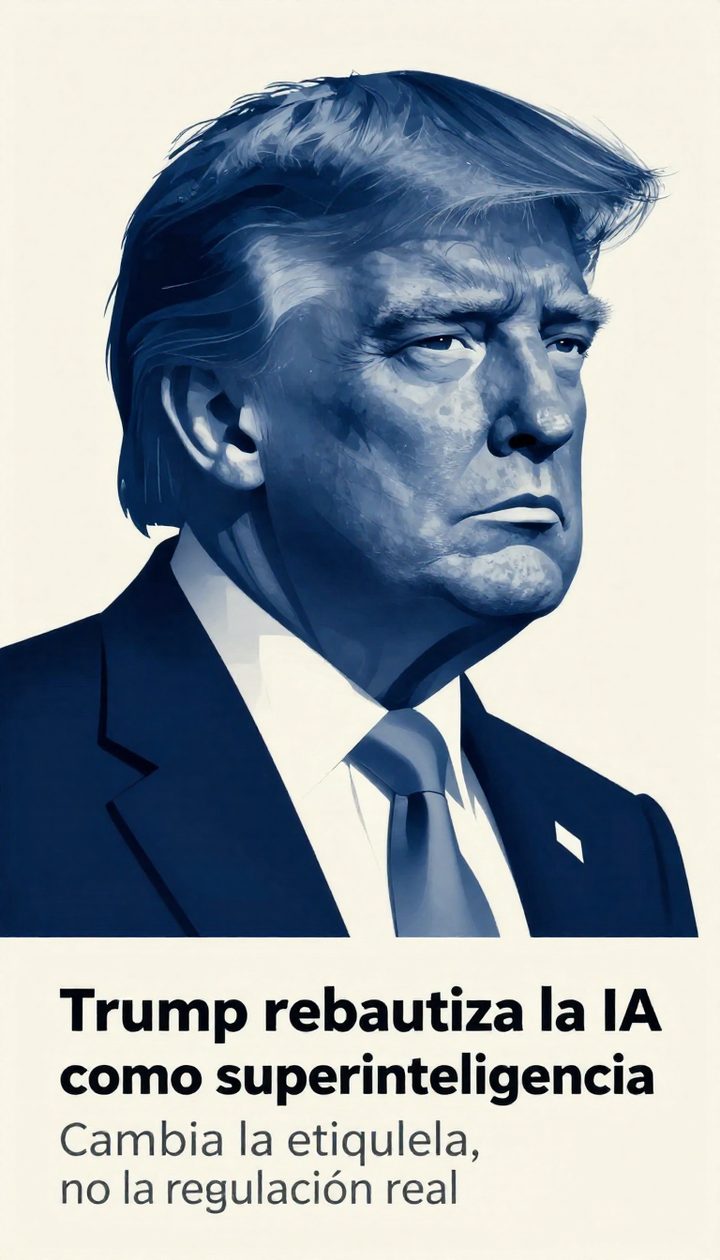
Trump rebrands AI as 'superintelligence': the label changes, the actual regulation doesn't
🕒 Published on Zendoric: September 30, 2026 · 00:34
✨ AI-generated · how it's made
In a meeting with Musk, Zuckerberg, Amodei, Huang and Brockman, Trump announced he will officially rename artificial intelligence as 'superintelligence' and said the industry had signed a 'morally binding' pact to regulate itself. Neither of the two is binding in practice.
📚 Go deeper

DeepMind co-founder on the dilemma of containing technologies that do not want to be contained.
As an Amazon Associate, Zendoric earns from qualifying purchases; the price does not change for you. · all our recommended books →
By Zendoric · September 29, 2026.
Donald Trump met on Tuesday at the White House with several of the top leaders of the artificial intelligence industry —Elon Musk (Tesla), Mark Zuckerberg (Meta), Dario Amodei (Anthropic), Jensen Huang (Nvidia) and Greg Brockman (OpenAI), among others— to discuss regulation of the sector, as reported by AFP and picked up by Portafolio.co. At the meeting, Trump announced that they would sign a document to "officially rename" artificial intelligence: "It's not artificial, we're going to call it Superintelligence," he declared.
At the close, Trump said the attendees had signed a "morally binding" commitment to establish safeguards in the development of AI. "They're going to self-regulate," he summed up. According to what the article reports, there are no details about the text of the document, oversight mechanisms or consequences for non-compliance: it is a voluntary gesture, not a law or a rule with executive force.
It is worth separating the symbolic wrapping from the content. "Superintelligence" is not an elegant synonym for "artificial intelligence": in the AI safety literature —the usual reference is the 2014 book "Superintelligence" by philosopher Nick Bostrom— it designates a system whose intellect would vastly surpass human intellect in practically every domain, something no current model, not even the most advanced ones from Anthropic, OpenAI or Google, has demonstrated. Rebranding today's chatbots and copilots as "superintelligence" does not change a single line of code or a single benchmark result; it changes the marketing. And Trump's own argument —"it's not artificial"— does not stand up to scrutiny either: in artificial intelligence, "artificial" never meant "fake," but "made by human beings," as opposed to biological intelligence.
The most relevant thing about the meeting is not the label, but who was in the room and what is missing from the document. That the companies that would be the subject of any eventual regulation —and that also compete with each other for capital, talent and market share— should pledge before the White House itself to police themselves is no guarantee of anything: the technology industry has already made similar voluntary commitments in the past, and its compliance record, with no supervisory agency or penalties involved, is limited. In general, the current US administration has shown a preference for self-regulation over binding federal rules on AI, and a "morally binding" pact fits that logic: it gives the appearance of governance without imposing compliance costs on those who, moreover, fund much of the public debate about the technology itself.
At Zendoric we have been arguing that AI regulation is necessary, but that the real risk lies in regulating fear instead of demonstrated capability. This episode is the flip side of that problem: there is no regulatory panic, there is an absence of regulation dressed up as solemnity. If the underlying ambition —which we share— is for AI to bring us closer to eradicating diseases, extending healthy life and generating abundance, far more is needed than a name change and a photograph at the White House: what is needed are verifiable rules and independent oversight, not that those who benefit most from the technology are also the ones drafting, behind closed doors, the conditions under which they are monitored.
📚 Go deeper

The definitive piece of investigative journalism on OpenAI: 260+ interviews, the clash between safety and speed, and the attempted firing of Sam Altma

AI as the latest chapter in the history of information networks, from gossip to the printing press to the algorithm.
As an Amazon Associate, Zendoric earns from qualifying purchases; the price does not change for you. · all our recommended books →
🔗 Related on Zendoric
- Trump rebrands AI as "superintelligence": the name changes, the science doesn't · 2026-09-30
- Trump rebrands AI as 'superintelligence' in the US and rejects global rules for its development · 2026-09-23
- Trump decrees that 'AI' be called 'superintelligence': the name changes, the risk doesn't · 2026-10-01
Sources & references
- Portafolio — Trump rebrands AI as 'superintelligence': the label changes, the actual regulation doesn't
- Tema ES · superinteligencia — Trump rebrands AI as "superintelligence": the name changes, the science doesn't
- cbsnews.com — Trump holds a private dinner with Anthropic CEO Dario Amodei amid tension over AI regulation