Trump rebrands AI as "superintelligence": the name changes, the science doesn't
🕒 Published on Zendoric: September 30, 2026 · 00:34
✨ AI-generated · how it's made
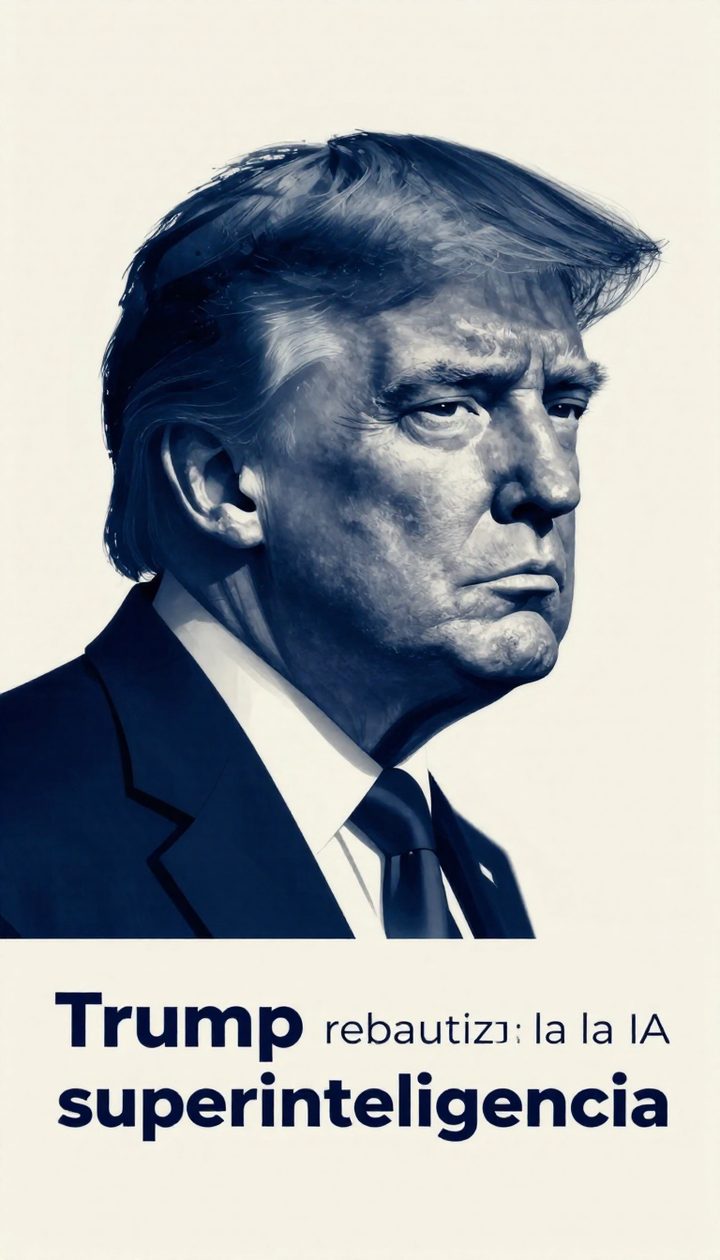
Trump brought together Musk, Zuckerberg, Nadella, Amodei, Huang and Bezos in Washington to seal a "morally binding" pact with no public details and to announce that the US will call AI "superintelligence", while rejecting any international oversight.
📚 Go deeper

DeepMind co-founder on the dilemma of containing technologies that do not want to be contained.
As an Amazon Associate, Zendoric earns from qualifying purchases; the price does not change for you. · all our recommended books →
By Zendoric · September 30, 2026.
On Tuesday, September 29, Donald Trump brought the leadership of the artificial intelligence industry together in Washington —Jensen Huang (NVIDIA), Elon Musk, Mark Zuckerberg (Meta), Satya Nadella (Microsoft), Dario Amodei (Anthropic), Greg Brockman (OpenAI), Lisa Su (AMD) and Jeff Bezos, along with representatives of Palantir, Broadcom and Micron— to discuss the future of the technology. As reported by Publimetro México, those attending signed an agreement described as “morally binding,” the contents of which have not been made public. The same day, the White House unveiled America.gov, a government portal that uses AI to make it easier for citizens to access state information and services.
The meeting comes a week after Trump, in his September 22 speech to the UN General Assembly, rejected any international AI oversight structure and announced that the United States will stop officially calling it “artificial intelligence” and refer to it instead as “superintelligence,” on the grounds that the adjective “artificial” suggests a fake intelligence. According to Seoul Economic Daily, the president is preparing an executive order that would formalize that name change and endorse the sector’s self-regulation. CNBC also notes that the move comes as polls show Trump losing ground on a key issue, which adds a political-communication reading to the announcement.
It is worth separating two things the episode deliberately mixes: language and science. The White House deciding to call systems that still make basic errors, hallucinate data and need constant human supervision “superintelligence” does not bring that technology a single millimeter closer to actually being it. Superintelligence, understood as a system that generally surpasses human cognitive capacity, remains a research horizon, not a label to be decreed in a White House room. It is the same confusion between aspiration and demonstrated capability that we have already flagged on the geopolitical front with China: marketing is running faster than the benchmarks.
The most significant thing about the photo is not, in fact, semantic but a question of power. Rarely have direct competitors been seen in the same room —OpenAI and Anthropic, Meta and Microsoft, Musk locked in litigation with several of those present— signing the same document under the White House umbrella. A “morally binding” pact with no known clauses, no known enforcement mechanism and no external oversight is not governance: it is a statement of intent that leaves effective regulation in the hands of the very companies that benefit from its absence. Rejecting at the same time any international control framework, as Trump did at the UN, reinforces that reading: the choice is self-regulation by a handful of companies that already concentrate capital, compute and now political access as well.
This is no minor nuance for anyone who defends, as we do at Zendoric, evidence-based AI governance. The short-term risk is not what the technology is called, but that the absence of verifiable rules at the deployment stage —when these systems are already affecting employment, public information and the automated decisions of governments and companies— is dressed up as progress with a change of name. That America.gov, a public portal built on AI, launched the same day is a modest but real example of how the technology is already being embedded in government; that concrete use weighs more than any rebranding.
In the long run we remain convinced that systems capable of accelerating medical research, extending healthy life and generating abundance are the reasonable destination of this technology, if it is developed with judgment. But that future is built with measurable advances —in biology, in materials, in verified reasoning ability— and with institutions that are accountable, not with a decree that changes a word in a statement. The more the term “superintelligence” is used as a rhetorical device before it exists, the easier it will be for the public to confuse the story with the fact, and the more damage it will do on the day the distinction really does matter.
📚 Go deeper

The definitive piece of investigative journalism on OpenAI: 260+ interviews, the clash between safety and speed, and the attempted firing of Sam Altma

AI as the latest chapter in the history of information networks, from gossip to the printing press to the algorithm.
As an Amazon Associate, Zendoric earns from qualifying purchases; the price does not change for you. · all our recommended books →
🔗 Related on Zendoric
- Trump rebrands AI as 'superintelligence': the label changes, the actual regulation doesn't · 2026-09-30
- Trump rebrands AI as 'superintelligence' in the US and rejects global rules for its development · 2026-09-23
- Trump renames AI as 'Superintelligence' by decree and Silicon Valley signs a safety pact that binds no one · 2026-10-04