Gunslinger: when agentic AI comes down from the lab to the cockpit of a turboprop
🕒 Published on Zendoric: June 27, 2026 · 09:00
✨ AI-generated · how it's made
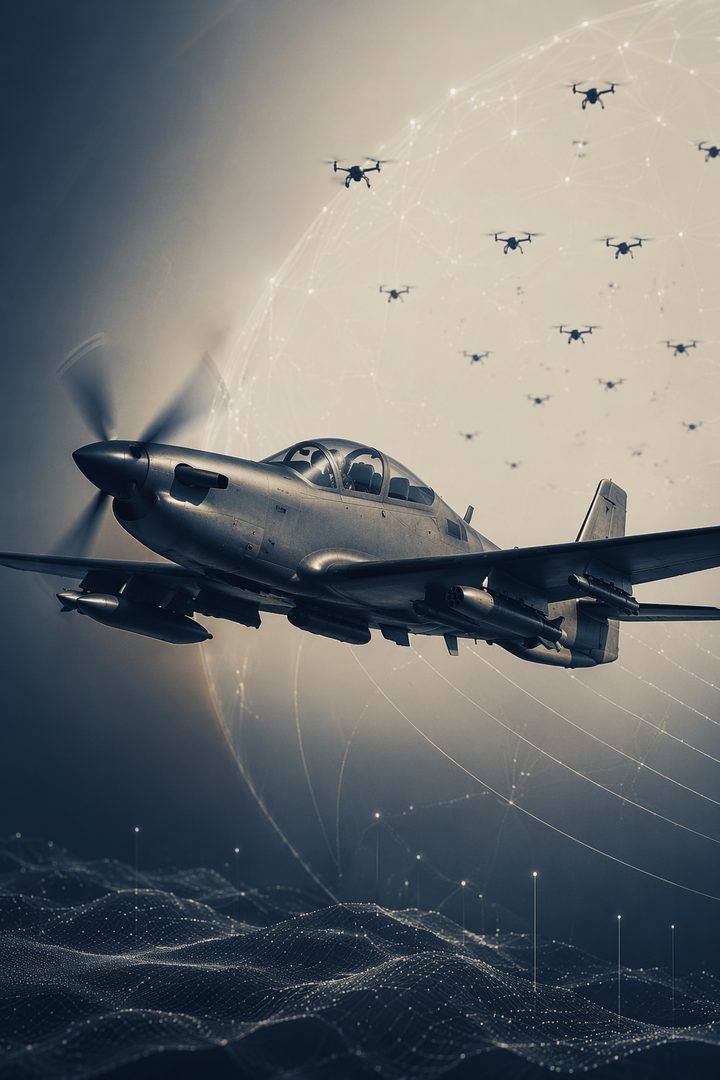
Valkyrie Aero proposes fitting an artificial intelligence agent onto a combat-proven aircraft, the A-29 Super Tucano, to hunt swarms of cheap drones without wrecking the budget. The idea matters less for the aircraft than for what it anticipates: agents that calculate and decide in real time, with the human in command of the trigger.
📚 Go deeper

The reference manual for building products on top of AI models: prompts, RAG, fine-tuning, agents, evaluation and deployment.
As an Amazon Associate, Zendoric earns from qualifying purchases; the price does not change for you. · all our recommended books →
There is one detail of Valkyrie Aero's proposal worth underscoring above all else: this is not a new aircraft or an exotic weapon, but a layer of intelligent software added to a platform with more than 25 years of service and tens of thousands of hours of real flight time. The Embraer A-29 Super Tucano already exists, already flies and has already proven that it can operate from austere airfields at an hourly cost far below that of any jet. What changes is who does the calculations in the cockpit.
The problem it addresses is real and is well framed in the Pucará Defensa article: the economic asymmetry of drones. A $20,000 device, even one made of cardboard, can threaten infrastructure valued in the hundreds of millions, while the missiles designed to shoot it down cost between $800,000 and more than a million dollars apiece. Defending yourself this way is not just expensive, it is mathematically unsustainable. Valkyrie's answer inverts the equation with .50 caliber machine guns and laser-guided rockets, ammunition of radically lower cost.
Where the news is most interesting for those following artificial intelligence is in the role of the Gunslinger agent. It does not merely classify images: it executes the "Find, Fix and Finish" chain, locates the threat with the electro-optical sensors the aircraft already carries, calculates attack geometry and intercept profile in real time, and delivers an actionable recommendation to the operator. It is, in essence, a specialized tactical copilot that offloads the human's cognitive burden without replacing their judgment.
And therein lies the key to the architecture: the human remains in the loop. The agent computes; the person selects the weapon and authorizes. That division —delegate the calculation, reserve the decision— is precisely the model most military AI programs are adopting, and the reason this case is more than anecdotal.
It remains to be seen whether the concept matures beyond the public presentation, and it is worth remembering that any automation of lethal functions demands rigorous control frameworks. But as a sign of where agentic AI is heading —from the computer screen to physical systems with real consequences— the Gunslinger is an example hard to ignore. The frontier is no longer whether AI can help decide, but how we design the division of responsibilities so that it helps well.
📚 Go deeper

The creator of Keras teaching from scratch, with working code and zero pedantry.

THE AI textbook: used by 1,500+ universities.
As an Amazon Associate, Zendoric earns from qualifying purchases; the price does not change for you. · all our recommended books →
🔗 Related on Zendoric
- Nutanix bets on governing AI agents before token spending spirals out of control · 2026-07-04
- Argentina proposes "automated companies" managed by AI, but unable to do without humans · 2026-07-07
- The figure that matters from Expo B2B Tech Asia isn't agentic AI: it's that you no longer need to code to deploy it · 2026-07-13