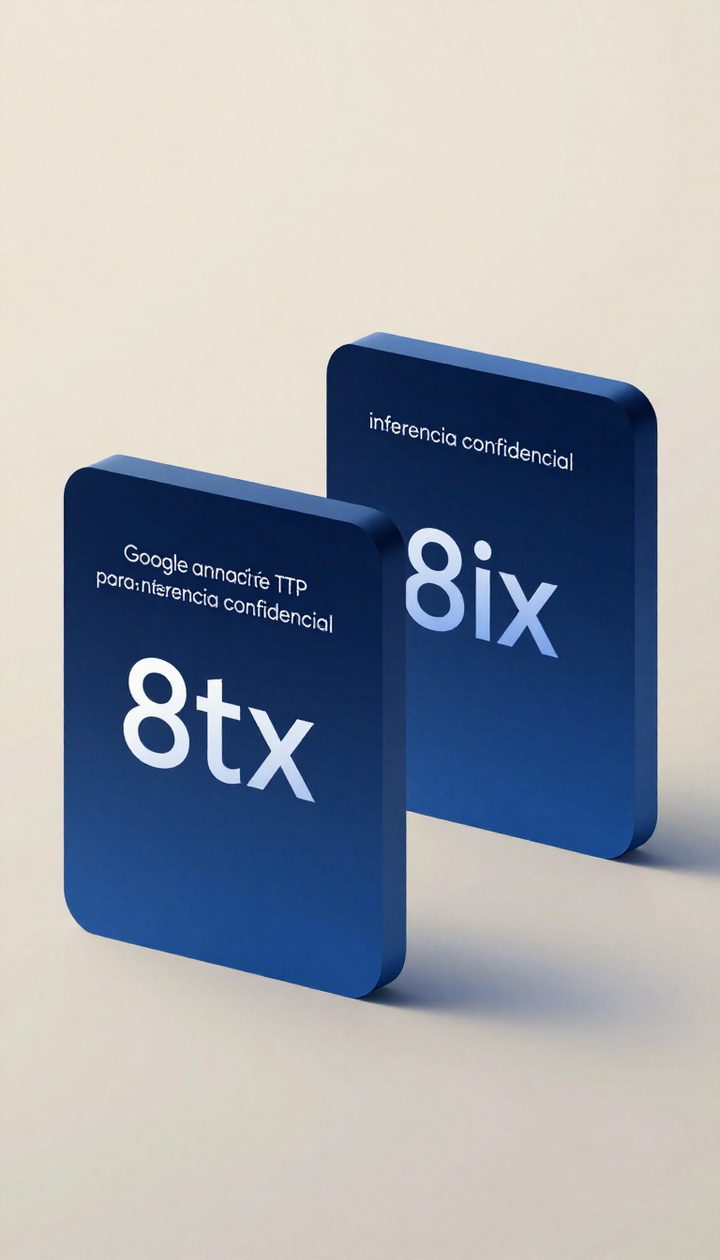
Google expands its eighth-generation TPU lineup with the 8tx, for confidential inference, and the 8i Max, for massive contexts
🕒 Published on Zendoric: November 11, 2026 · 00:19
✨ AI-generated · how it's made
Google has unveiled two new systems in its eighth TPU generation: the TPU 8tx and the TPU 8i Max. According to the company, this is the first time it has launched four TPU systems in a single year. The announcement is signed by Amin Vahdat, senior vice president and chief technologist for AI and infrastructure.
📚 Go deeper
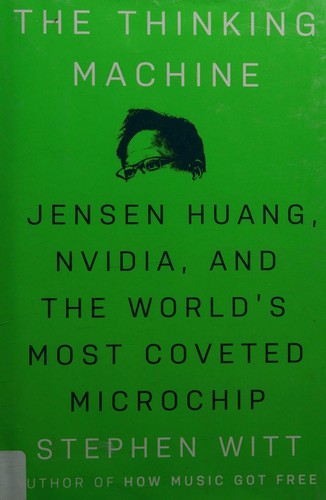
The story of NVIDIA and Jensen Huang: how a video-game card company ended up making the most coveted resource on the planet.
As an Amazon Associate, Zendoric earns from qualifying purchases; the price does not change for you. · all our recommended books →
Google has unveiled two new systems in its eighth generation of TPUs: the TPU 8tx and the TPU 8i Max. According to the company, this is the first time it has launched four TPU systems in a single year. The announcement is signed by Amin Vahdat, senior vice president and chief technologist for AI and infrastructure. The text is dated November 9, 2026.
The context Google provides is as follows. TPUs were designed more than a decade ago for internal needs such as speech recognition and translation. Today they cover four uses: training and serving Gemini models, agent-based workloads, services for Google Cloud customers and, more recently, deploying TPUs directly in customers' data centers. Google says the business is growing rapidly and already has close to 100 customers, including frontier labs, trading firms, retailers and universities.
At Google Cloud Next in April, the company introduced two specialized TPUs in this generation: the 8t, for large-scale training, and the 8i, for real-time reasoning. According to Google, they offer up to 2.7 times more training performance and 80% better inference price-performance, respectively, compared with the previous generation. The figures are the company's own and the article does not detail how they were measured.
The 8t is positioned as a training machine for large foundation models, with maximum “goodput,” which Google defines as useful intelligence delivered per watt. The 8i is described as the reasoning engine, designed to break through the “memory wall” and cut chip-to-chip communication delays by up to half.
Google explains that it now receives more feedback from outside organizations, in addition to co-designing TPUs with Google DeepMind. On one hand, companies are asking for accelerators capable of reasoning over enormous context windows as computing shifts from human scale to agent scale. On the other, some highly regulated customers are asking for specialized encryption capabilities.
A conceptual point in the announcement is the distinction between chip and system. Designing a chip is a multi-year process, while a system means combining compute, networking and storage around the chip, including how they are packaged. Google says it bet on modularity within its AI Hypercomputer, so that packaging, high-bandwidth memory, optical networking and security can be adjusted. It says this allows it to deliver specialized supercomputers in months rather than years.
The TPU 8tx is the generation's third system. It is optimized for secure, confidential inference and is also suitable for small-scale training. It targets regulated companies and governments running frontier or proprietary models, and autonomous agents, alongside their most sensitive data. Google notes that data is usually encrypted at rest and in transit, but must be decrypted in memory while it is processed. The 8tx is based on the same silicon as the 8t and is paired with host servers running 5th-generation AMD EPYC CPUs. According to Google, it builds security into the hardware layer and keeps data and model weights protected and isolated even while in use.
The 8tx also adopts the low-latency Boardfly network built for real-time reasoning. Google says it delivers up to twice as low latency as the 8t with almost no performance penalty. By combining training-grade compute with a fast inference network, an organization can run and customize its models on a single system. That includes fine-tuning with private data, distilling large models into smaller ones and training agents through reinforcement learning, without moving sensitive data between separate clusters.
The TPU 8i Max is the fourth system and addresses the memory wall problem. When dozens of agents work simultaneously on an entire codebase or on hours of video, memory bandwidth becomes the bottleneck. Google combined two low-latency TPU 8i chips in a single package. The result, according to the company, doubles the compute, SRAM and HBM bandwidth compared with the 8i. Because it fits twice the silicon into the same rack space, data centers can deploy more compute capacity per square meter and per watt.
Google sums up the portfolio this way: 8t for large-scale training, 8i for low-latency reasoning, 8tx for confidential computing and 8i Max for massive contexts and the highest compute density per rack. It stresses that all four are flexible across workloads.
The second part of the announcement deals with software accessibility. Google argues that TPUs already serve a broad range of companies and that it has been removing adoption barriers for some time. The measures it lists are these:
First, last month it open-sourced TorchTPU. With it, PyTorch code and Hugging Face models run natively on TPUs, with no rewrites. There are also backends for open inference engines such as vLLM and SGLang. In addition, a new open set of TPU agents, in preview, integrates with coding tools such as Claude Code, Cursor and Google Antigravity. According to Google, it automates TPU onboarding in minutes, diagnoses bottlenecks and auto-tunes custom kernels using natural language. For production, the new XLA Serving Engine, also open, lets users train in Python and serve on a low-latency C++ runtime across TPUs, GPUs and CPUs.
Second, Google says its native vLLM-TorchTPU stack achieved state-of-the-art price-performance marks on the InferenceX and AgentX benchmarks, which measure agentic coding and long-context work. It adds that new evaluations show similar advantages across several open frontier models without losing accuracy, and that more software optimizations are coming. Google presents these results without specific figures in the text.
Third, the Agent Compute Engine software automatically suspends and resumes idle agent sessions, which often pause for seconds or hours waiting on a database, an external tool or a person's response. Google says this reduces infrastructure costs.
Fourth, Google is open-sourcing TPU Sync, the model state layer for TPU clusters. It unifies on-chip HBM, host DRAM, shared storage and the data center network into a single memory hierarchy. It automatically tiers huge KV caches off-chip in milliseconds, streams context between disaggregated prefill and decode nodes and synchronizes reinforcement learning weights. According to Google, it cuts KV transfer latency and time to first token by more than 90%.
Fifth, Cloud Pathways is now generally available on Google Kubernetes Engine (GKE). It brings the Google DeepMind runtime behind Gemini to all Google Cloud customers. With a single-controller architecture, it lets users orchestrate large TPU systems spread across multiple slices as if they were a single local machine, for pretraining, reinforcement learning and multi-host inference. Google adds that it keeps long-running jobs going through hardware failures, with hot-swapping of slices in under a minute and elastic resharding.
Sixth, GKE dynamic slicing is also generally available. It decouples physical hardware provisioning from logical slice formation using optical circuit switching (OCS). It allows TPU cubes to be assembled into larger topologies or split into smaller isolated workloads on the fly. Google says it cuts job startup times by up to 5 times and speeds up failure recovery by up to 4.5 times.
To close, Google stresses that launching four systems and an open software stack in one year requires joint work by silicon architects, network engineers, compiler teams and DeepMind researchers. It says it also uses AI to design the next generation of infrastructure, with DeepMind's AlphaChip reinforcement learning system and with Gemini to produce chip designs in hours instead of weeks. It presents this as a distinctive advantage of its own.
Editorially, the announcement is a company publication and nearly all performance figures are internal comparisons without detailed methodology or absolute numbers. Even so, it shows a clear strategy: making accelerators modular and specialized for each stage of the AI lifecycle, and reducing adoption friction with open software and PyTorch compatibility. The text offers no pricing, availability dates for the 8tx and 8i Max, or technical details of the encryption mechanisms.
📚 Go deeper

DeepMind co-founder on the dilemma of containing technologies that do not want to be contained.

The best starting book if you're not technical: a Wharton professor explains how to work WITH AI — when to delegate, when to supervise, when to keep i
As an Amazon Associate, Zendoric earns from qualifying purchases; the price does not change for you. · all our recommended books →
🔗 Related on Zendoric
- Google launches Gemini 4 Argon, its frontier model for engineering, science and professional work · 2026-10-15
- Microsoft redesigns Copilot with Home, Code and Autopilot, and adds an IT-managed runtime for employee apps · 2026-09-29
- Oracle Cloud will be the first hyperscaler outside Google to offer TPUs, with capacity starting in 2027 · 2026-10-29