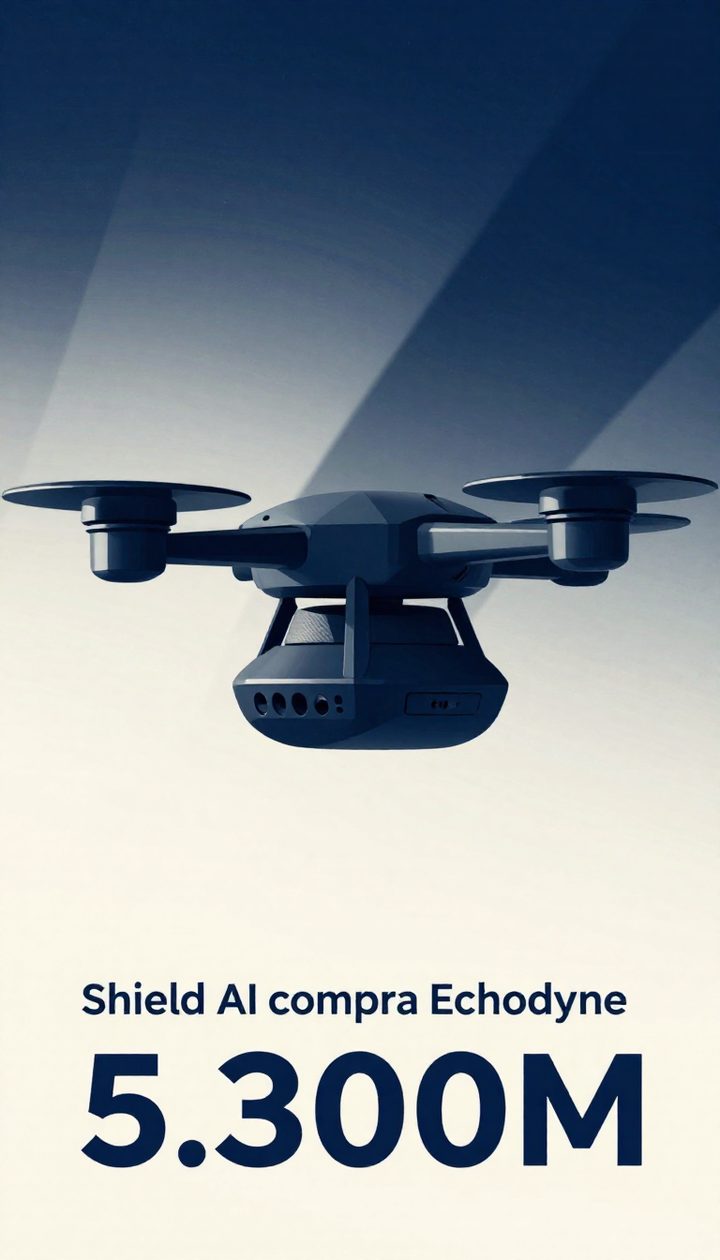
Shield AI buys Echodyne for $5.3B: counter-drone radar becomes central to autonomous warfare
🕒 Published on Zendoric: November 6, 2026 · 00:20
✨ AI-generated · how it's made
Shield AI, known for its drones and AI pilot software, is acquiring radar maker Echodyne for $5.3 billion. Our take: in drone warfare, whoever controls the sensors controls the system.
📚 Go deeper

The reference manual for building products on top of AI models: prompts, RAG, fine-tuning, agents, evaluation and deployment.
As an Amazon Associate, Zendoric earns from qualifying purchases; the price does not change for you. · all our recommended books →
By Military Times · November 5, 2026.
Shield AI has agreed to acquire Echodyne in a $5.3 billion deal announced on Thursday, according to Military Times. Echodyne makes solid-state radars based on its patented MESA (Metamaterials Electronically Scanned Array) technology, designed to detect drones.
According to the outlet, these radars integrate easily with other systems, including high-energy lasers and microwave weapons. They can track small quadcopters and more than 1,000 objects at once.
The commercial backdrop is strong. In September, Echodyne won a $250 million contract with JIATF-401, the Department of Defense's joint counter-drone task force, to supply technology to the armed forces over 36 months. In July, its CEO, Eben Frankenberg, told Defense News that demand for counter-drone radar is "red hot" and could grow tenfold by 2030. That is his estimate, not a verified figure.
Shield AI is known for its V-BAT and X-BAT vertical-takeoff drones (the latter an AI-piloted fighter unveiled in 2025) and for Hivemind, its autonomy software that lets "AI pilots" coordinate swarms of aircraft, vessels and spacecraft. Its CEO, Gary Steele, describes the goal as building a company with three divisions: autonomy software, autonomous systems and mission systems.
**Our take.** Frankenberg's line sums it up: autonomous systems "can only act on what they perceive." Shield AI already has the brain (Hivemind) and the body (the drones); with Echodyne it adds the eyes. This is vertical integration: sensing, deciding and acting within a single company.
The price tag matters for what it says about the market. Paying $5.3 billion for a sensor maker signals that counter-drone defense is no longer a niche but a structural expense. Cheap drones force defenders to respond with equally cheap, scalable sensors and software, not just expensive missiles.
There are risks worth naming. The deal has been announced, not closed: it will depend on the usual approvals. And concentrating sensing, autonomy and weaponry in a few contractors raises oversight questions: the more the detection-to-action chain is automated, the more important it is that human control be real rather than merely nominal.
More broadly, military AI is the uncomfortable face of a technology with enormous potential in medicine and abundance. In the short term, the defense race will keep absorbing capital and talent. But the sensors, autonomy and data fusion being refined here are dual-use technologies that will also end up in civilian security, airspace control and infrastructure management. The question to watch is who governs them.
📚 Go deeper

The creator of Keras teaching from scratch, with working code and zero pedantry.

THE AI textbook: used by 1,500+ universities.
As an Amazon Associate, Zendoric earns from qualifying purchases; the price does not change for you. · all our recommended books →
🔗 Related on Zendoric
- Apple's Full Disk Access clampdown shows the real regulator of AI agents is the operating system, not the law · 2026-10-06
- The switch that decides: the F-16 VENOM isn't seeking a pilotless fighter, but one with two brains · 2026-07-18
- AI drones to watch over the moorland: Sopó debuts a system that counts stray cattle, cow by cow · 2026-07-19