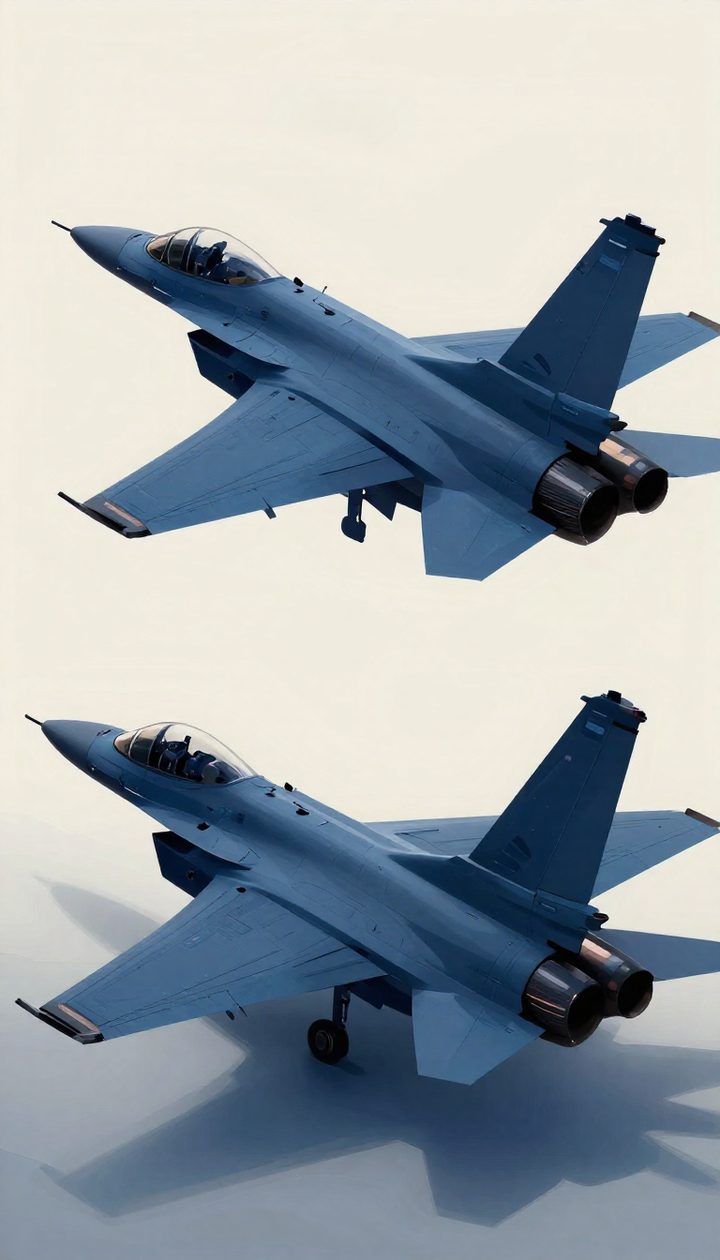
The switch that decides: the F-16 VENOM isn't seeking a pilotless fighter, but one with two brains
🕒 Published on Zendoric: July 18, 2026 · 01:58
✨ AI-generated · how it's made
The USAF and DARPA are already flying F-16s where an AI agent takes the controls while a test pilot supervises from the cockpit. It is not the leap to autonomous warfare the headline suggests: it is the engineering lab, cautious and reversible, that will decide how much lethal autonomy we are willing to certify.
📚 Go deeper
Semiconductors as the oil of the 21st century: history, espionage, and why an island of 23 million people underpins the entire AI economy.
As an Amazon Associate, Zendoric earns from qualifying purchases; the price does not change for you. · all our recommended books →
By Zona Militar · July 17, 2026.
The facts are concrete and less spectacular than the headline sounds. Within the VENOM program (Viper Experimentation and Next-generation Operations Model), the U.S. Air Force and DARPA modified several F-16 Fighting Falcons with a kit called VAK (VENOM Autonomy Kit): added hardware and software that allow an artificial intelligence agent to take control of the flight controls and sensors, without touching the aircraft's core software, and with a physical switch that returns control to the pilot at any moment. Ground testing and simulation began in 2024; the first verification flights took place in June 2026, and in July the first flights with real autonomous control were completed, always with a test pilot on board supervising the mission. The program stems from the Air Combat Evolution (ACE) umbrella and directly inherits the work of the X-62A VISTA, which had already demonstrated an AI agent flying in simulated air combat against crewed F-16s.
What matters here is not that an AI "flies a fighter jet" —that was already proven with VISTA— but the institutional engineering behind it: a modular kit, reversible with a single gesture, that does not alter the certified flight software. It is, in essence, a method for accumulating real flight data without compromising airworthiness or the chain of human responsibility. In a sector where any error is paid for with lives and with the credibility of multibillion-dollar programs, that conservative design —testing live but with instant reversion— is as significant as the algorithm flying the plane itself.
The stated goal is not to replace pilots, but to scale toward DARPA's AIR (Artificial Intelligence Reinforcements) program, where the VENOM F-16s will serve as a testbed for a human pilot to coordinate and command swarms of autonomous aircraft, including those planned under the Collaborative Combat Aircraft (CCA) program: the uncrewed "wingmen" that will accompany sixth-generation fighters. That is the real strategic turning point: going from "the AI flies a plane" to "a human directs a formation of several," multiplying air combat mass without multiplying the number of pilots. It is the United States' direct response to a very real problem of pilot shortages and cost per crewed unit, and it fits into the broader race —also visible in China— to turn aerial autonomy into a low-cost saturation advantage.
Here it is worth applying the same criterion we use for any announcement of military AI capability: distinguishing the demonstrated engineering milestone (supervised autonomous control, with a kill switch, in a real combat aircraft) from the long-term aspiration (autonomous swarms fighting under minimal human command). The former is solid and verifiable; the latter is still a program, not a deployed capability, and the distance between the two is usually where the risks that really matter accumulate: sensor perception errors, coordination failures between agents, or the legal and ethical question of who answers when the final decision —even if it remains human today— rests increasingly on a system that decides in fractions of a second.
That is precisely the short-term side of the optimism with which we view AI: here we are not talking about eradicating diseases or about abundance, but about responsibly governing a dual-use technology before geopolitical pressure —the race with China for low-cost aerial autonomy— pushes to skip validation steps. The VAK's physical switch is, in that sense, more than a technical detail: it is an institutional commitment to keeping the human in the loop while the trust needed to delegate more is built. Whether that commitment holds, and does not erode as the program advances toward the CCA and autonomous swarms, will be the real metric of whether this path is walked with the caution that putting algorithms in command of weapons demands.
📚 Go deeper
The reference manual for building products on top of AI models: prompts, RAG, fine-tuning, agents, evaluation and deployment.
China vs.
As an Amazon Associate, Zendoric earns from qualifying purchases; the price does not change for you. · all our recommended books →
🔗 Related on Zendoric
- Agentic AI gives power back to the private cloud: Broadcom bets that governing agents matters more than compute · 2026-09-02
- Gunslinger: when agentic AI comes down from the lab to the cockpit of a turboprop · 2026-06-27
- 900 Million Users vs. The Revenue Crown: Why Enterprise Spend May Matter More Than Reach · 2026-06-29