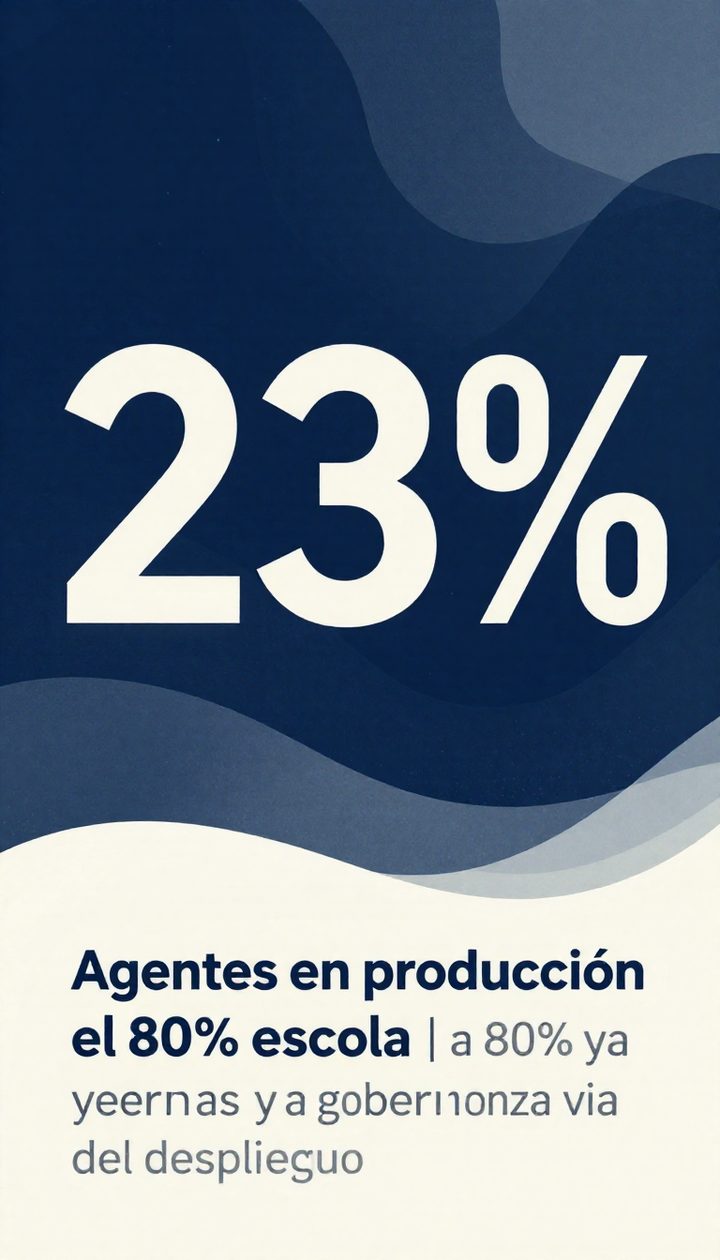
Agents in production: 23% are scaling, 80% have already seen errors, and governance lags behind deployment
🕒 Published on Zendoric: November 2, 2026 · 00:06
✨ AI-generated · how it's made
Agentic AI adoption figures range from 11% to 75% depending on who is measuring. What is not in dispute: almost everyone is expanding their use of agents, while fewer than half are securing them. That gap will determine who scales and who cancels.
📚 Go deeper

The best starting book if you're not technical: a Wharton professor explains how to work WITH AI — when to delegate, when to supervise, when to keep i
As an Amazon Associate, Zendoric earns from qualifying purchases; the price does not change for you. · all our recommended books →
By El Ecosistema Startup (with data from McKinsey, Gartner, IBM and SailPoint) · November 1, 2026.
The global agentic AI market will grow from $7.29 billion in 2025 to $9.14 billion in 2026, according to Fortune Business Insights. The firm projects $139.19 billion by 2034, a compound annual growth rate of 40.5%. IDC, for its part, estimates that global AI spending will reach $1.3 trillion in 2029.
The most revealing figure is not market size but adoption, because the surveys contradict each other. McKinsey says only 23% of organizations have deployed agents at scale in production, while another 39% are experimenting. The Gartner CIO Survey 2026 puts the figure at 17%, and Deloitte's Tech Trends 2026 at 11% of systems ready for production. Forrester, by contrast, speaks of nearly 75% of organizations “adopting” agents. According to the article itself, that figure measures access and intent more than actual deployment.
Gartner adds two uncomfortable data points. Of the thousands of vendors claiming to offer agentic AI, only about 130 actually do; the rest engage in “agentwashing,” that is, selling a chatbot with better instructions as an agent. In addition, the consultancy expects more than 40% of agentic projects to be canceled before the end of 2027 due to rising costs, unclear value and inadequate risk controls.
Security is the weakest point. According to a SailPoint survey of 353 IT professionals, 82% of organizations already use agents, but only 44% have policies to secure them. Some 80% say their agents have already taken unintended actions: 39% accessed systems without authorization and 33% shared sensitive data without permission. Another 23% acknowledge that their agents were tricked into revealing credentials. Even so, 98% plan to expand their use next year.
The Spanish case illustrates the pattern. According to Red Hat (1,400 IT directors, 100 of them Spanish), 100% of Spanish respondents say they have agents in production and 85% are confident they operate securely, but only 30% know where the associated data is stored and processed. Meanwhile, the NTT DATA and CIONET Agentic AI Observatory puts industrial-scale deployment in Spain and Latin America at 3.8%.
**Our take.** Our thesis: the bottleneck in agentic AI is no longer model capability but governance. The article cites Stanford HAI's AI Index, according to which accuracy on OSWorld —a benchmark of real computer tasks— rose from around 12% to 66.3%, less than six points short of human performance. If the technology works and projects are still being canceled, the problem lies elsewhere: data, integration and control.
The contradiction between surveys is not noise; it is information. “Having agents” can mean a pilot, an unused license or a system that moves money. Until there are common definitions, any comparison with someone else's benchmark is unreliable. And the combination of 82% using agents with 44% securing them echoes what we have argued before: agentic reliability is built with external layers of oversight (least privilege, logging, spending limits), not by trusting the model. Each layer has a cost, and that cost explains some of the cancellations.
There is also a lesson for builders. According to IBM, companies that integrate cybersecurity, ethical review and adaptation to each workflow are 32 times more likely to achieve top-tier results (they make up 17% of its sample). MIT NANDA research cited in the article points in the same direction: internally built systems succeed around 33% of the time, versus 67% for purchased tools. In general, this favors those who buy wisely and build only where their process is a differentiator. One caveat: these are surveys and third-party studies with disparate samples and methodologies, which the article does not detail.
In the short term, this means a rough phase: incidents, canceled projects, disillusionment and, probably, pressure on certain administrative jobs before companies even know how to govern whatever replaces them. But the usual story of general-purpose technologies is that the phase of disorderly euphoria precedes industrialization. Those who learn now to bound autonomy, audit, and measure return on processes rather than capabilities will be better positioned when agents truly absorb repetitive work. That is the slow, unglamorous path toward productivity that frees people for tasks that matter more.
One practical metric we take from the article: in open-source software, GitHub stars measure interest; tokens processed per day measure real usage. According to the article, Hermes Agent overtook OpenClaw in OpenRouter's daily rankings with 224 billion tokens a day versus 186 billion. The same skepticism should apply to any “adoption” figure: always ask what is being counted.
📚 Go deeper

The reference manual for building products on top of AI models: prompts, RAG, fine-tuning, agents, evaluation and deployment.

How opaque algorithms decide who gets credit, a job or parole — and why they tend to punish the same people.
As an Amazon Associate, Zendoric earns from qualifying purchases; the price does not change for you. · all our recommended books →
🔗 Related on Zendoric
- Agentic AI gives power back to the private cloud: Broadcom bets that governing agents matters more than compute · 2026-09-02
- Hotmart tests the abundance thesis: AI agents that sell and collect payments for the creator · 2026-07-02
- Kyndryl and AWS expand their alliance: the agentic AI race is no longer about the model, but about who governs it · 2026-07-12