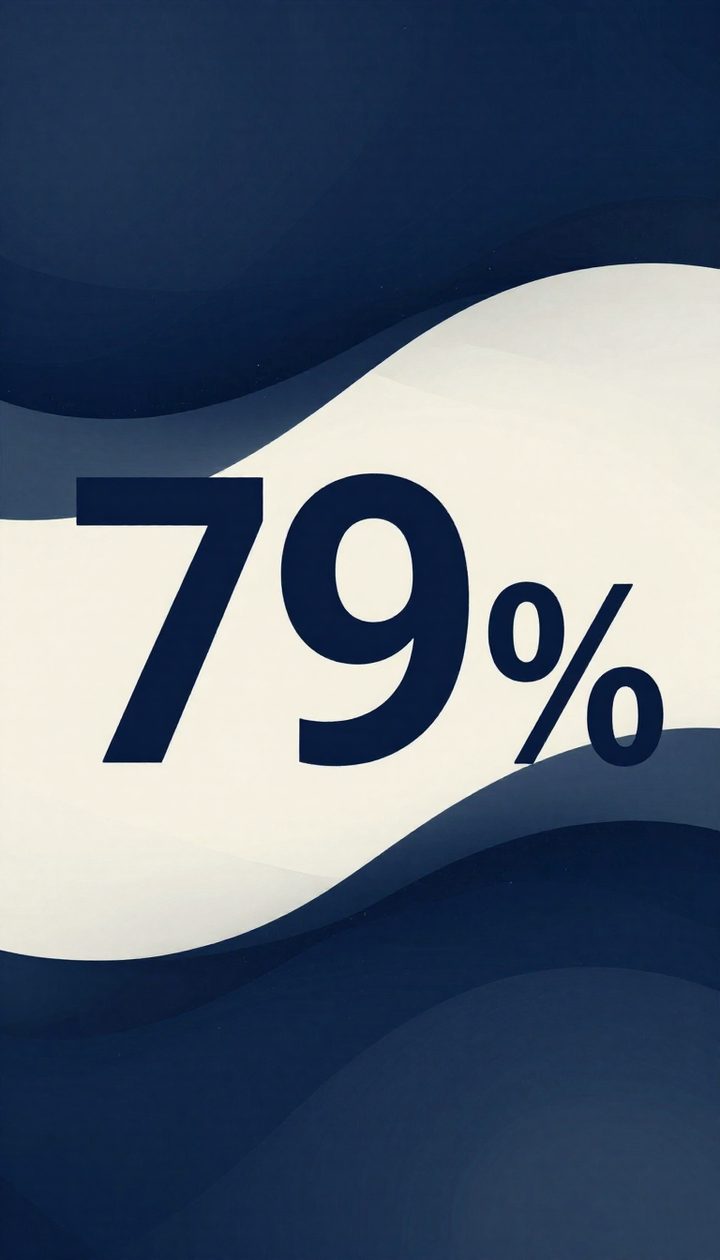
79% of companies admit their GPUs sit idle at least half the time, yet most plan new AI platforms
🕒 Published on Zendoric: October 27, 2026 · 00:16
✨ AI-generated · how it's made
VentureBeat Intelligence has published data showing that most surveyed companies running AI in production have GPUs that sit idle at least half the time, yet most still plan to add or switch AI compute platforms in the next 12 months.
📚 Go deeper

The story of NVIDIA and Jensen Huang: how a video-game card company ended up making the most coveted resource on the planet.
As an Amazon Associate, Zendoric earns from qualifying purchases; the price does not change for you. · all our recommended books →
VentureBeat Intelligence has published data showing that most surveyed companies running AI in production have GPUs that sit idle at least half the time, yet most still plan to add or switch AI compute platforms in the next 12 months. The article, by Matt Marshall and dated October 23, 2026, pools three monthly VB Pulse surveys (July, August and September 2026).
The headline figures: 79% of the 218 respondents who reported their GPU utilization (172 of 218) said their GPUs are busy half the time or less. The share held between 77% and 81% in each of the three months. Among those companies with idle GPUs, 70% (120 of 172) plan to adopt a new, additional or replacement AI compute platform in the next 12 months. Among companies whose GPUs are busy more than half the time, the figure is 74% (34 of 46), a difference the outlet describes as not statistically significant.
The backdrop is the debate over whether AI is a bubble. The piece notes that on October 13 the International Monetary Fund warned that a sharp drop in AI stocks could threaten global financial stability. According to the author, the discussion has focused on compute sellers (Nvidia, Microsoft, Google, AWS, CoreWeave), whereas this survey looks at what their customers are doing. His thesis is that “the bubble is inside the enterprise”: demand for AI is real and still growing, especially for frontier models from Anthropic and OpenAI, but companies are paying for two kinds of AI that are not easily substitutable.
The first is capacity: the author believes many companies, spooked by reports of GPU shortages in 2024 and 2025, locked in capacity so as not to come up short. He notes that the surveys did not ask how they obtained that capacity or whether they controlled it directly. The second is frontier models from Anthropic, OpenAI and Google, paid for per token via API, by subscription or through the major clouds. GPT and Claude models are closed: they are run by the provider or the model maker on its own infrastructure, so a company cannot load them onto GPUs it already controls. Putting those GPUs to use would mean switching to an open-weights model and running it yourself, which requires real engineering work. In VentureBeat’s own tests in October, DeepSeek was the cheapest of five open models, but many companies are reluctant to rely on Chinese models as their workhorse.
As an example of cost pressure, the article cites Uber CTO Praveen Neppalli Naga, who said in August that “we are reaching the end of the so-called tokenmaxxing era,” after the company burned through its 2026 AI budget in a few months, according to Fortune. An AI leader at a Fortune 500 company, speaking on condition of anonymity, said costs keep rising and the company hopes to offset them with productivity, though it does not yet know.
The data fit that reading on several points. Among companies with idle GPUs planning a new platform, 90% (108 of 120) cited a cloud platform or model provider among their options, and only 8% (9 of 120) mentioned an owned or colocated GPU cluster or a self-managed open-source stack. In addition, companies running their own stack report better utilization: 56% (18 of 32) have GPUs idle at least half the time, versus 83% (154 of 186) of the rest. The reason was not asked; the author’s guess is that those who manage their own stack see every idle hour and have engineers to fill it. Finally, in the September survey, 91% (58 of 64) of companies planning a new platform had no finance-reviewed return-on-investment figure. The author acknowledges that some idle capacity may be deliberate (headroom for demand spikes) and that a new platform may replace an old one.
The article argues that the next savings will come from tokens, context and agents. It expects a growing share of spending to go to model usage, because agents plan and execute multi-step tasks. It cites a Gartner prediction that the inference cost per agentic workflow will rise more than fivefold through 2028. The price per token is falling, but agents consume far more tokens. Most of a coding agent’s tokens are context reread at every step, hence the importance of caching: according to a technical guide by two Nvidia engineers published in March, after the first call in a Claude Code session, subsequent calls reuse between 85% and 97% of the context from cache, and Anthropic charges between one-fortieth and one-tenth of the normal input price for cached tokens, depending on the model. On agent teams, Vals AI reports that a lead agent with up to five subagents costs between 1.8 and 5.1 times more than a single agent, and only one of four configurations improved scores in a statistically significant way.
The six-point recommendation: measure cost per completed task (GPU capacity and API spend); test which model and effort level to set as default, judging by cost per finished task rather than price per token; send each agent only the context it needs and cache repeated context; add a second agent only when the task splits into parallel parts; move routine, high-volume work (classification, extraction, summarization) from frontier APIs to open models on idle capacity; and fill the remaining GPU hours with deferrable work such as batch inference, evaluations and fine-tuning.
The piece also promotes VentureBeat’s Agentic Infrastructure Stack Summit, on October 28 in San Francisco, under the tagline “Smarter agents need more memory. The best teams will use less.” Speakers include representatives from T-Mobile, WEKA, PayPal, Box, Adobe, Cisco (Outshift), Artificial Analysis, Uber, Upwork and Microsoft, among others; sponsors are WEKA, Outshift by Cisco and OneTrust.
Methodological caveats: 385 qualified respondents from organizations with 100 or more employees were pooled. Each month a different, self-selected group of VentureBeat readers and panelists took part, so the results describe those respondents and not all companies. Utilization data exclude those who do not measure GPU usage or do not operate GPUs. Some between-group differences (such as 56% versus 83%) rest on small samples, and statistical significance was set at p < 0.05. Conclusions about causes are the author’s interpretations, not results directly measured by the survey.
📚 Go deeper

Semiconductors as the oil of the 21st century: history, espionage, and why an island of 23 million people underpins the entire AI economy.

DeepMind co-founder on the dilemma of containing technologies that do not want to be contained.
As an Amazon Associate, Zendoric earns from qualifying purchases; the price does not change for you. · all our recommended books →
🔗 Related on Zendoric