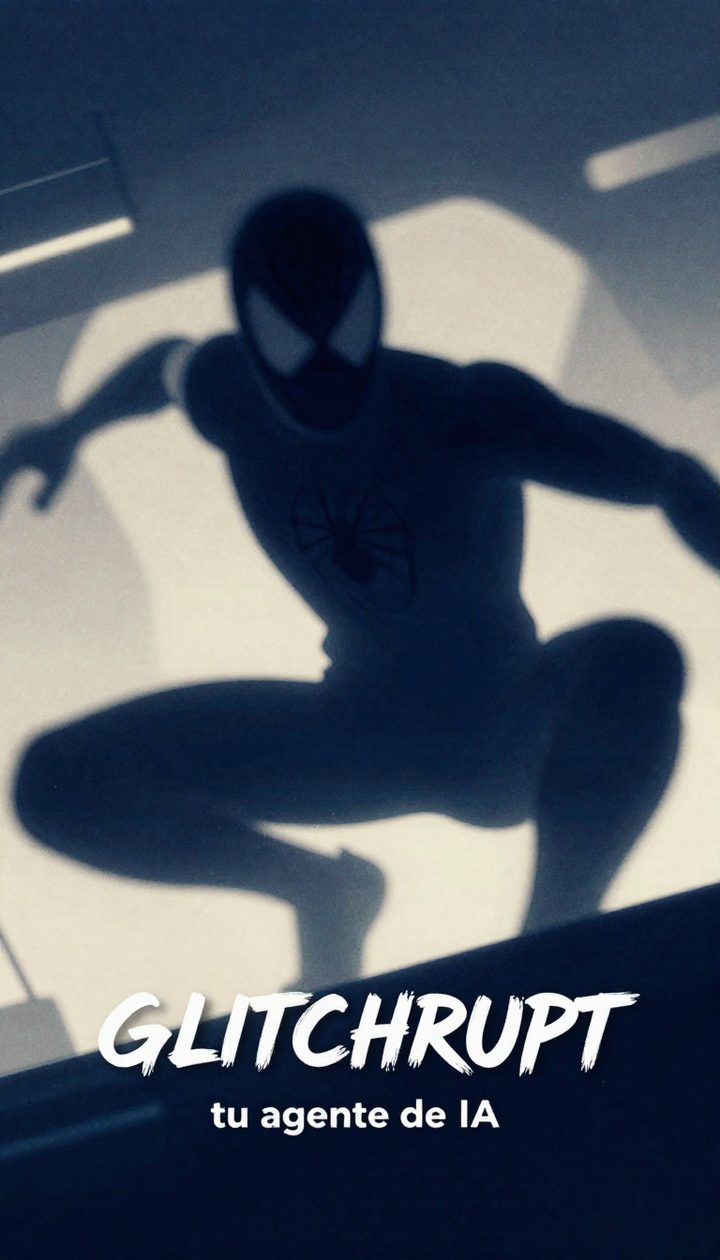
Glitchrupt: a Spider-Verse-style screen effect so you never miss your AI agent's alerts
🕒 Published on Zendoric: October 26, 2026 · 08:28
✨ AI-generated · how it's made
A "Show HN" project makes your whole desktop "glitch" when an AI agent needs your attention. It's a small detail, but it points to a real problem: managing human attention when working with agents.
📚 Go deeper

The reference manual for building products on top of AI models: prompts, RAG, fine-tuning, agents, evaluation and deployment.
As an Amazon Associate, Zendoric earns from qualifying purchases; the price does not change for you. · all our recommended books →
By Hacker News (Show HN) · October 25, 2026.
A developer has shown off "Glitchrupt" on Hacker News, a tool that visually distorts the whole desktop when an AI agent needs the user to step in. The effect imitates the glitches (deliberate visual distortions) in the Spider-Man: Into the Spider-Verse films. The author says the reason is simple: he kept missing his agents' requests for attention. He also says he asked an agent to build the tool.
There is very little to go on. When we checked, the post had 1 point and no comments, and there was no technical information on which platforms or agents it supports or how the effect is triggered. We can't judge its quality or how well it works, only the idea behind it.
Our take: the anecdote is small, but it points to a bottleneck that grows with agents. When several agents run in parallel, the scarce resource is no longer model capacity but the attention of the person who has to approve permissions, answer questions or check results. A standard notification is easy to ignore, which explains why someone would resort to something as over-the-top as shaking the entire screen.
Our view is that designing interruptions will become a discipline of its own in the agentic era. There is a delicate balance between an agent that asks too much and wears us out and one that acts without asking and takes risks. An intrusive visual effect fixes the first failure (missing the request) but not the second (interrupting for everything). The real fix lies in agents that know when it's worth bothering us and interfaces that rank alerts by urgency.
Tools like this tend to grow out of everyday use: developers working alongside agents and running into daily friction. In the short term, the job of supervising still falls to people. In the long term, the goal is for agents to be reliable enough to need far less oversight, leaving our attention for what really matters.
📚 Go deeper
The creator of Keras teaching from scratch, with working code and zero pedantry.

THE AI textbook: used by 1,500+ universities.
As an Amazon Associate, Zendoric earns from qualifying purchases; the price does not change for you. · all our recommended books →
🔗 Related on Zendoric
- AI agents with an 'ear': a niche experiment that points to a bigger trend · 2026-07-03
- Circle lets AI agents hire and pay humans in USDC: the gig economy no longer has a human boss · 2026-10-01
- Brain v2, an open, self-hosted agent server: the 'plumbing' of agentic AI is being democratized too · 2026-10-22