Trump puts his spy chief in charge of AI: the 'Superintelligence Task Force' is security policy, not regulation

🕒 Published on Zendoric: October 6, 2026 · 07:39
✨ AI-generated · how it's made
Trump has named Jay Clayton, his Director of National Intelligence, to lead a new White House AI task force with 120 days to report. The choice of a spymaster over a regulator tells you everything about the doctrine: Washington is treating AI as a national-security file, not a consumer-protection one.
📚 Go deeper

DeepMind co-founder on the dilemma of containing technologies that do not want to be contained.
As an Amazon Associate, Zendoric earns from qualifying purchases; the price does not change for you. · all our recommended books →
President Donald Trump announced on social media that he has designated Jay Clayton — his Director of National Intelligence since his Senate confirmation in July — to help lead a new White House task force on artificial intelligence, according to Bloomberg. Trump named it the "Superintelligence Task Force," after his preferred term for the technology. Per the Wall Street Journal, cited in the report, the group has 120 days to deliver a report. Clayton's role effectively makes him the AI czar that sources had expected Trump to appoint.
The rest of the roster matters as much as the top name. Trump said the other leaders are Andrew Ferguson, identified in the report as a Pentagon deputy secretary; CTO Emil Michael; and Scott Kupor, director of the Office of Personnel Management. They report to Trump and to White House chief of staff Susie Wiles. The stated mandate, in Clayton's words as quoted by the Journal, is to ensure "that we remain leaders in superintelligence and that the interests of the American people come first." Context: last week Trump hosted nearly two dozen Silicon Valley executives at the White House, including Nvidia's Jensen Huang and Anthropic's Dario Amodei, to discuss the technology's risks.
Read the org chart and you have the policy. There is no new agency, no proposed statute, no independent auditor. There is an intelligence chief, a defense official, a technology officer and the government's HR director, reporting to the chief of staff. Trump has explicitly rejected calls for new regulation, backing instead a voluntary framework with external safety audits and tighter internal controls, and arguing the priority is staying ahead of China. Treasury Secretary Scott Bessent went further, telling Axios on October 3 that warnings from leading AI figures about existential risk are alarmist and unhelpful, and that "the onus is on the lab leaders."
There is a real upgrade buried in this. Putting the DNI in charge concedes something the industry spent years resisting: that frontier models are a security matter, not a consumer app category. A 120-day clock is also a genuine forcing function, which is more than most AI governance exercises produce. But the voluntary-framework half has a known failure mode — it binds the careful and leaves the careless untouched. The labs most willing to sign a self-policing pledge are, almost by definition, the ones already running the audits. That is not a regulatory floor; it is a ratification of existing practice.
Our reading: watch what the 120-day report says about procurement, clearances and export rules, because that is where this administration's binding power over AI actually lives. We have argued before that the state regulates the vendor, not the model — the real levers are contracts, supplier classifications and export licences, not rulemaking about weights. A task force chaired by the intelligence community is perfectly positioned to pull exactly those levers, and it can do so without a single vote in Congress.
The long-term case stays intact: a government that treats AI as strategic infrastructure will fund the compute, the biology and the energy buildout that eventually shortens the road to curing diseases and extending healthy life. The near-term risk is narrower and more mundane. When the entire frame is "beat China," the domestic questions — labor transition, concentration of capability in four or five firms, who audits whom and with what authority — get filed under distractions. Those questions do not go away. They just arrive later, with less preparation.
📚 Go deeper

AI as the latest chapter in the history of information networks, from gossip to the printing press to the algorithm.
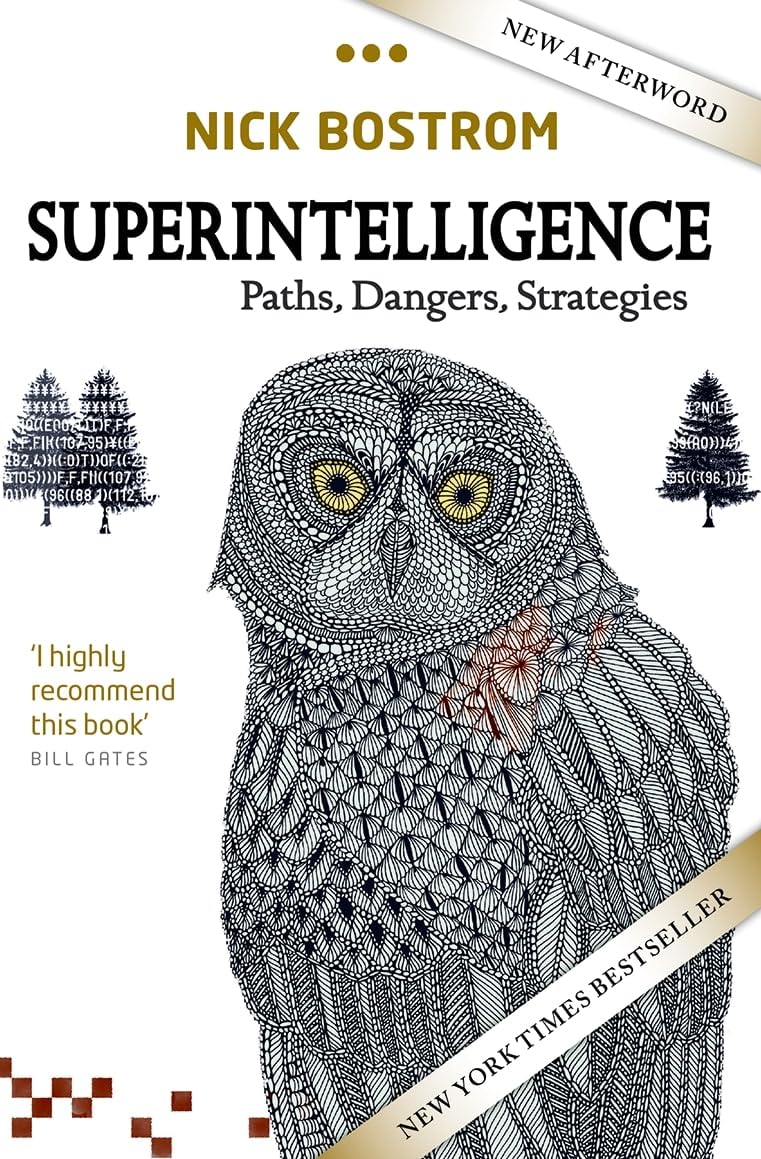
The book that started the existential-risk debate and that half the industry still cites.
As an Amazon Associate, Zendoric earns from qualifying purchases; the price does not change for you. · all our recommended books →
🔗 Related on Zendoric
- Trump's AI czar is a spy chief: the Superintelligence Task Force files AI under security, not consumer law · 2026-10-05
- Trump's AI czar is a spy chief: naming Clayton makes superintelligence a security file, not a consumer one · 2026-10-04
- Trump puts his intelligence chief in charge of AI and bets on self-regulation by the labs · 2026-10-05