Television: a tiny open-source GUI betting on taking AI agents out of the text chat
🕒 Published on Zendoric: October 4, 2026 · 09:58
✨ AI-generated · how it's made
Telepath has launched Television, an open-source interface that gives agents such as Claude Code or Codex a persistent visual canvas to create documents, charts or apps, beyond the text chat. With barely 103 stars on GitHub the project is minuscule, but it previews what working side by side with an agent will look like.
📚 Go deeper

The reference manual for building products on top of AI models: prompts, RAG, fine-tuning, agents, evaluation and deployment.
As an Amazon Associate, Zendoric earns from qualifying purchases; the price does not change for you. · all our recommended books →
By Zendoric · October 3, 2026.
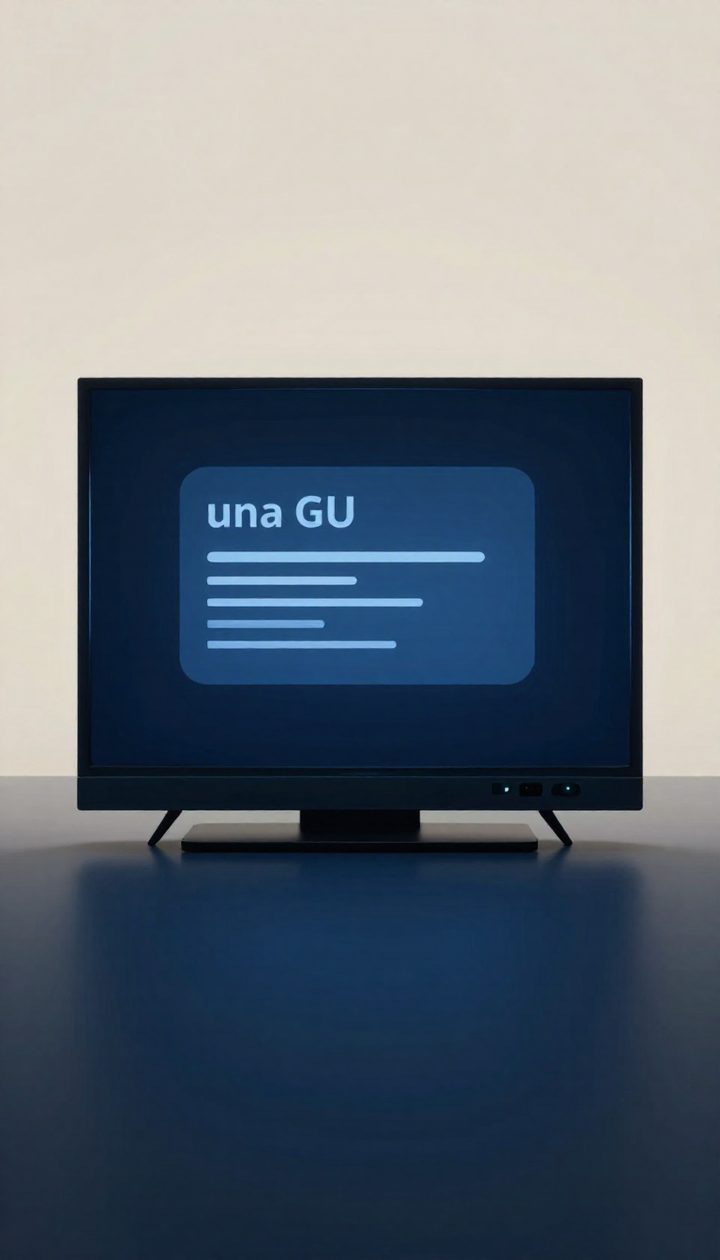
Telepath, a software studio incorporated as Unternet PBC, has released Television, an open-source tool (MIT license) described as the missing GUI (graphical user interface) for personal artificial intelligence agents. According to the project's own documentation, instead of merely replying with text in a chat window, the agent can create artifacts -documents, data visualizations, interactive web pages or even applications the agent itself codes on the fly- and place them in a persistent visual space that the user can keep modifying alongside it.
The system is made up of three pieces, according to the repository: a lightweight server that runs on the same machine as the agent, a package of skills (instructions that teach the agent how to create and edit content in Television) and a sidecar-style client app, a standalone window that coexists with the usual chat, available as a desktop application for macOS or accessible from any browser. The README itself lists Claude Code, Codex and other lesser-known agents (Hermes, OpenClaw, Pi) as compatible, provided they run on Linux or macOS; Windows is left out for now.
It is worth putting the announcement's real scale in perspective. At the time of writing, the repository has 103 stars and 7 forks on GitHub, and its Hacker News post got no further than 2 points and zero comments. The team itself also acknowledges that development follows, for now, a process closed to outside contributions. There is no funding round here, no user count, no adoption figure to analyze: there is an interface idea, well executed on paper, still to be validated in practice.
And even so, the idea deserves a line of attention. Ever since coding agents -Claude Code, Codex and their equivalents- stopped being autocompleters and became programs that carry out long tasks on their own, text chat has fallen short: it works for conversation, not for supervising or working on what the agent produces. Television is a symptom, not a finished solution, of an emerging wave of projects seeking to give the agent a canvas of its own, something closer to a shared desktop than to a conversation window.
In our coverage of the fight among the big platforms for control of agent distribution and standards, we have argued that the war is being fought as much in the plumbing -who integrates, who connects, who defines how an agent is used day to day- as in the quality of the model running underneath. Small, open projects like this one are the testing ground where those standards are trialed before the big players adopt them, buy them or ignore them. It may remain a niche curiosity; it may also be one of the first sketches of what the screen will look like, a couple of years from now, when we work side by side with an agent that no longer merely answers, but builds.
📚 Go deeper

THE AI textbook: used by 1,500+ universities.

The academic "bible" of deep learning, with a Turing Award winner among its authors, and legally free on the web.
As an Amazon Associate, Zendoric earns from qualifying purchases; the price does not change for you. · all our recommended books →
🔗 Related on Zendoric
- AI agents with an 'ear': a niche experiment that points to a bigger trend · 2026-07-03
- Brain: a WebAssembly agent runtime betting on isolation as the answer to agentic AI's security failures · 2026-09-03
- A homemade proxy for mixing models in t3's Codex and Claude tabs, a symptom of LLM commoditization · 2026-09-03