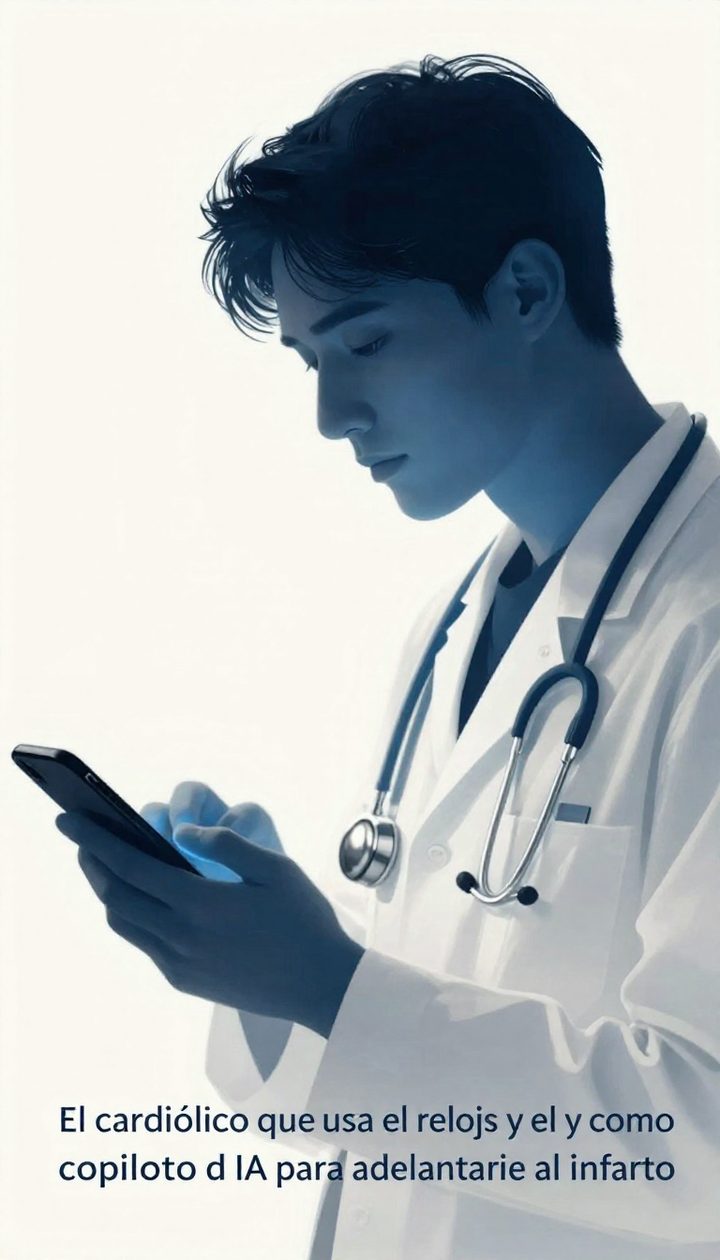
The cardiologist using a watch and a phone as an AI copilot to get ahead of heart attacks
🕒 Published on Zendoric: September 17, 2026 · 08:28
✨ AI-generated · how it's made
A cardiologist at ICBA showed how photos of an electrocardiogram, selfies and pictures of your plate of food already work as digital biomarkers to detect disease before symptoms appear. With 1 billion people worldwide living with hypertension, AI promises to close the gap between knowing what to do and doing it.
📚 Go deeper

THE AI textbook: used by 1,500+ universities.
As an Amazon Associate, Zendoric earns from qualifying purchases; the price does not change for you. · all our recommended books →
By La Nación · September 16, 2026.
At the Health Summit organized by LA NACION, cardiologist Mariano Benzadón, director of Quality, Safety, Patient Experience and Innovation at the Instituto Cardiovascular de Buenos Aires (ICBA), presented a handful of tools that already use artificial intelligence (AI) to monitor the heart outside the doctor's office: an app that photographs a plate of food and calculates its nutrients, a system that estimates blood pressure from a video selfie, and a photo-based electrocardiogram reader that lowers the cost of diagnoses that previously required more expensive tests.
The starting point is a paradox Benzadón summed up bluntly: medicine knows what has to be done to prevent a heart attack —don't smoke, stay active, sleep well, keep blood pressure, cholesterol, blood sugar and weight under control— but real-world adherence is low. He noted that there are more than 1 billion people with hypertension worldwide, a significant share of them uncontrolled, and that close to six out of ten adults are overweight or obese. The diagnosis is not new; what is new is the tool that promises to close that gap between knowing and doing.
That tool is what the sector calls "digital biomarkers": physiological data —steps, heart rate, sleep— captured continuously by a smartphone or smartwatch, instead of just once every six months at the doctor's office. Benzadón mentioned that AI systems approved by the United States Food and Drug Administration (FDA) already exist that can read electrocardiograms and detect disease before it produces clinical symptoms. At ICBA they apply the same logic to patients with heart failure: after hospital discharge they enter a telemonitoring program using their phone and devices provided by the institute which, according to Benzadón, "has scientifically been shown to reduce readmissions."
The underlying change is not only technical, it is relational. Until now, when a doctor sent a patient off until the next check-up in six months or a year, that period fell outside any follow-up. Apps and telemonitoring make it possible to accompany that intermediate stretch and, according to Benzadón, various clinical studies have analyzed their effectiveness and some showed improvements in certain outcomes compared with conventional care. The specialist himself was careful with the framing: he defined AI as "cognitive support or a copilot" that allows doctors to make better decisions.
These advances are worth reading with the caution any institutional announcement at a summit deserves: they are real developments, some with regulatory approval such as the FDA case and others in local clinical research stages, but the presentation offered no diagnostic accuracy figures, sample sizes or comparisons against the hospital reference standard. The difference between "it works in a study" and "it is ready to replace a hospital electrocardiogram" remains large, and it is worth waiting for broader validation before taking its effectiveness at population scale for granted.
Even with that caveat, the underlying trend fits one of the most solid promises of AI applied to health: moving medicine from reactive —waiting for the symptom— to preventive and continuous. That is exactly the terrain where we believe this technology can deliver the most over the long run, bringing closer the prospect of detecting and halting diseases before they take hold, rather than treating them once they have already caused irreversible damage. If digital biomarkers confirm what this first batch of developments suggests, the photo-based electrocardiogram or the selfie that estimates blood pressure are not a carnival trick: they are a step toward a medicine that gains years of healthy life, not just years of life.
But the short term has its own problems, and there is no point papering over them. The gap Benzadón describes —1 billion people with hypertension, six out of ten adults with excess weight— will not be closed with more data alone: adherence to healthy habits is above all a behavioral problem, not an informational one, and a smartwatch is no substitute for the will to move more or eat differently. Moreover, these tools depend on having a smartphone, a watch and a health system willing to integrate them, something that in Latin America and much of the world remains a privilege, not the norm. If early detection ends up reserved for those who can afford an institute like ICBA, the health gap could widen instead of narrowing: that is the real challenge if the promise of the "medical copilot" is to stop being a benefit for the few and become a tool for everyone.
📚 Go deeper

The academic "bible" of deep learning, with a Turing Award winner among its authors, and legally free on the web.

AI as an extractive industry: the lithium, the energy, the underpaid data-labeling work and the bodies behind the cloud.
As an Amazon Associate, Zendoric earns from qualifying purchases; the price does not change for you. · all our recommended books →
🔗 Related on Zendoric
- AI glasses in exams: when cheating beats the top 5 of the class, the assessment system has a bigger problem · 2026-06-28
- AI fraud will grow 153% in five years: the arms race companies cannot afford to lose · 2026-06-30
- AI-generated CSAM at an Illinois school: the hardest abuse to detect no longer needs a hidden camera · 2026-07-04