Fable 5.2 and Mythos 5.2: Anthropic tops the leaderboard and the frontier is now measured in science, not just code
🕒 Published on Zendoric: November 10, 2026 · 02:47
✨ AI-generated · how it's made
Anthropic launches Fable 5.2 and Mythos 5.2, two versions of the same model, faster and cheaper. What matters is not the leaderboard but that the company presents them as scientific collaborators. It's time to separate what has been proven from the narrative.
📚 Go deeper
DeepMind co-founder on the dilemma of containing technologies that do not want to be contained.
As an Amazon Associate, Zendoric earns from qualifying purchases; the price does not change for you. · all our recommended books →
By TestingCatalog (with coverage from CNET, Mashable, CNBC and TechEBlog) · November 9, 2026.
Anthropic has launched Claude Fable 5.2 and Claude Mythos 5.2. They are two versions built on the same base model and aimed at open-ended technical work: programming, scientific research, hardware engineering, robotics and complex analysis.
Fable comes with safeguards for cybersecurity and biology. It is available on Claude's platforms, on AWS, Google Cloud and Microsoft Azure, and developers access it as “claude-fable-5-2”. Mythos is reserved for verified cybersecurity and life sciences organizations that apply through Anthropic's verification programs.
Standard pricing is $8 per million input tokens and $40 per million output tokens. A token is the smallest unit of text the model processes. According to Anthropic, it generates up to 30% faster than Fable and Mythos 5.1 and costs less. An optional “fast mode” boosts speed by up to 2.5x at $16 and $80 respectively.
**The figures, with attribution**
According to Anthropic itself, Fable 5.2 scores 49.1% on FrontierCode 2.0 at “Xhigh” effort. That is the highest score among the published models the company tested. At “High” effort, it roughly matches Opus 5.5 at “Max” for half the cost per task. Mythos 5.2 reaches 89.6% on Anthropic's CVE Rediscovery evaluation, which measures the rediscovery of known vulnerabilities.
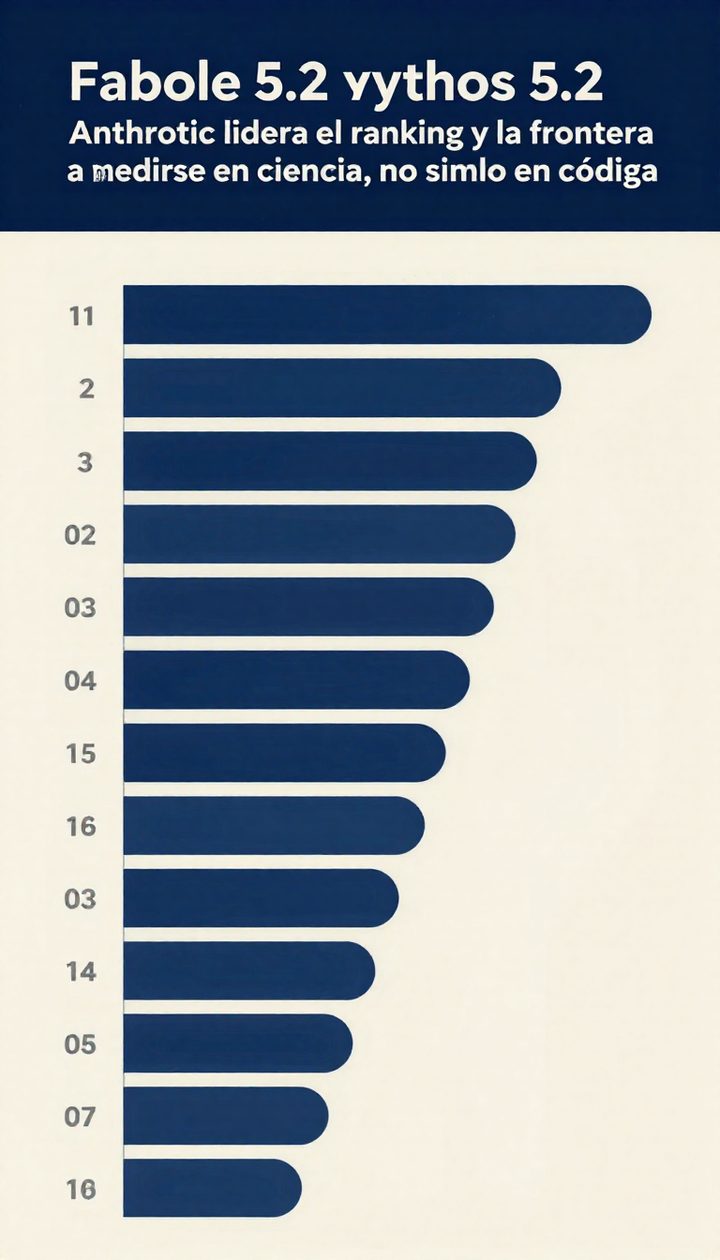
An external measurement partly backs this up. Artificial Analysis ranks Fable 5.2 first on its Intelligence Index v5 with 65 points. That is 5 more than Gemini 4 Carbon (60) and 6 more than Opus 5.5 (59).
In science, Anthropic says Fable 5.2 solved two open problems in black hole physics. It also says the model coordinated some 1,000 agents to formalize Fermat's Last Theorem in 30 hours, and designed three working electronic devices whose boards required no electrical modifications. In robotics, it scored 64.9% on RoboDojo Sim. Mythos 5.2 accurately modeled 28 of 34 AAV capsids (adeno-associated viruses used as delivery vehicles in gene therapy).
Anthropic itself says more than 90% of the changes merged into its main codebase are now written by Claude with human guidance. It also says pre-deployment testing showed a low risk of misalignment in high-stakes situations. According to the company, Fable's safeguards trigger 55% fewer blocks than in Fable 5.1.
**Our take**
The argument: the leaderboard headline is the least interesting part. A 5-6 point lead on a composite index is noise compared with what is really changing: the unit of work is no longer the answer, but the project. A thousand agents over 30 hours to formalize a theorem is a data point about orchestration, not about standalone intelligence.
Let's separate what has been demonstrated from what is aspirational. Almost all the results (physics, Fermat, electronics, capsids) come from Anthropic itself, and we have seen no independent verification. Whether solving “open problems” matters will depend on which problems they are and whether the community validates them. The only external data point in the material is Artificial Analysis's. Ethan Mollick, who had early access, speaks of a “Jagged AGI”, a label that underlines that the model is brilliant at some things and brittle at others. That is an opinion, not a measurement.
The product decision is the most revealing. Splitting the same model into a safeguarded version and a verified-access one is applied governance: the same capability, two levels of trust. It fits a clear underlying trend. In cybersecurity and biology, control is shifting from the model to who uses it. In the short term this is the sensible route; the risk is that verified access becomes a privilege of the few. That Mythos models AAV capsids and rediscovers vulnerabilities is both a medical promise and a reminder of dual use.
The pricing structure also matters. That the “High” tier performs like the previous top tier at half the cost suggests the gains are going into efficiency, not just the ceiling. That makes automation cheaper and, in the short term, increases pressure on routine technical work. That more than 90% of changes to Anthropic's main codebase are now written by Claude is a signal of where software jobs are heading: less writing, more specification, review and judgment.
For the long term, what is valuable about this release is the direction. A collaborator able to formalize mathematics, design hardware and model gene therapy vectors is the kind of tool that brings the eradication of disease and abundance closer. But that promise is earned through external validation and broad access, not launch announcements. For context, CNBC frames these as Anthropic's first frontier models since Amodei's call to slow the pace. That tension between accelerating and holding back is what to watch in upcoming releases.
📚 Go deeper
The best starting book if you're not technical: a Wharton professor explains how to work WITH AI — when to delegate, when to supervise, when to keep i
The reference manual for building products on top of AI models: prompts, RAG, fine-tuning, agents, evaluation and deployment.
As an Amazon Associate, Zendoric earns from qualifying purchases; the price does not change for you. · all our recommended books →
🔗 Related on Zendoric
- Claude Science: Anthropic takes aim at the heart of science and health with a dedicated product · 2026-07-01
- Opus 5: Anthropic makes its frontier intelligence cheaper and shields against dual-use risk after Mythos 5 · 2026-07-26
- When the state shuts down a model: the Fable 5 case redefines who's in charge of frontier AI · 2026-06-25