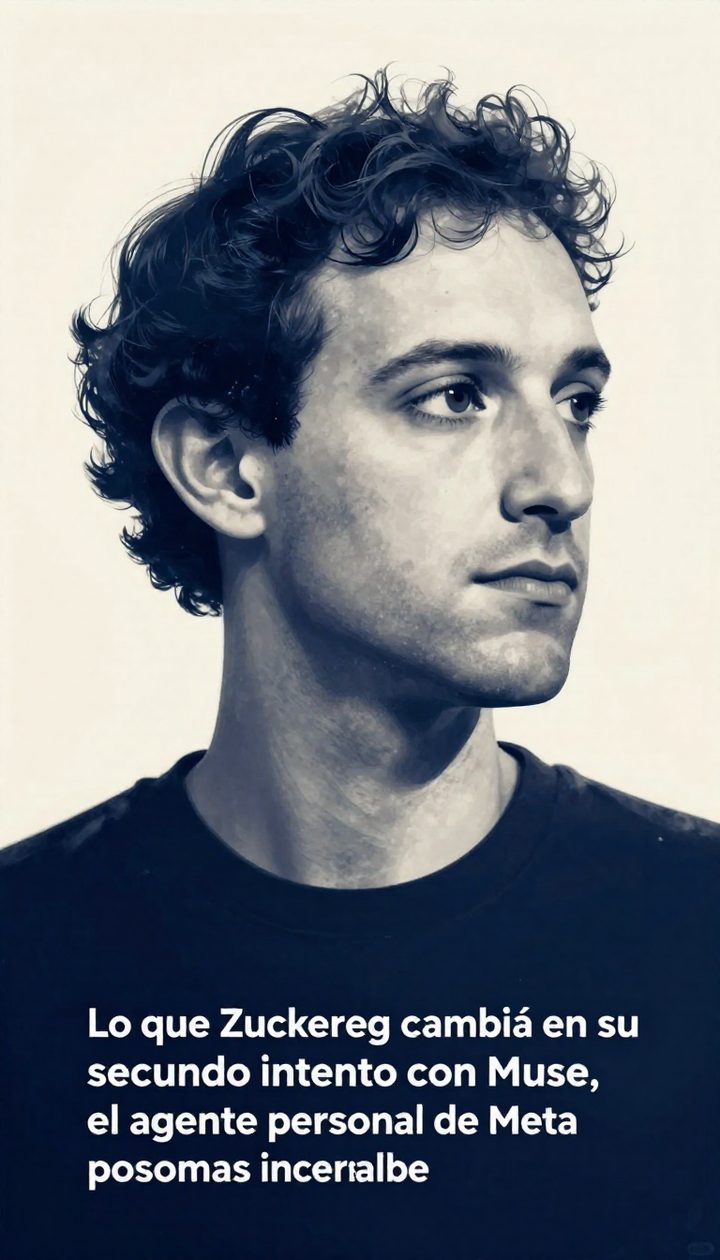
What Zuckerberg changed in his second attempt with Muse, Meta's personal agent, and what we can learn
🕒 Published on Zendoric: November 4, 2026 · 00:20
✨ AI-generated · how it's made
Nate's newsletter starts from a problem he says he hears again and again from creators, people starting their careers, people ending them and executives: "it's too hard," "it's too expensive," "I'm not technical," "I'm late." Meanwhile, what can be done keeps expanding.
📚 Go deeper

The reference manual for building products on top of AI models: prompts, RAG, fine-tuning, agents, evaluation and deployment.
As an Amazon Associate, Zendoric earns from qualifying purchases; the price does not change for you. · all our recommended books →
By Nate (Nate's Substack) · November 3, 2026.
Nate's newsletter starts from a problem he says he hears again and again from creators, people starting their careers, people ending them and executives: “it's too hard,” “it's too expensive,” “I'm not technical,” “I'm too late.” Meanwhile, what's possible keeps growing. We have better tools for learning, building, finding answers and solving problems, but we keep bringing them the same narrow set of tasks we brought to the previous generation of tools.
His thesis is that some decisions about what to do with our lives were made based on how much time, money and help it took to master something. Those costs are changing, so those decisions deserve another look. Nate argues that simply making the life we already have more efficient is far too small an ambition for this moment. He poses two questions: how timidly am I living my life? And what would change if I were a little bolder?
The email previews what the full article covers: what Zuckerberg changed on his second attempt (who he brought in, how much freedom he gave them and why Muse starts with a to-do you already need to get done); how to recheck a limit you set for yourself years ago; how to break a five-year estimate down into learning, waiting for help and searching for answers, and see which of those parts AI now shortens; how to trace back to what you couldn't learn by finding the exact point where you got lost; and the one cost that hasn't fallen, embarrassment, which Nate says hurts just as much and must be told apart from the old technical limit people keep citing. Paid subscribers get access to the full archive, Nate's Library MCP and his Slack community.
The Zuckerberg case. Nate recalls that Zuckerberg renamed his entire company for the metaverse, spent tens of billions of dollars and watched the world turn him into a joke. According to the source he links to, Reality Labs, Meta's virtual and augmented reality division, lost $19.2 billion in 2025 alone, and the promised mass-market platform never arrived. Even so, he tried again: according to the October 21 earnings presentation, more than ten million people in the United States and Canada have set up Muse, Meta's personal AI agent, in about six weeks.
Nate makes clear he doesn't want to talk about Mark the person but about Mark the founder. Zuckerberg could have simply milked his advertising business and played it safe after the metaverse, but he kept his ambition and changed how he pursued it.
The first difference: Muse gives people an immediate reason to use it. You bring it a to-do, on the phone you already have, and it helps you. Nate says that when he reviewed it in September, his Muse (which he named Marvin, after Douglas Adams) helped him cancel $1,285 a year in subscriptions, something he had been putting off for a while. His lesson: that's how you earn the next conversation with a customer. You may see a whole future, but the person you want to reach only sees the first thing you ask them to do; if that first thing is worth it, you get the chance to take it further.
The second difference: the people. Citing David Senra's interview with Alexandr Wang, Nate explains that the work Wang and Nat Friedman led was done by fewer than 200 people across model and product. Zuckerberg had the resources to throw a huge organization at it but instead let a small group make the decisions and build the product. Nate acknowledges that Meta has resources almost no one else will ever have, but what interests him is what Zuckerberg did with them: he brought in other people, gave them room and allowed the new attempt to produce something the previous approach hadn't. The money gave him options, but he still had to choose an approach and bet on it.
The question he puts to the reader: after failing at something you care about, what has to change for the next attempt to work? Perhaps someone who understands the customer better, a skill you've been avoiding, or dropping five projects to finish one. Coming back with the same assumptions and hoping enthusiasm will fix the problem is a good way to fail twice. What he admires is keeping ambition alive while changing enough to give it another chance, and he argues that AI makes this relevant to far more people because it changes the resources each of us can bring to our next attempt.
Decisions made with old information. Nate recalls that three years ago, on his 41st birthday, he wrote a list of things he would tell his younger self; one was that learning to execute quickly unlocks your biggest constraint in life: time. He argues that time determines which ambitions ever get a serious attempt: you can want to learn something and decide the years required are out of reach, see a problem and conclude that solving it would take a team you could never afford, or have a book in your head and put it off until life calms down. Over time, “I don't have time to learn that” becomes “I'm not that kind of person,” and it stops looking like a decision made under certain circumstances and starts feeling like a fact about yourself.
That's how we end up with an old list of things we can't do, a graveyard of unstarted projects, unstudied subjects and discarded ideas. Some entries are there because we tried and failed, others because we saw someone else and concluded we didn't have what that person had, and many because we looked at the work once, years ago, and never looked again. For Nate, AI is a very good reason to look again.
An example: someone who tried to learn programming after work, with an hour each evening. They spent almost all of that hour figuring out why a tutorial example didn't work; the next night another error appeared, and a week later they were still wrestling with setup without having touched what they wanted to build, until they concluded programming wasn't for them. Put an assistant beside them that reads the error, explains what happened and helps them move forward, and the evening changes: they spend more time on what they wanted to learn, can ask the question that seems too basic for a forum, ask it again and try the next step with the answer in front of them. According to Nate, past experience doesn't tell you how this new attempt will go.
He adds that many of us have more to bring to an attempt than we give ourselves credit for.
📚 Go deeper

The best starting book if you're not technical: a Wharton professor explains how to work WITH AI — when to delegate, when to supervise, when to keep i

The definitive piece of investigative journalism on OpenAI: 260+ interviews, the clash between safety and speed, and the attempted firing of Sam Altma
As an Amazon Associate, Zendoric earns from qualifying purchases; the price does not change for you. · all our recommended books →
🔗 Related on Zendoric
- How to design an agent loop that a small, cheap model can complete on its own · 2026-10-07
- When the camera stops reading license plates and starts remembering journeys: the debate urban AI forces us to have · 2026-06-25
- ChatGPT-4o's age bias is not a technical glitch: it's society reflected at industrial scale (KAIST quantifies it) · 2026-06-28