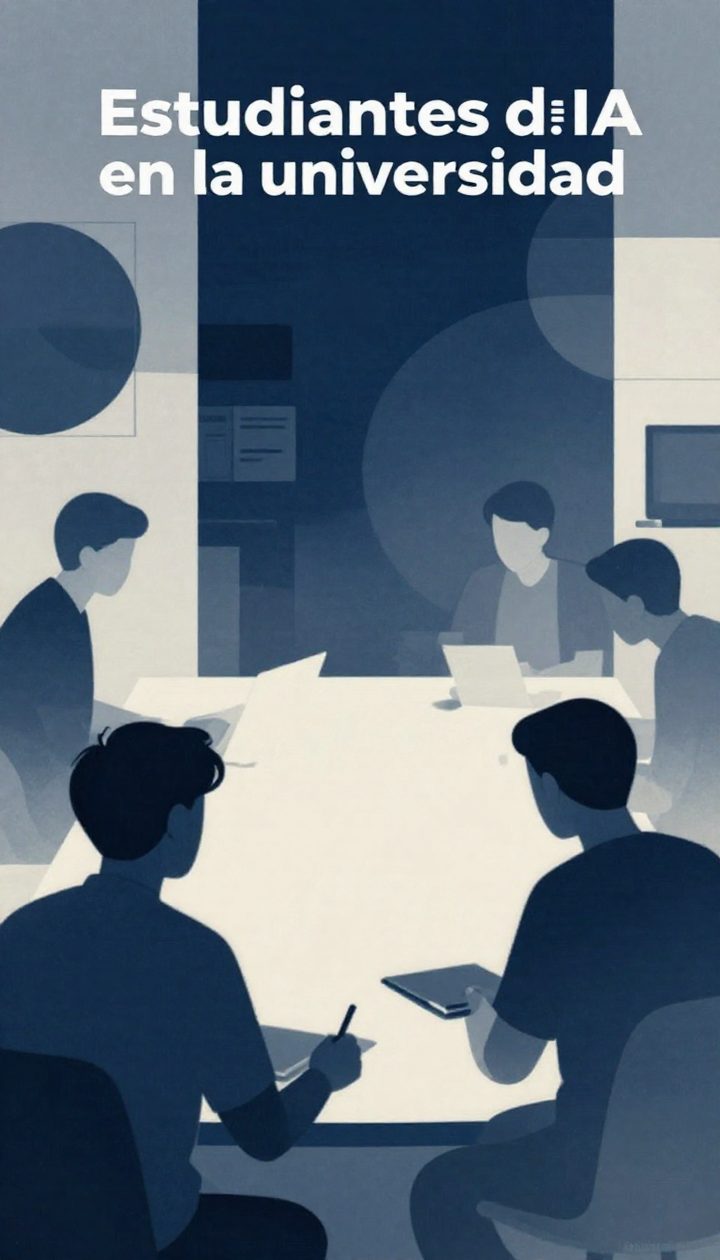
AI students at university: a student satire that isn't news, but captures the sector's fears well
🕒 Published on Zendoric: November 3, 2026 · 00:06
✨ AI-generated · how it's made
The Exponent, UW-Platteville's student newspaper, reports in its satirical section The Antagonist that Wisconsin's regents will create AI-generated students. It's humor, not fact, but it points to a real anxiety: what happens to education if classrooms empty out.
📚 Go deeper

The memoir of the creator of ImageNet, the scientist who made the deep learning revolution in vision possible.
As an Amazon Associate, Zendoric earns from qualifying purchases; the price does not change for you. · all our recommended books →
By Exponent · November 2, 2026.
First, to avoid any confusion: this is NOT news. The text comes from The Antagonist, the humor section of the Exponent, the student newspaper of the University of Wisconsin-Platteville. The events it describes are made up, including the regents' unanimous vote, the classes of 1,500 artificial "students" and the regent quoted with a joke name. The text itself gives the game away with gags such as "In unrelated news, faculty retirements rise." Nothing in the material indicates any real decision by the Board of Regents.
The piece pokes fun at several ideas: dorms converted into data centers, amendments to Title IX (the US law against discrimination in education) to protect artificial students, tuition for those students paid by their parent companies alongside a fee hike across the entire UW system, and employers delighted with graduates who "can be paid less." Each joke targets a specific fear in the university community.
Our take: satire is a useful barometer. That a student newspaper chose this joke shows that the "AI replaces people at university" narrative is already in the air. The underlying fears it expresses are plausible: that cost pressures push institutions to automate, that enrollment falls due to demographics, and that technology is used to cut rather than to improve teaching.
Overall, the real direction of the sector is different and far less absurd. Universities are exploring AI tutors, assisted assessment and tools for faculty. Our thesis is that the teacher who orchestrates AI as an augmented tutor wins, and the one who only delivers content loses. That is where the serious debate lies, not in synthetic students.
The short-term risk is real and worth stating: if decisions are made purely to save money, the transition will be hard on faculty and staff. In the long term, personalized, accessible education for all is one of this technology's most solid promises. Laughing at the excesses helps us remember that the goal is to educate people, not to save on dorms.
📚 Go deeper

AI as an extractive industry: the lithium, the energy, the underpaid data-labeling work and the bodies behind the cloud.

The only novel on the list, by a Nobel laureate: an artificial friend observes humans with a blend of lucidity and innocence no essay achieves.
As an Amazon Associate, Zendoric earns from qualifying purchases; the price does not change for you. · all our recommended books →
🔗 Related on Zendoric
- Hunting AI cheats at university: half of those accused suffer extreme anxiety, study reveals · 2026-09-08
- AI-generated fake nudes of 45 students reported in Lomas de Zamora: the technical barrier to abuse no longer exists · 2026-10-08
- ULA brings Gemini for Education into its classrooms: the AI bet at university is about literacy, not software · 2026-10-10