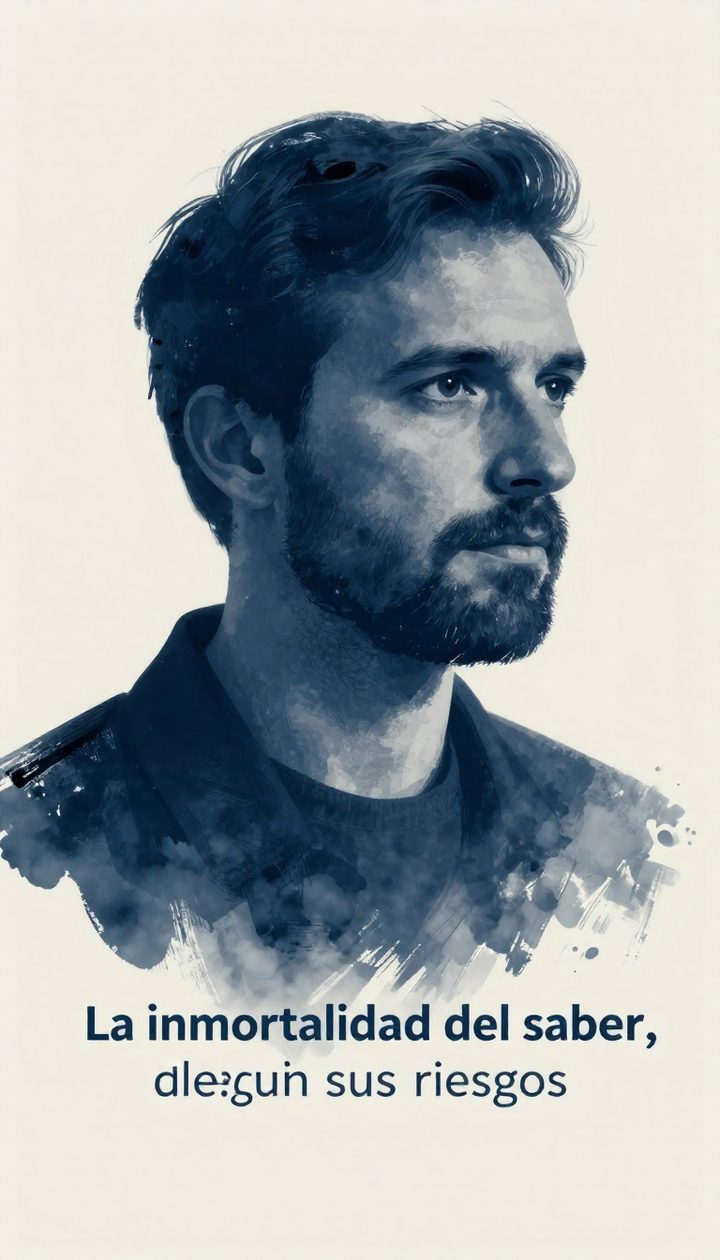
A terminally ill Dutch professor creates an AI twin to keep teaching: the immortality of knowledge, with its risks
🕒 Published on Zendoric: November 1, 2026 · 00:10
✨ AI-generated · how it's made
Jan Rotmans, 65, who has metastatic prostate cancer, is training an AI on his books and lectures so it can keep teaching after his death. It is a human case and a useful one for thinking about what it means to bequeath knowledge and who is accountable for what it says afterward.
📚 Go deeper

THE AI textbook: used by 1,500+ universities.
As an Amazon Associate, Zendoric earns from qualifying purchases; the price does not change for you. · all our recommended books →
By The Eastleigh Voice · October 31, 2026.
Jan Rotmans, a 65-year-old Dutch professor who has had metastatic prostate cancer for almost two years, is building an AI version of himself. According to the outlet, which cites Dutch public broadcaster NOS, the digital twin will be able to teach classes and answer questions after his death.
The system is fed with his books, his scientific papers and his recorded lectures. It is being developed by Dutch studio The Synths, which has already created a digital likeness of former footballer Ruud Gullit. The first online version should be ready before the end of 2026. The developers also plan a holographic version that can take the stage and give lectures.
According to the article, doctors gave Rotmans five years to live in 2024, although he says his recent test results are encouraging. "This way I can keep being in places where I am no longer there," he told NOS.
The project's ambitions go beyond an archive. Rotmans admits he could use the avatar to discuss problems he already raised during his life. He does not rule out that it might propose solutions he himself has not considered. That leap, from repeating what he said to extrapolating what he would have said, is where things get both interesting and delicate.
The source acknowledges doubts about reliability. The twin could give misleading answers or attribute opinions to him that he does not hold. According to the article, the developers are testing the system to fix errors. Rotmans wants to review the answers while he is alive and hopes others will take on that task later. He also admits the technology could be misused, but prefers to develop it while he can still oversee it and raise the alarm if problems arise.
**Our take.** This case is a good example of a use of AI that almost nobody disputes: a person with an intellectual legacy and full consent decides to preserve it. It is a useful counterpoint to the usual debate about "resurrecting" the dead without their permission. Here, consent, control during his lifetime and purpose (teaching) are clear.
Even so, our view is that the twin's value depends on two things technology cannot solve on its own. The first is the line between archive and extrapolation. A system that retrieves and organizes what Rotmans wrote is a library with a voice. One that "suggests solutions" is already generating new content with his face and his authority. That content can be wrong while sounding authoritative, and readers may not be able to tell what comes from the professor and what comes from the model.
The second is governance after his death. Rotmans will review the answers while he lives, but the underlying question is who will do it afterwards, and by what criteria. For now, clear mechanisms for oversight, labeling and expiry are lacking. In general, such projects should always make clear that users are talking to a replica and keep a record of which answers have been validated by the person.
In the short term, we will see more cases like this: academics, creators and public figures who want to leave behind "tutors" of themselves. There will be abuses, from replicas made without consent to false attributions, and these should be regulated based on evidence rather than panic. In the long term, the idea points to something valuable. If AI helps eradicate diseases and extend life, the knowledge of the best minds need not be lost with them. Meanwhile, a digital twin does not replace the person. It is a living archive that inherits their strengths and, also, its own technical limits.
📚 Go deeper

The academic "bible" of deep learning, with a Turing Award winner among its authors, and legally free on the web.

The reference manual for building products on top of AI models: prompts, RAG, fine-tuning, agents, evaluation and deployment.
As an Amazon Associate, Zendoric earns from qualifying purchases; the price does not change for you. · all our recommended books →
🔗 Related on Zendoric
- TexTNet sharpens prostate cancer grading with texture-guided AI, but its leap is still on the benchmark · 2026-10-20
- AI as the modern Cyrano: a useful crutch that risks hollowing out the very intimacy it promises · 2026-06-25
- Alicante shows that useful innovation is now born tied to a sector: health, the environment and data sovereignty · 2026-06-27