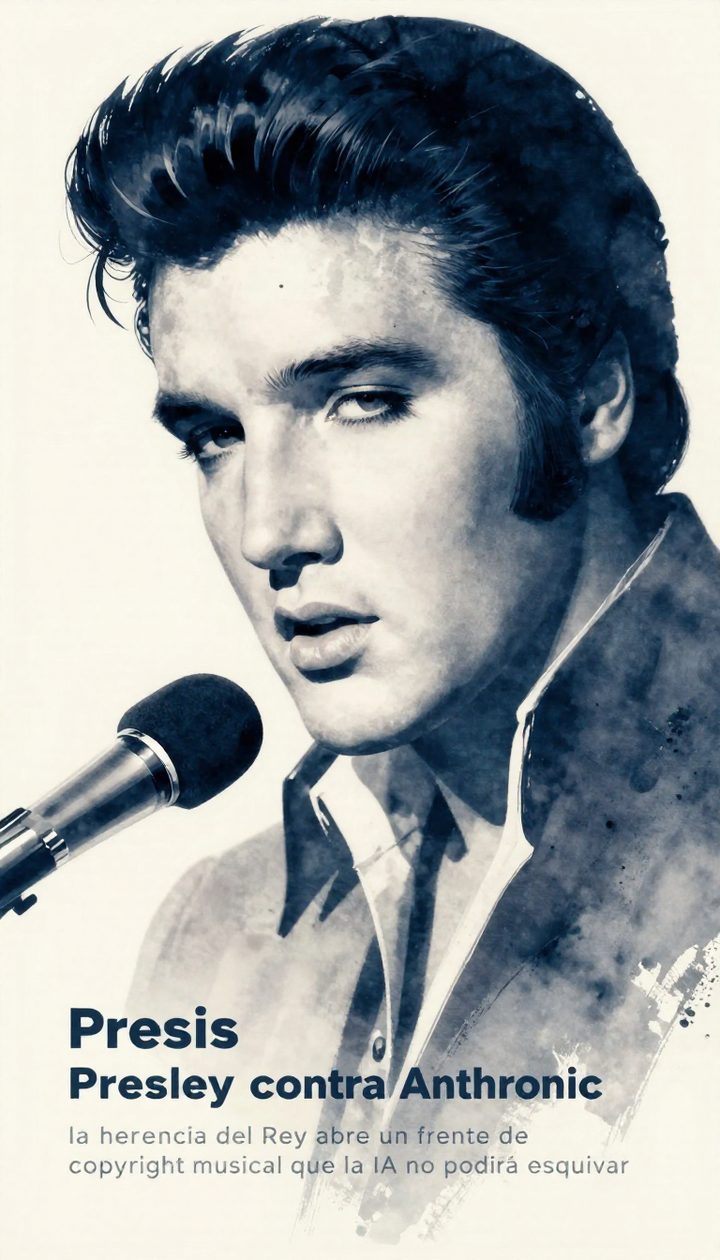
Elvis Presley vs. Anthropic: the King's estate opens a music copyright front AI won't be able to dodge
🕒 Published on Zendoric: October 26, 2026 · 08:28
✨ AI-generated · how it's made
Authentic Brands Group, which holds Elvis's rights, is suing Anthropic over 274 songs. It is one of the first lawsuits by an artist's estate against an AI developer, and its outcome could shape how music is licensed for model training.
📚 Go deeper

The definitive piece of investigative journalism on OpenAI: 260+ interviews, the clash between safety and speed, and the attempted firing of Sam Altma
As an Amazon Associate, Zendoric earns from qualifying purchases; the price does not change for you. · all our recommended books →
By Happy Mag (with coverage from Vulture and the New York Daily News) · October 26, 2026.
Authentic Brands Group, the licensing company that manages Elvis Presley's estate, has sued Anthropic over the alleged unauthorized use of the singer's songs to train its AI models. According to the lawsuit, which was filed on Friday and first reported by Billboard, the rights to 274 tracks are at stake.
Happy Mag reports that the suit seeks $150,000 per infringed work, the usual cap on statutory damages for willful infringement in the US. Applied to all 274 songs, that would come to roughly $41 million. This is our own calculation based on figures in the lawsuit, not a number confirmed by either party.
Attorney Richard Busch, who signed the filing, argues that Anthropic has built its "entire business model" on copyright infringement "on a scale never seen before." That is the plaintiffs' accusation. So far there has been no ruling, and the material available to us contains no response from Anthropic. It should be treated as an allegation and nothing more.
Context matters. The music industry has been fighting AI companies in court for some time. The RIAA (the US recording industry association) has filed claims, and labels such as Universal, Sony and Warner are pursuing licensing deals and regulation. According to Happy Mag, what sets this case apart is that it comes from an artist's estate rather than a record label or an industry association.
Our take: the lawsuit matters less because of Elvis than because of the approach. An estate with a limited, identifiable catalog of enormous commercial value is the ideal plaintiff to force a court to decide whether training on copyrighted works requires a license. That question has gone without a clear answer for years, and every case that moves forward brings an answer closer.
There is also a practical point. Music is easier to protect than text: the works are specific, the rights holders are clearly defined and a licensing market already exists. That tilts the field toward payment deals, like the ones already being negotiated with labels, and away from the endless "fair use" versus "infringement" fight.
In the short term, expect more lawsuits, higher legal costs and more uncertainty for developers. It is a rough transition, and artists who fear AI "slop" and impersonation on streaming platforms have real reasons for concern. Spotify says it has removed about 50 million songs it considered "slop" from its recommendations over the past year, a figure that shows the scale of the problem.
In the long term, the goal should be a clear licensing and traceability framework that pays creators and still lets AI democratize music-making. A system like that does not hold progress back; it puts it on a sustainable footing. What does not work is regulation driven by panic. We need evidence of what was used for training, how, and with what effect on the market, and that is exactly what a trial can bring to light.
What to watch: whether Anthropic responds with a fair use defense or a licensing offer, and whether other estates (Prince, Sinatra, the Beatles) copy the strategy. That will show where the industry is heading.
📚 Go deeper

DeepMind co-founder on the dilemma of containing technologies that do not want to be contained.

AI as the latest chapter in the history of information networks, from gossip to the printing press to the algorithm.
As an Amazon Associate, Zendoric earns from qualifying purchases; the price does not change for you. · all our recommended books →
🔗 Related on Zendoric
- Elvis estate sues Anthropic over 274 songs, and individual artists now become the new front in AI copyright · 2026-10-25
- Elvis estate sues Anthropic over 274 songs, testing whether one artist can make AI training costly · 2026-10-24
- $1.5 billion: judge approves the largest copyright settlement of the AI era with Anthropic · 2026-07-21