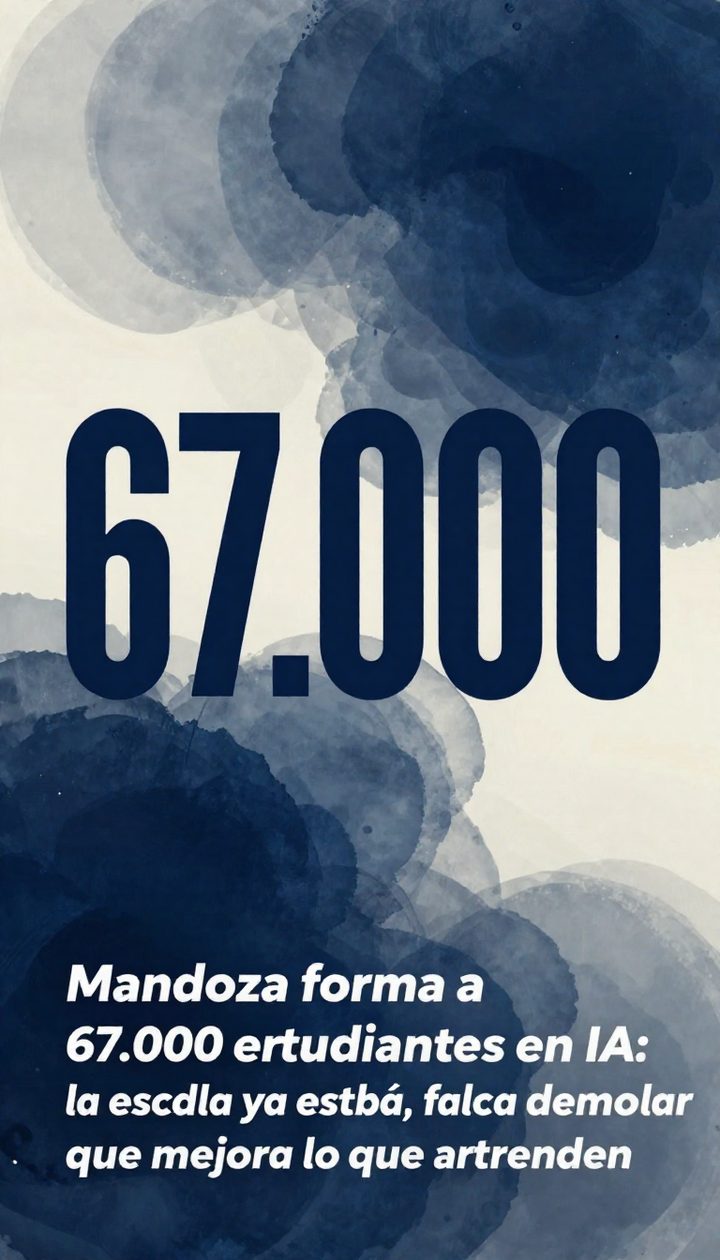
Mendoza trains 67,000 students in AI: the scale is there, now it must prove it improves what they learn
🕒 Published on Zendoric: October 23, 2026 · 00:20
✨ AI-generated · how it's made
The Argentine province of Mendoza has brought an AI program to 67,000 secondary school students, starting with the most remote schools. The coverage figure is impressive; the real test will be measuring whether they learn more.
📚 Go deeper

The best starting book if you're not technical: a Wharton professor explains how to work WITH AI — when to delegate, when to supervise, when to keep i
As an Amazon Associate, Zendoric earns from qualifying purchases; the price does not change for you. · all our recommended books →
By 617 News · October 22, 2026.
Mendoza (Argentina) has enrolled 67,000 secondary school students in Mendoza Aumentada, an artificial intelligence training program. According to its head, Romina Méndez, it launched in 2025 with some 47,000 students in years one to three and was later extended to the upper years and to the sixth year of technical schools.
The program is part of EduTech, the educational innovation line of the province's Dirección General de Escuelas (DGE). It includes 210 pieces of content adapted to the different secondary tracks (technical, chemistry and others). On completion, students could earn a certification as "junior artificial intelligence operators," Méndez explained.
The approach goes beyond teaching a tool. According to the interview, the program covers writing instructions ("prompts"), critical thinking and the need to check what the AI says. Examples of student projects include a video or a brochure for a relative's business and songs for graduation ceremonies.
One design choice deserves attention: the rollout began with rural and border schools, not the big cities. Where connectivity was lacking, the province turned to Starlink antennas (satellite internet). The first school to complete the course was the one in Jaime Prats, in San Rafael, with just 16 secondary students.
The expansion is already looking beyond the classroom. According to Méndez, there are 20 sites outside schools for young people aged 18 to 25, and minister Tadeo García Zalazar signed agreements with municipalities to offer platform licenses to municipal staff and residents. The program also received recognition at the Sadosky awards, in the talent development category.
**Our take.** Counting enrolled students measures the scale of a policy; it does not measure whether students learn more. The source itself acknowledges this: the DGE carried out an internal assessment and commissioned Universidad Austral to run an external evaluation of the first year, which will be repeated for comparison. Fluency, comprehension and math indicators are also being tracked. That is the crucial point. The claim that struggling students make progress with these tools is, for now, the program head's assessment, not a published comparative result. We have not seen figures from those evaluations in the available material.
That said, there are sound decisions here. Prioritizing the most remote reverses the usual logic, in which technology reaches those who already have connectivity first. And keeping the teacher at the center, as a guide who puts the answers in context, is the most sensible bet. In general, the available evidence on educational technology suggests that its effect depends on how it is integrated into teaching, not on the tool itself.
The short-term risk is twofold: that the "certification" becomes a stamp of little value in the job market, and that familiarity with the tool is mistaken for real competence. A "junior operator" credential is only worth something if it is tied to verifiable skills. In the long run, however, the case is strong. If AI is going to change which work matters, teaching thousands of teenagers to direct it, question it and check it is an investment in agency, not dependence. Mendoza now has the chance to turn a good rollout into a benchmark case, but only if it publishes the evaluation results, whatever they turn out to be.
📚 Go deeper

The reference manual for building products on top of AI models: prompts, RAG, fine-tuning, agents, evaluation and deployment.

The definitive piece of investigative journalism on OpenAI: 260+ interviews, the clash between safety and speed, and the attempted firing of Sam Altma
As an Amazon Associate, Zendoric earns from qualifying purchases; the price does not change for you. · all our recommended books →
🔗 Related on Zendoric
- CEA launches a summer AI school for teachers: Connecticut's teachers' union embraces doubt as a method · 2026-07-01
- The real AI curriculum isn't using it, but knowing when not to · 2026-07-09
- AI is now the majority in the classroom: 9 out of 10 university students use it, and the question is no longer whether but how · 2026-07-29