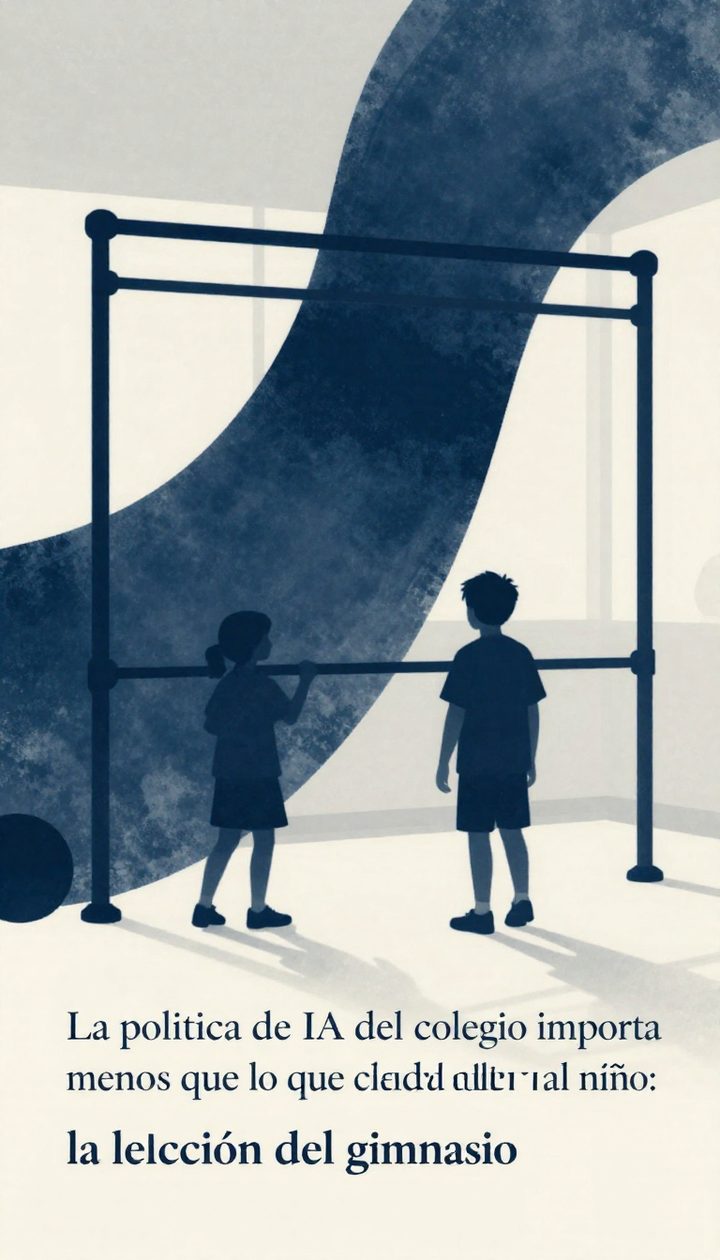
A school's AI policy matters less than what each shortcut takes away from the child: the lesson from the gym
🕒 Published on Zendoric: October 20, 2026 · 00:19
✨ AI-generated · how it's made
An op-ed in The 74 notes that at back-to-school night, parents bombard teachers with questions about AI, yet no one asks whether a chatbot can make their kids run. That asymmetry says a lot about what education is.
📚 Go deeper

THE AI textbook: used by 1,500+ universities.
As an Amazon Associate, Zendoric earns from qualifying purchases; the price does not change for you. · all our recommended books →
By The Good Men Project (by Conor P. Williams, originally published in The 74) · October 19, 2026.
The article is an opinion piece, not a study. Its author, Conor P. Williams, describes back-to-school night at a US secondary school. In every classroom, parents ask about the AI policy. Teachers respond with a rehearsed speech: they admit to personal doubts and recite the school's rules, which allow only very limited uses. Some parents press on whether students can use it to practice, brainstorm or do research.
In the gym, the author notes, nobody asks whether a student can use AI in a cross-country race or hand off hill sprints to it. His argument is that schoolwork has a direct goal and an indirect one. Kids don't run 5 km to win medals but to learn to set goals and push through the tedious work those goals demand. The same goes, he argues, for Boyle's law or a novel: the specific content matters less than the attention, memory and confidence built through hard study.
He concedes that AI can help pinpoint a flaw in an experiment or guide a student through a problem. But he argues that these shortcuts add up year after year. He says research increasingly shows their cost, although the piece does not cite any specific study.
**Our take.** The sports analogy is useful because it dismantles a false choice. We debate whether AI is a “tool” or a “cheat” as if that depended on the software. It depends on what each task is meant to train. If the goal is the result (a report, code that works), delegating makes sense. If the goal is the effort itself, delegating empties out the exercise, like a robot running for you.
There is a nuance the article does not explore. A gym has an advantage the classroom lacks: physical effort is visible and cannot be faked. An essay written with a chatbot's help can be. That is why school rules collide with reality: they are hard to enforce and push students toward covert use. Part of the work ahead is redesigning assignments so the process is visible, through in-class exercises, oral explanations and supervised drafts, rather than simply banning the technology.
Nor should the piece be read as a rejection of AI in education. In general, the promise of the personalized tutor still holds: well-used AI can give every student the individual attention that today only those who pay for private tutoring get. It is one of the clearest paths toward the abundance of knowledge we champion in the long run. But such a tutor must be designed to make the student do the work, not to spare them from it.
In the short term, the transition will be uncomfortable: teachers with carefully measured speeches, anxious parents and improvised rules. In the long term, the useful question is not “Is AI allowed?” but “What muscle are we training with this task?” Answering it well will still pay off years from now, when the tools have changed but learning still demands perseverance.
📚 Go deeper

The academic "bible" of deep learning, with a Turing Award winner among its authors, and legally free on the web.

The memoir of the creator of ImageNet, the scientist who made the deep learning revolution in vision possible.
As an Amazon Associate, Zendoric earns from qualifying purchases; the price does not change for you. · all our recommended books →
🔗 Related on Zendoric
- AI to retain teachers: when the algorithm acts as a critical mirror for school principals · 2026-07-01
- AI literacy from primary school: why teaching the habit matters more than banning the tool · 2026-07-09
- Hong Kong now has an AI plan for the classroom; what it lacks is a plan for the teachers who don't use it · 2026-07-17