AMD unveils Helion: an open rack blueprint for agentic AI, with CPU-only and CPU+GPU configurations
🕒 Published on Zendoric: October 15, 2026 · 00:13
✨ AI-generated · how it's made
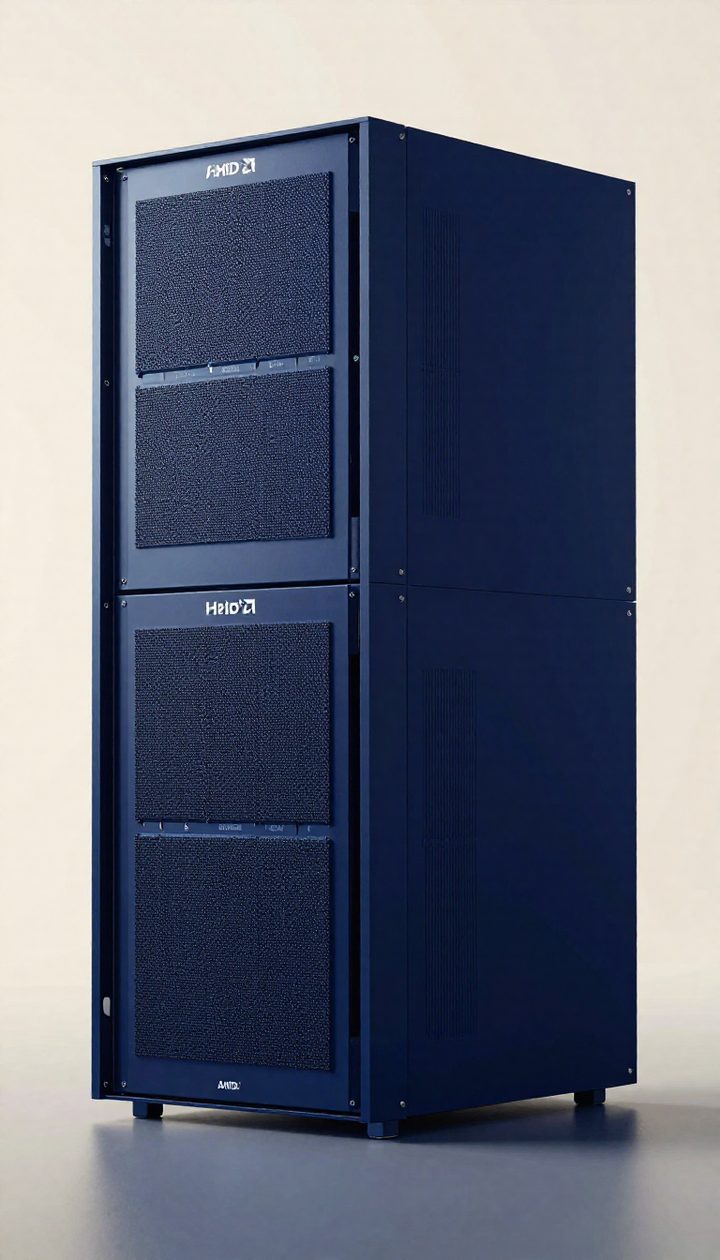
AMD announced AMD Helion on October 12, 2026, from Santa Clara (California), describing it as an agentic AI rack and an open blueprint for agentic AI infrastructure. It is based on an Open Compute Project (OCP) design specification and runs on AMD compute.
📚 Go deeper

The story of NVIDIA and Jensen Huang: how a video-game card company ended up making the most coveted resource on the planet.
As an Amazon Associate, Zendoric earns from qualifying purchases; the price does not change for you. · all our recommended books →
AMD on October 12, 2026, announced AMD Helion from Santa Clara, California, describing it as an agentic AI rack and an open blueprint for agentic AI infrastructure. It is based on an Open Compute Project (OCP) design specification and runs on AMD compute. The company presents it as an extension of the open-platform approach behind its AMD Helios rack-scale solution. The text received is a press release from AMD itself, so the assessments and benefits it contains are company claims, not independently verified results.
The core idea is that agentic AI is not a single workload. Dan McNamara, senior vice president and general manager of Compute and Enterprise AI at AMD, says it spans personal agents, enterprise applications, code execution and complex workflows, each with different compute requirements. With Helion, AMD proposes that customers tune CPU performance, core density and power consumption, and pair them with GPU acceleration depending on the work their agents do.
The design supports both liquid-cooled and air-cooled versions. AMD says this makes it possible to build virtually any configuration a customer needs. The release cites two specific examples.
The first is a CPU-only rack with 6th Gen AMD EPYC processors that can reach up to 32,768 CPU cores. It is aimed at hyperscale customers. It provides dedicated capacity for agent execution and connections to a separate model inference infrastructure.
The second is an all-in-one rack that combines AMD EPYC CPU nodes, AMD Instinct MI350P GPU nodes and general-purpose compute in a single platform. It is geared toward enterprise agentic AI deployments.
The approach separates agent execution, which runs on CPUs, from model inference, which uses GPUs. In the hyperscale design, the two sit on separate infrastructure. In the enterprise design, they are integrated into a single rack.
AMD argues that Helion allows agentic AI to be deployed on the IT infrastructure customers already have, so that existing investments serve as a foundation for new capabilities. According to the release, partners will be able to tailor CPU and GPU configurations to each customer's workloads. They will need to match agent execution, inference and supporting compute to the performance, power and cost requirements of each deployment.
The release's highlights add that Helion combines open hardware and software with an integrated token router. That router directs agents' model calls between frontier models and open-source models. The text received does not explain how the router works, so no further details can be given about it.
On the openness of the design, AMD plans to contribute the Helion specification to the OCP so the community can continue developing and adopting it. As for availability, Helion agentic rack configurations are in development with ecosystem partners. AMD expects them to be available in November 2026. This is a target date, not a confirmed delivery.
The release includes statements of support from several partners.
Cisco Compute, through Jeremy Foster, stresses that agentic AI also requires connecting, managing and securing the entire system, not just compute power.
Dell Technologies, through Arun Narayanan, cites its support for the Helion agentic rack reference design and its Dell PowerRack offering for networking and storage.
Hon Hai Technology Group backs the reference design and highlights its rack-level integration and global manufacturing capabilities.
HPE, through Trish Damkroger, mentions a recent customer agreement to deploy AMD Helios and its collaboration with AMD on open standards.
Lenovo, through Scott Patti, frames it within its Lenovo Hybrid AI Advantage.
QCT, through Mike Yang, praises the flexibility to tailor configurations.
Supermicro, through Vik Malyala, says it will bring Helion to market as an ORv3-compatible rack architecture through its Data Center Building Block Solutions.
Wiwynn, through William Lin, highlights its experience in rack-level integration and advanced cooling for hyperscale customers.
All of these statements are corporate endorsements and do not amount to purchase commitments or technical validations.
Overall, the announcement reflects a trend: agentic workloads require a great deal of general-purpose execution on CPUs in addition to GPU inference. AMD is trying to position itself there with an open platform based on OCP standards and backed by the major server makers. Full technical details have yet to be disclosed. These include real-world performance, power consumption, pricing and how the token router works. None of them appear in the material received.
The release also includes the usual forward-looking statements disclaimer. It warns that Helion's features, performance, availability and timelines may differ from expectations. The text received is truncated in that risk section, so this summary is limited to what appears in the available portion.
📚 Go deeper

DeepMind co-founder on the dilemma of containing technologies that do not want to be contained.

Semiconductors as the oil of the 21st century: history, espionage, and why an island of 23 million people underpins the entire AI economy.
As an Amazon Associate, Zendoric earns from qualifying purchases; the price does not change for you. · all our recommended books →
🔗 Related on Zendoric
- SpaceX launches Google's first AI chips into space in the initial orbital test of Alphabet's Suncatcher project · 2026-10-03
- Four freshmen build in 10 weeks what a factory couldn't afford for years · 2026-07-14
- Agentic AI comes to chip design: Agnisys brings end-to-end automation for semiconductors to DAC 2026 · 2026-07-23