Microsoft launches the Surface Laptop Ultra: a 15" laptop with the NVIDIA RTX Spark superchip for $2,599
🕒 Published on Zendoric: October 11, 2026 · 10:19
✨ AI-generated · how it's made
The material analyzed is Microsoft Store's own product page for the new Surface Laptop Ultra — that is, official marketing content rather than independent journalism.
📚 Go deeper

The story of NVIDIA and Jensen Huang: how a video-game card company ended up making the most coveted resource on the planet.
As an Amazon Associate, Zendoric earns from qualifying purchases; the price does not change for you. · all our recommended books →
The material analyzed here is Microsoft Store's own product page for the new Surface Laptop Ultra—that is, official marketing content rather than independent journalism. That means nearly every performance claim comes from the manufacturer, that several key figures (for example, support for AI models of up to 120 billion parameters) are based on theoretical FP4 TOPS with sparsity enabled, and that the battery life data was measured on pre-production hardware under lab conditions controlled by Microsoft in September 2026. The specifications are worth reading through that filter until independent testing exists.
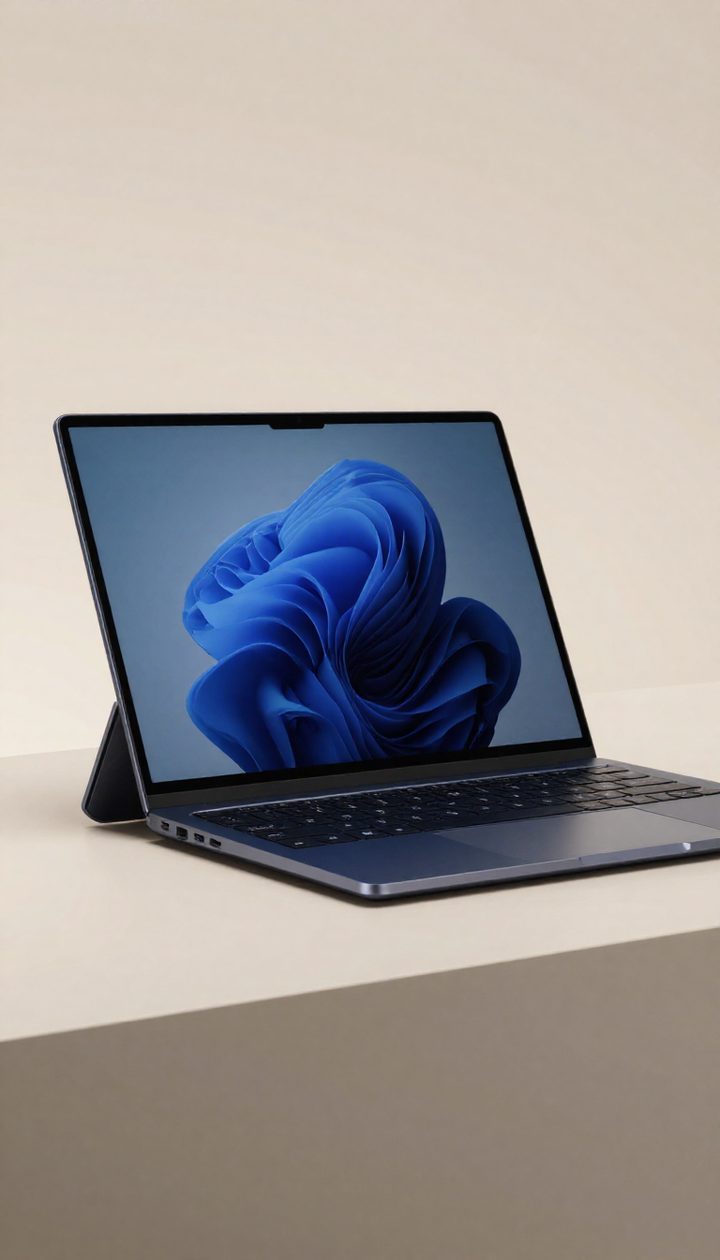
That said, the announcement matters because it puts Microsoft in the race to bring "local" artificial intelligence capabilities—inference run on the device itself, without relying on the cloud—to a 15-inch consumer/professional laptop. The Surface Laptop Ultra is billed as "the most powerful Surface laptop ever built," with a starting price of $2,599.99 and available now for pre-order; the source does not specify which markets the pre-order covers.
The centerpiece is the NVIDIA RTX Spark superchip, which combines in a single package NVIDIA AI blocks, RTX graphics based on the Blackwell architecture, an NVIDIA Grace CPU with up to 20 cores and up to 128 GB of unified memory shared between CPU and GPU. This unified memory architecture—conceptually similar to the one Apple popularized with its M-series chips—allows large AI models to fit in memory without relying on a separate discrete graphics card, which explains why Microsoft presents it as a machine capable of "building, creating and analyzing" locally: prototyping AI agents, reviewing code and testing large models while development tools keep running, thanks to NVIDIA CUDA acceleration. It is worth noting that the 128 GB figure is the system total and that the maximum amount addressable by the GPU depends on configuration and workload, and is always lower than the total, according to the manufacturer's own fine print.
On design, Microsoft highlights a thermal system it considers the largest ever fitted to a Surface, with bigger fans that move more air at lower speed, delivering up to 2.5 times the thermal capacity of the 8th Edition 15-inch Surface Laptop, with less fan noise. Despite that expanded cooling system, the machine weighs less than 4.5 pounds (about 2 kg) and measures under 18 mm thick. It will come in Platinum and a new shade called "Nightfall." Among the physical novelties is what the company describes as the world's first magnetic USB-C charging port, combining the convenience of a magnetic connector with the versatility of a standard USB-C port, along with a precision haptic touchpad described as the largest ever included in a Surface. Connectivity includes three USB-C ports, one USB-A, HDMI, an SD card reader and a headphone jack, intended to reduce reliance on adapters.
The display is another focus of the launch: Microsoft calls it the brightest it has ever made, with 2,000 nits of peak HDR brightness (measured on a 10% window with HDR content, compared with commercially available laptops as of October 2026), a 15-inch touchscreen, Dolby Vision IQ support, 100% DCI-P3 color gamut coverage and a 120 Hz refresh rate, aimed both at precision creative work (color, contrast and detail editing) and at RTX-accelerated gaming with ray tracing, NVIDIA DLSS and NVIDIA Reflex for lower latency.
On security, the machine is billed as a Secured-core PC, with combined hardware, firmware and system protections, sign-in via Windows Hello (facial recognition, fingerprint or PIN) and device encryption to protect source code, customer data and sensitive work in case of loss or theft—an approach explicitly aimed at organizations handling proprietary code, AI models and intellectual property.
Microsoft also stresses longevity: it points to published repair guides, available replacement parts and expandable SSD storage, with configurations of up to 2 TB, positioning the machine for "ambitious projects" and long-term ownership, while clarifying that component availability and service options vary by market and over time, and that repairs must follow its official guide.
Commercially, there is a trade-in promotion running from October 7 to November 23, 2026, available only through the Microsoft Store online in the U.S. and Canada, offering up to $1,000 in additional cash back for handing over a used device in working condition, subject to third-party assessment (Teladvance) and numerous conditions (the device must power on, hold a charge, have no cracked screen or liquid damage, and so on). The accompanying slogan, "break up with your MacBook," makes clear Microsoft's intent to position this machine as a direct alternative to Apple laptops with their own unified memory chips, a field where Apple has dominated the performance-per-watt narrative in recent years.
The Surface Laptop Ultra is also part of a broader family that Microsoft confirms on the same page: alongside the familiar Surface Pro and Surface Laptop, there is a new "Surface RTX Spark Dev Box," described only as a machine "built for frontier developers" and likewise available for pre-order, suggesting Microsoft is not limiting the RTX Spark superchip to a single laptop form factor but extending it to a dedicated development workstation—a strategy reminiscent of NVIDIA's own desktop AI computers based on the same Grace Blackwell superchip family, though the document does not detail how the two products differ.
Taken together, the launch confirms a trend that has been taking hold across the sector: PC makers are starting to sell unified memory and local AI acceleration as the main selling point, ahead of raw clock speed or core counts, targeting developers and creative professionals who want to run large language models or AI workloads without permanently relying on cloud services. Independent reviews and real-world performance testing—outside Microsoft's promotional material—will be needed to judge whether the battery life, brightness and AI capability figures hold up in everyday use.
📚 Go deeper

The best starting book if you're not technical: a Wharton professor explains how to work WITH AI — when to delegate, when to supervise, when to keep i

The reference manual for building products on top of AI models: prompts, RAG, fine-tuning, agents, evaluation and deployment.
As an Amazon Associate, Zendoric earns from qualifying purchases; the price does not change for you. · all our recommended books →
🔗 Related on Zendoric
- Microsoft unveils the Surface Laptop Ultra, with an NVIDIA RTX Spark superchip for local AI and graphics · 2026-10-09
- CAKIE: record your screen with voice so your AI understands what you're asking (Mac beta) · 2026-10-14
- Gartner webinar: what CIOs need to know about AI agents (registration, not an article) · 2026-07-06