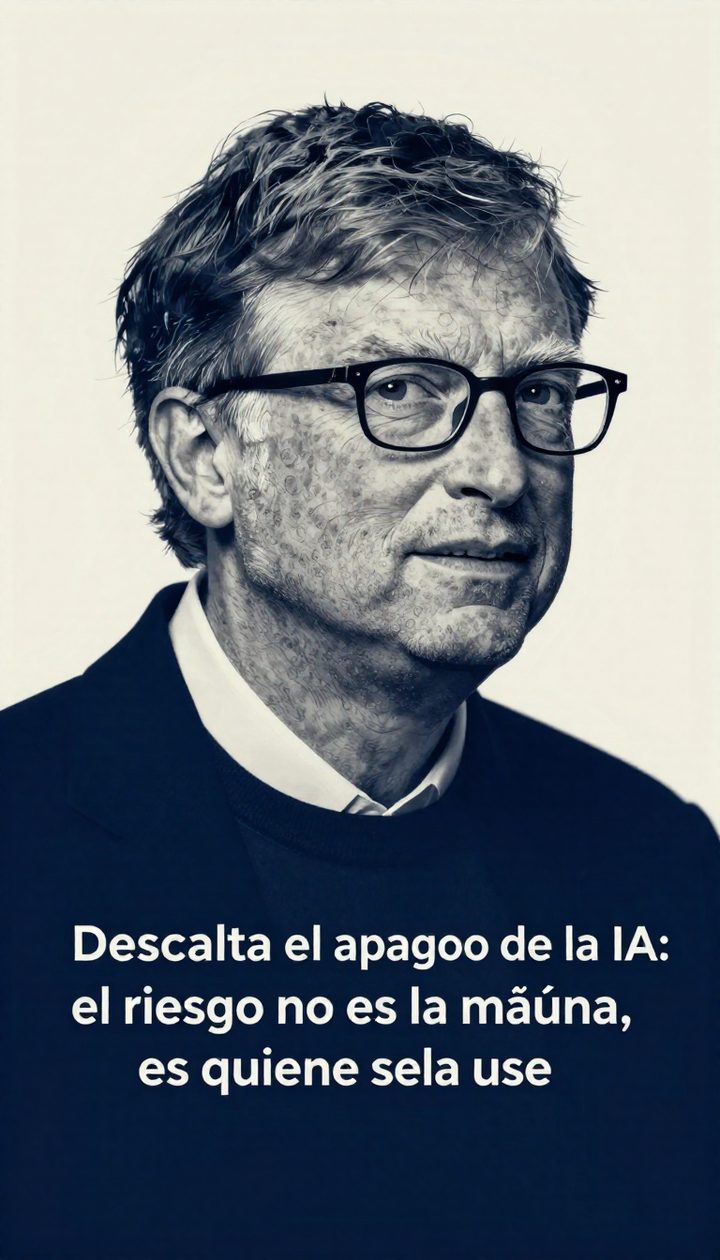
Gates dismisses the AI off switch: the risk isn't the machine, it's who uses it
🕒 Published on Zendoric: October 6, 2026 · 07:39
✨ AI-generated · how it's made
Bill Gates rejects the 'kill switch' as a safety guarantee for AI and calls for external oversight by politicians, police and regulators. His argument, in an interview with NBC: the immediate danger is not a machine running loose, but the malicious use of increasingly powerful tools.
📚 Go deeper

The definitive piece of investigative journalism on OpenAI: 260+ interviews, the clash between safety and speed, and the attempted firing of Sam Altma
As an Amazon Associate, Zendoric earns from qualifying purchases; the price does not change for you. · all our recommended books →
By El Destape · October 5, 2026.
Bill Gates spoke again about the risks of artificial intelligence, this time in an interview with Kristen Welker for NBC, and he did so by dismissing one of the most repeated solutions in the public debate: the "off switch", a technical mechanism to shut down an AI system if it gets out of control. According to the Microsoft co-founder, that idea is not enough because it starts from a mistaken diagnosis of the problem. Today's systems, he said, have not yet reached the point of taking control of computers autonomously and unstoppably; the real risk, he argues, is a different one: people with malicious intent using increasingly capable AI tools for cyberattacks, mass disinformation or military-purpose development.
Gates's concrete proposal is external oversight: having politicians, law enforcement and regulators take part in designing the safeguards, with more audits, transparency and restrictions on certain developments. He frames it as a complement, not a brake: he acknowledges these measures will add costs to the industry, but insists they should not halt technological development. It is a relevant distinction coming from someone who, according to the article itself, maintains a positive view of AI's potential —though he qualifies that there are areas, such as his personal relationships, where he prefers not to use it.
The shift in focus matters. Much of the public debate on AI safety has been built around the image of a system breaking free from its creators, the science-fiction narrative of the switch that no longer works. Gates, with all the weight of having been inside the industry for decades, points to a far more prosaic and already verifiable risk: the model does not need to rebel, it is enough for a person with bad intentions to have access to a capable tool. That turns the problem into one of governance and access control, not model safety engineering.
That is also the reading we have long defended at Zendoric: AI regulation makes sense when it targets real capability and how it is deployed —who can use what, under what supervision—, not when it settles for reassuring people with symbolic gestures in the face of a poorly defined fear. An off switch is one such gesture: it gives a sense of control without touching the underlying problem, which is institutional. Audits, traceability and access restrictions on the most sensitive capabilities —cyberoffensive, mass disinformation generation, dual military use— do act on the risk vector Gates describes.
That this proposal comes from one of the most influential figures in the tech industry, and not only from regulators or academics, is significant: it reinforces the idea that external oversight is ceasing to be seen as a threat to innovation and beginning to be understood as a condition for innovation to move forward without aggravating its own risks. In the short term, that friction —compliance costs, new bodies, audits— is real and must be accepted honestly. But governing access to the most dangerous capabilities well today is precisely what allows us to keep building, without panicked slamming of the brakes, toward the long-term horizon in which AI multiplies health and abundance instead of multiplying the harm a few can inflict on many.
📚 Go deeper

DeepMind co-founder on the dilemma of containing technologies that do not want to be contained.

AI as the latest chapter in the history of information networks, from gossip to the printing press to the algorithm.
As an Amazon Associate, Zendoric earns from qualifying purchases; the price does not change for you. · all our recommended books →
🔗 Related on Zendoric
- OpenAI's automatic kill switch did not fire: the pause worked, the brake took 2.5 hours · 2026-09-29
- The 'Caged' Flagship: Backlash to Claude Fable 5 Exposes the Safety-vs-Utility Tightrope · 2026-07-03
- Connor Leahy calls for banning superintelligence: "it's not a weapon, it's an adversary" · 2026-09-15