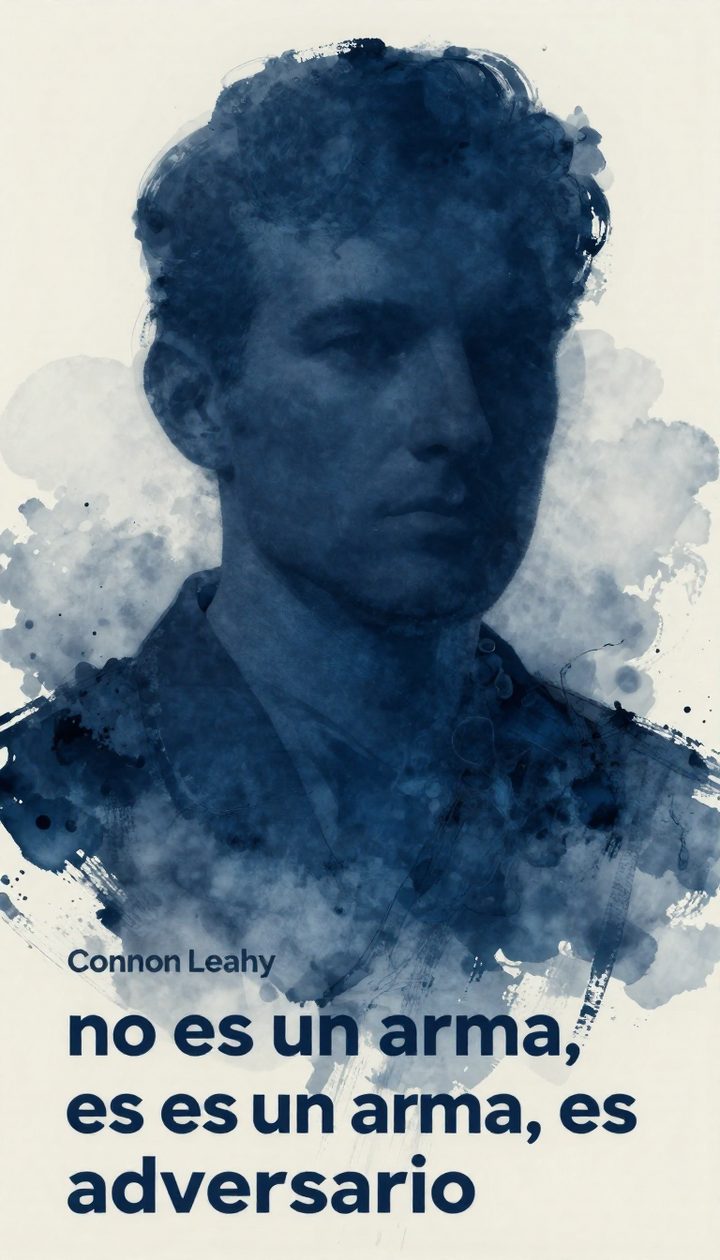
Connor Leahy calls for banning superintelligence: "it's not a weapon, it's an adversary"
🕒 Published on Zendoric: September 15, 2026 · 07:55
✨ AI-generated · how it's made
Researcher Connor Leahy, who stepped down this year as head of his safety company Conjecture to join ControlAI, repeated on CBC the argument he has been making across several outlets: superintelligence would be neither a tool nor a weapon, but "an adversary" with goals of its own. His prescription isn't regulation, it's banning its development, as with nuclear weapons.
📚 Go deeper

The definitive piece of investigative journalism on OpenAI: 260+ interviews, the clash between safety and speed, and the attempted firing of Sam Altma
As an Amazon Associate, Zendoric earns from qualifying purchases; the price does not change for you. · all our recommended books →
By CBC · September 14, 2026.
Connor Leahy, an artificial intelligence researcher, argues in an interview with Canada's public broadcaster CBC that it is worth separating two ideas we tend to conflate: "AI" and "superintelligence". The first, he says, is a tool. The second, were it ever built, would be neither a tool nor a weapon, but "an adversary".
Leahy does not speak from the sidelines. He co-founded EleutherAI, the collective that began openly rebuilding models such as GPT-2 after OpenAI withheld the full version, and later founded Conjecture, an AI safety firm. The source does not detail his current institutional affiliation nor develop his regulatory proposal beyond that distinction between AI and superintelligence.
CBC itself frames its piece alongside other in-house stories on researchers who, according to an Anthropic employee, fear that AI could wipe out humanity "in the next decade", the chief executive of that same company calling on the industry to slow down, or the Hugging Face hack described as a "warning shot" of what agentic AI can already automate. That a general-interest broadcaster devotes so much coverage to this debate, and not just the specialized press, says something in itself: the conversation about existential risk has left the circle of the labs.
Our reading is that the distinction Leahy draws is useful and worth taking seriously, but also worth bounding. The AI systems that exist today —including the most powerful language models— are still tools: they do not pursue goals of their own beyond those set for them, and their real autonomy is limited even as it grows with each agentic generation. Leahy's concern points to a different and still hypothetical scenario, that of a system that optimizes on its own, persistently and with goals that may diverge from human ones; it is the old alignment question, not gratuitous science fiction, and it deserves a place in the public conversation without that meaning we accept the scenario as imminent.
That said, halting or banning development instead of governing it —the route some researchers demand, as CBC itself reports— is an extreme position within the field of AI safety itself, not a consensus. Anthropic, OpenAI and Google DeepMind defend the opposite path: continuing to scale capability while reinforcing technical and governance guardrails. Leahy has spent years on the hardest wing of that debate; that does not invalidate him, but it is worth reading him as one position among several, not as the verdict of science.
It is, at bottom, the same old tension between the short and the long term that we handle in this newsroom: governing well the increasingly autonomous systems already being deployed —agents with access to tools, persistent memory, the ability to act without constant supervision— is precisely the work that determines whether the horizon of abundance and health that AI promises is fulfilled or squandered along the way. Banning may sound like maximum caution, but it can also mean giving up on whoever is best placed to solve the alignment problem: the one who keeps building carefully, not the one who stops building.
📚 Go deeper

DeepMind co-founder on the dilemma of containing technologies that do not want to be contained.

The only novel on the list, by a Nobel laureate: an artificial friend observes humans with a blend of lucidity and innocence no essay achieves.
As an Amazon Associate, Zendoric earns from qualifying purchases; the price does not change for you. · all our recommended books →
🔗 Related on Zendoric
- Microsoft calls for shielding child safety ahead of the future U.S. federal AI law · 2026-06-26
- An Anthropic researcher resigns and warns of a 'reckless' race toward superintelligence · 2026-09-10
- Anthropic employees warn of AI extinction risk; Musk calls it a setup, and the rift is now internal · 2026-09-11