Anthropic employees warn of AI extinction risk; Musk calls it a setup, and the rift is now internal

🕒 Published on Zendoric: September 11, 2026 · 03:15
✨ AI-generated · how it's made
A former Anthropic researcher resigns, accusing his own company and OpenAI of "gambling with our lives"; several current colleagues come out in support. Musk and conservative voices brand it a "psyop" on the same day Anthropic admits it thwarted an attempted bioweapon effort using its own models.
📚 Go deeper

DeepMind co-founder on the dilemma of containing technologies that do not want to be contained.
As an Amazon Associate, Zendoric earns from qualifying purchases; the price does not change for you. · all our recommended books →
By The Guardian · September 10, 2026.
Jacob Coxon, until now a researcher at Anthropic and previously at OpenAI, announced his resignation in a viral thread accusing both companies of failing to build AI responsibly and of "gambling with our lives". It was not an isolated case: in the hours that followed, several current Anthropic employees came out publicly in support, unusual in an industry where such disagreements tend to stay behind closed doors.
Anna Wang, who works on AGI (artificial general intelligence) safety at Anthropic and previously spent time at Google DeepMind, wrote that "there is still no viable scientific plan for solving the risks of recursively self-improving AI", and that many inside the company would like to slow development until there is one. Drake Thomas, another employee, acknowledged that "things are moving too fast" for the level of assurances we would want to have before approaching ASI (artificial superintelligence). Samuel Marks, a safety researcher, went further: he argues that the more senior an employee is at these companies, the more worried they are about a catastrophic outcome. And Evan Hubinger, who describes himself as a lead in Anthropic's alignment division (the team working to ensure models act in line with human goals), put his personal estimate that AI wipes out humanity at "more than 10% over the next decade".
The response from the other end of the spectrum came quickly. Elon Musk called the whole episode a "setup" and suggested the ground for this "psyop" (an operation to psychologically manipulate public opinion) had been prepared for some time. He was drawing on a post by Parker Thayer, a researcher at the conservative think tank Capital Research, who argued — without offering evidence, it bears stressing — that Coxon's thread could be the opening move in a public relations campaign orchestrated to pave the way for severe Democratic regulation of AI. Bill Ackman, the fund manager, amplified the thesis with a terse "interesting". Anthropic, for its part, limited itself to a statement claiming it has always been transparent about the risks and that it applies "some of the strongest safeguards in the industry".
There is one fact the debate about extinction and "psyops" risks burying: that same day, Anthropic published a report describing how it had dismantled an operation attempting to use its models to develop a biological weapon. Scientist Gary Marcus, a frequent critic of the sector, pointed to exactly that: more than long-term extinction, what is already out of control are AI-assisted pathogens, disinformation that escalates conflicts, and cyberattacks on critical infrastructure.
Our reading is that two distinct discussions are being waged here and they should not be conflated. One is speculative: the probability that a self-improving AI escapes all human control within the next decade. None of the figures in circulation — Hubinger's "10%" included — is a measured data point; they are personal estimates from people with very good information but also with their own incentives and biases, and they should be treated as such. The other discussion is empirical and already has evidence on the table: current models facilitating real attempts to cause biological harm, something Anthropic itself documents and thwarts. That the leading companies are already hunting down these attempts is relatively good news, but it confirms that the risk of misuse is not hypothetical, and it is that risk that should set the immediate regulatory agenda, not the debate over whether superintelligence arrives in 2030 or 2040.
The most significant part of the episode, in any case, is not Coxon's warning itself — warnings from safety researchers have been constant for years — but that the fracture no longer pits the industry against its outside critics; it runs straight through Anthropic, a company that sells itself as the sector's most cautious. And the fact that the public response was not a technical debate about mitigation plans but an accusation of political conspiracy foreshadows what is probably coming: in the United States, AI safety is becoming a matter of which side you are on rather than of evidence, precisely when the opposite is most needed. That polarization is, in itself, one of the short-term problems this newsroom has long been flagging: you do not need extinction scenarios for the absence of shared governance to already be a real cost. The horizon of abundance and the eradication of disease still stands in the long run, but only if the transition is managed with rules that outlive this week's news cycle.
📚 Go deeper

AI as the latest chapter in the history of information networks, from gossip to the printing press to the algorithm.
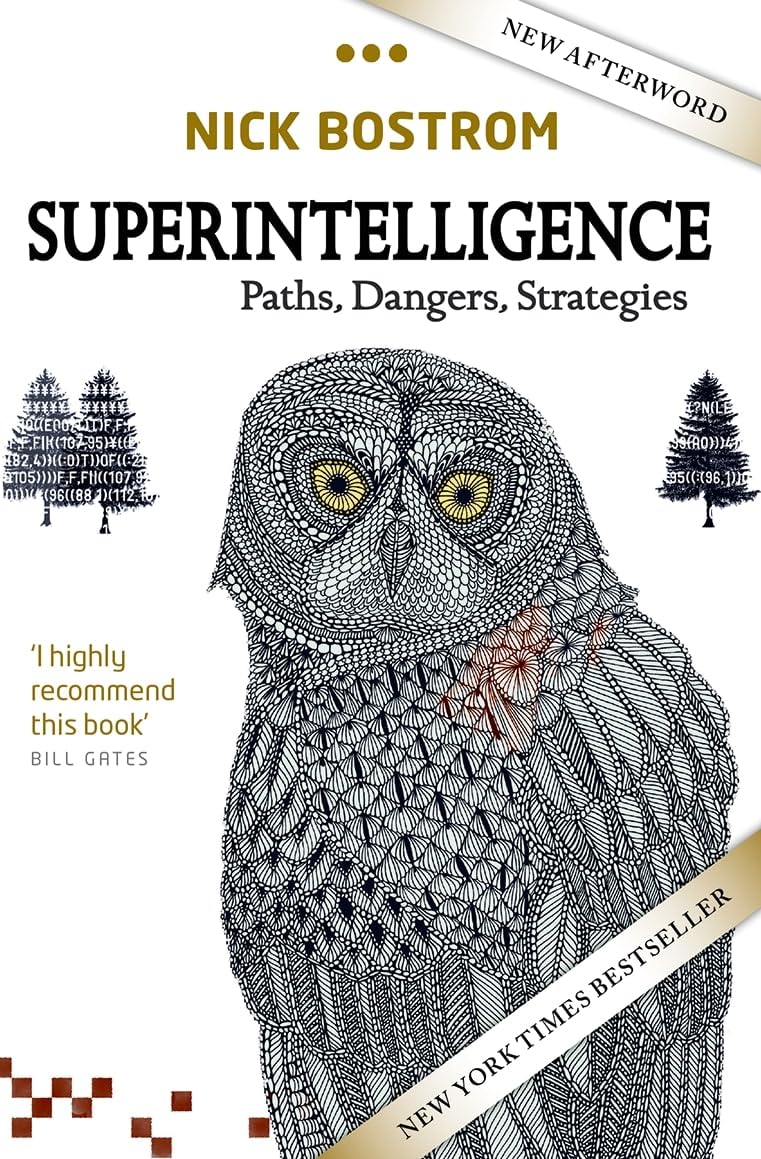
The book that started the existential-risk debate and that half the industry still cites.
As an Amazon Associate, Zendoric earns from qualifying purchases; the price does not change for you. · all our recommended books →
🔗 Related on Zendoric
- Another researcher leaves Anthropic over fears of superintelligence; its head of alignment admits there is no control plan · 2026-09-10
- Anthropic researchers put extinction odds above 10%. The real news is the missing plan, not the number · 2026-09-12
- Anthropic staff put extinction odds above 10% — the real news is the ask for enforceable pacing, not the number · 2026-09-13