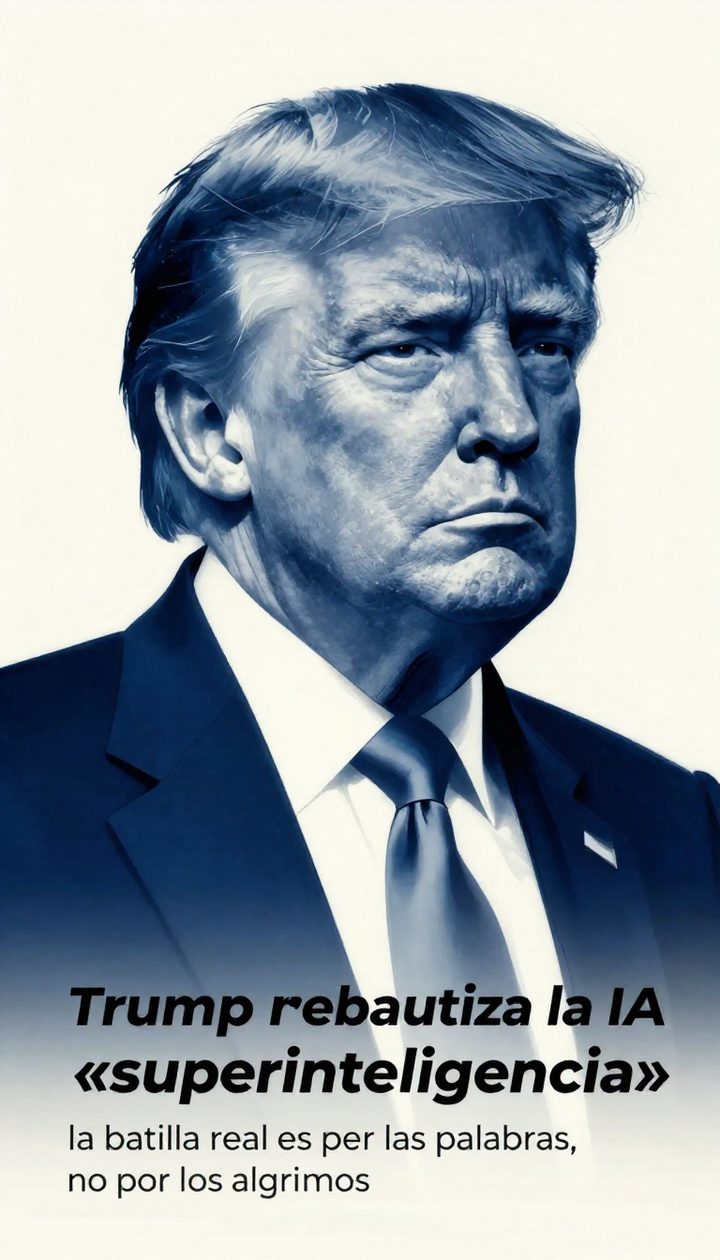
Trump rebrands AI as «superintelligence»: the real battle is over words, not algorithms
🕒 Published on Zendoric: October 5, 2026 · 00:06
✨ AI-generated · how it's made
The White House orders AI to be called «superintelligence» (SI) in government business, while a viral sketch mocks Dario Amodei, Bernie Sanders talks with Chinese scientists and Bill Gates defends regulation to Ezra Klein. The real dispute is about narrative, not labs.
📚 Go deeper

DeepMind co-founder on the dilemma of containing technologies that do not want to be contained.
As an Amazon Associate, Zendoric earns from qualifying purchases; the price does not change for you. · all our recommended books →
By Diari ARA · October 4, 2026. The White House has ordered that, in the official language of the United States government, artificial intelligence be renamed "superintelligence," with the acronym SI replacing AI, as reported by Diari ARA. Donald Trump's order comes at a moment of growing public distrust toward the industry and just as its protagonists are overlapping preparations for a stock market listing with fears of an AI bubble.
The move coincides with the viral spread of a sketch by actress Jane Wickline mimicking the doom-laden tone of Dario Amodei, chief executive of Anthropic, and with Sam Altman and Amodei becoming targets of public mockery, as the column describes. The contrast is telling: if AI can destroy jobs or, at worst, pose an existential risk, what is the benefit that justifies taking that risk?
The change of terminology is not neutral. The calendar provides context: the debate over AI regulation and its future will be central to the 2028 US elections, the columnist notes. Rebranding the technology as "superintelligence" in the government's own mouth shifts the register: from an everyday tool that threatens paychecks to an almost inevitable destiny better embraced than resisted.
The political contrast is real. While Trump imposes a word, independent senator Bernie Sanders organized a debate this spring on Capitol Hill with Chinese scientists on the existential risk of AI and the need for international agreements, the opinion piece notes. They are two opposite ways of reacting to the same public unease: one dresses up the language; the other seeks shared governance with the only country capable of rivaling the United States in this race.
Between those two extremes sits Bill Gates, who this very week gave an interview to Ezra Klein for The New York Times in which he defended the need to regulate AI, arguing that every previous technological revolution has required it. Klein, according to the column, did not make it easy for him: his critical tone reflected public distrust of the industry, at a time when the historical relationship between Microsoft and OpenAI leaves Gates in an awkward position to set himself up as a neutral arbiter. Asked which jobs will survive superintelligence, Gates replied that we may end up creating "human reserves," analogous to nature reserves, where teachers and human trades could be kept if we decide to preserve them.
Against this axis —techno-optimists calling for calm, politicians calling for agreements, founders calling for time— Timnit Gebru and Emily M. Bender published a column in The Guardian a few days ago with a different argument: as the authors contend, the danger lies not in some hypothetical absolute power of language models, but in their inevitable tendency to err. Gebru and Bender go so far as to claim that AI came close to triggering an international armed conflict, an accusation we attribute entirely to their column and that we have not been able to verify independently.
Our reading. What this episode describes is not a technical debate about capabilities: it is a war of narratives over who defines what AI is and which risks are worth running. And in that war, language is the first weapon. Calling a system that still makes basic reliability errors "superintelligence" is as imprecise as calling a model that already automates entire company functions a "simple tool." Neither term honestly describes the technology; both describe a political position.
There is also an underlying contradiction within the "superintelligent" camp itself: the same industry that needs to sell a narrative of almost unlimited power in order to justify valuations in the hundreds of billions of dollars is the one with the least interest in seeing that narrative translate into real regulatory obligations. Rebranding the technology serves both goals at once: it feeds the myth that sustains the investment while, at the same time, the government that coins the word signals it has no intention of slowing it down.
It is worth taking seriously, though, Gebru and Bender's argument stripped of its flashiest headline: the immediate risk of today's AI is not runaway superintelligence, it is reliability. A system that hallucinates, that fails in critical contexts or that makes automated decisions without sufficient oversight is a far more urgent —and far less cinematic— governance problem than the science fiction scenario that both the White House and the labs themselves use to sell their story, each for opposite reasons.
And as for Gates's answer —those "human reserves" to preserve teachers and trades "if we decide" to do so— there is a fundamental objection to be made. It is a metaphor of containment, not of abundance: it imagines protected enclosures where the human survives, surrounded by an automated world that no longer needs it. If the promise of AI is, as we argue at Zendoric, a society of abundance in which people work at what they are passionate about because they can, not because they are allowed to within a fenced-off space, then the "human reserve" is not good news: it is an admission that not even its architects are clear on how to share out that abundance.
In the short term, this dispute over vocabulary resolves nothing that really matters: not the loss of administrative jobs already documented in other sectors, not the real reliability of deployed systems, not who pays for the transition. In the long term, we continue to believe this technology can bring us closer to eradicating disease and generating shared prosperity, but that trajectory does not depend on what a government calls it: it depends on the rules of accountability, transparency and distribution negotiated while the battle over the name takes the headlines. Watch the rules, not the words.
📚 Go deeper

The best starting book if you're not technical: a Wharton professor explains how to work WITH AI — when to delegate, when to supervise, when to keep i

The definitive piece of investigative journalism on OpenAI: 260+ interviews, the clash between safety and speed, and the attempted firing of Sam Altma
As an Amazon Associate, Zendoric earns from qualifying purchases; the price does not change for you. · all our recommended books →
🔗 Related on Zendoric
- Casar and Sanders want to ban superintelligence in the US; the White House is already saying no · 2026-09-25
- Trump puts his intelligence chief in charge of AI and bets on self-regulation by the labs · 2026-10-05
- Amodei sits down to dinner with Trump while Anthropic litigates against the Pentagon over military use of its AI · 2026-09-28
Sources & references
- Diari ARA — Trump rebrands AI as «superintelligence»: the real battle is over words, not algorithms
- Voz en Red — Trump creates a 'Superintelligence Force' at the White House: AI is now a national security matter
- Tema ES · superinteligencia — Trump creates a 'Superintelligence Force' at the White House and puts his chief of staff in charge of watching it