Musk calls for replacing 'AI' with 'superintelligence': a rebrand that doesn't touch a single model parameter

🕒 Published on Zendoric: October 5, 2026 · 00:06
✨ AI-generated · how it's made
Elon Musk urged on X that people stop saying "AI" and call it "superintelligence", backing an idea Trump floated at the UN and which, as announced this week, would be formalized through an executive order renaming the technology that way in U.S. Government documents. The change is one of vocabulary, not capability.
📚 Go deeper

DeepMind co-founder on the dilemma of containing technologies that do not want to be contained.
As an Amazon Associate, Zendoric earns from qualifying purchases; the price does not change for you. · all our recommended books →
By Zendoric · October 5, 2026.
Elon Musk wants to erase two letters from the tech vocabulary. "No more AI. SI. It's better that way," he wrote on X this weekend, calling for "artificial intelligence" to be replaced by "superintelligence" in everyday language. The idea is not his own: he is backing a proposal that U.S. President Donald Trump floated in September before the 81st UN General Assembly and that this week appears to have gone a step further. According to the Venezuelan outlet Globovision, citing RT en Español, Trump announced that he will sign an executive order requiring all U.S. government documents to use "superintelligence" instead of "artificial intelligence".
The term was not chosen at random. "Superintelligence" is the concept that philosopher Nick Bostrom popularized more than a decade ago to describe a system that surpasses human intelligence across practically every domain at once —scientific reasoning, creativity, social skill— and not merely on specific tasks. It is a threshold that, by consensus even among the leading labs themselves (OpenAI, Anthropic, Google DeepMind), no system has yet crossed. However powerful the 2026 models may be at coding or on specific benchmarks, they remain specialized, fallible tools, not agents with a general intelligence superior to our own.
Why rename, then, something whose nature has not changed? The explanation has less to do with science than with political and commercial narrative. Trump framed the idea at the UN as a matter of U.S. global leadership in the sector: "We will only encourage superintelligence. We are going to encourage it, not hold it back," he said, according to the same source. For Musk, CEO of xAI —one of the companies competing for capital, talent and headlines in that same race— adopting the more ambitious vocabulary carries an added benefit: it places his company and his country in the lexical territory of the next big thing, rather than that of a technology that is already familiar and, for much of the public, already under suspicion.
Here it is worth applying the same standard we use to analyze any benchmark or product announcement at Zendoric: separating demonstrated capability from narrative. Changing a label in official documents does not move a single parameter in any model, does not cure any disease and does not generate a single extra hour of the abundance that AI promises over the long term. What it does do is load a term with urgency and expectation when, used precisely, it should be reserved for a leap that has not yet happened. It is the same rhetorical inflation we see in leaderboards "optimized for voters" or in generous benchmarks: when the narrative runs too far ahead of the measurement, the disillusionment that follows also splashes onto the real, verifiable advances.
There is also a governance reading that matters more than the semantics itself. Framing the technology as something to be "encouraged, never held back" is, in effect, an argument against regulation, formulated before the system that would supposedly justify it even exists. If specific safety rules are needed in the future for systems genuinely superior to human intelligence, calling today's chatbots and copilots "superintelligence" now does not help to design them: it dilutes the term at precisely the moment when it would demand the most precision.
The underlying paradox is that the horizon that really interests us —systems capable of accelerating cures for diseases or freeing people from jobs they did not choose— depends on that leap arriving and being recognized when it happens, not on being declared by decree. Renaming today's AI as superintelligence does not bring that future a single day closer: it only makes it harder to know, when it finally does arrive, that it has.
📚 Go deeper

AI as the latest chapter in the history of information networks, from gossip to the printing press to the algorithm.
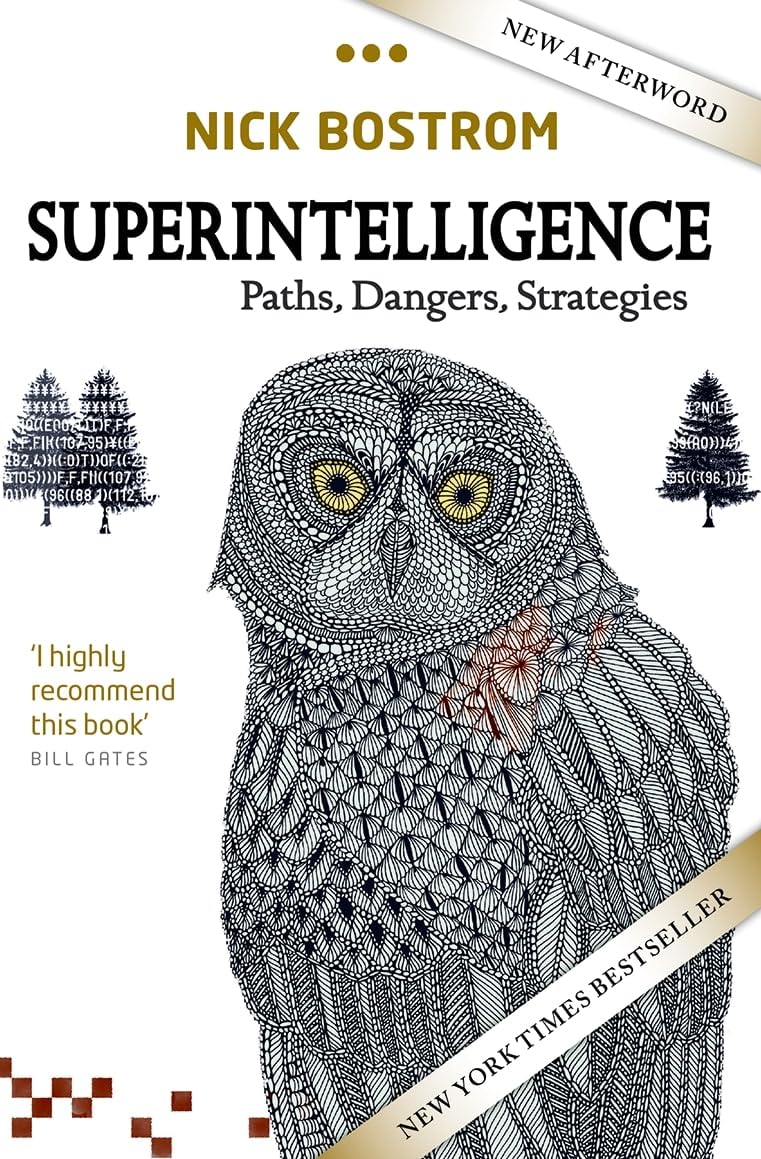
The book that started the existential-risk debate and that half the industry still cites.
As an Amazon Associate, Zendoric earns from qualifying purchases; the price does not change for you. · all our recommended books →
🔗 Related on Zendoric