Transporter-18 puts the key parts of future orbital data centers to the test
🕒 Published on Zendoric: October 3, 2026 · 02:03
✨ AI-generated · how it's made
The launch of Transporter-18, SpaceX's rideshare mission that lifted off Thursday from Vandenberg, had an unusual thread for this kind of flight: three different payloads designed to test, each on its own, one piece of the puzzle needed to build data centers…
📚 Go deeper

The story of NVIDIA and Jensen Huang: how a video-game card company ended up making the most coveted resource on the planet.
As an Amazon Associate, Zendoric earns from qualifying purchases; the price does not change for you. · all our recommended books →
The launch of Transporter-18, SpaceX's rideshare mission that lifted off Thursday from Vandenberg, had an unusual through-line for this kind of flight: three separate payloads designed to test, each on its own, one piece of the puzzle needed to build orbital data centers (ODCs). The underlying message, according to one of the executives at the companies involved, is that the sector has already moved past the question of whether there will be artificial intelligence computing in space, to focus on how to build the infrastructure that makes it possible.
The first piece comes from Reason-1, by Cowboy Space, which will attempt to beam solar power down to Earth using an infrared laser, as a trial of the optical links its future orbital data centers will need. Cowboy Space began as Aetherflux, a startup focused on power transmission, before changing its name in May to pivot toward orbital data centers and rockets; Reason-1 is the bridge between the two business lines. The company expects to make its first transmission attempt as soon as late October, beaming solar power to a 10-to-20-meter spot at a ground test facility, with the goal of delivering between 30 and 100 watts. Cowboy Space presents it as the first commercial kilowatt-class laser in space designed to deliver power to Earth. The same laser technology will serve as the basis for the data link on Reason-2, slated for the first half of 2027, which will carry H200 GPUs and this time transmit data rather than power. Longer term, Cowboy Space is developing its own rocket, whose upper stage would double as a 1-megawatt data center, with launch planned for December 2028.
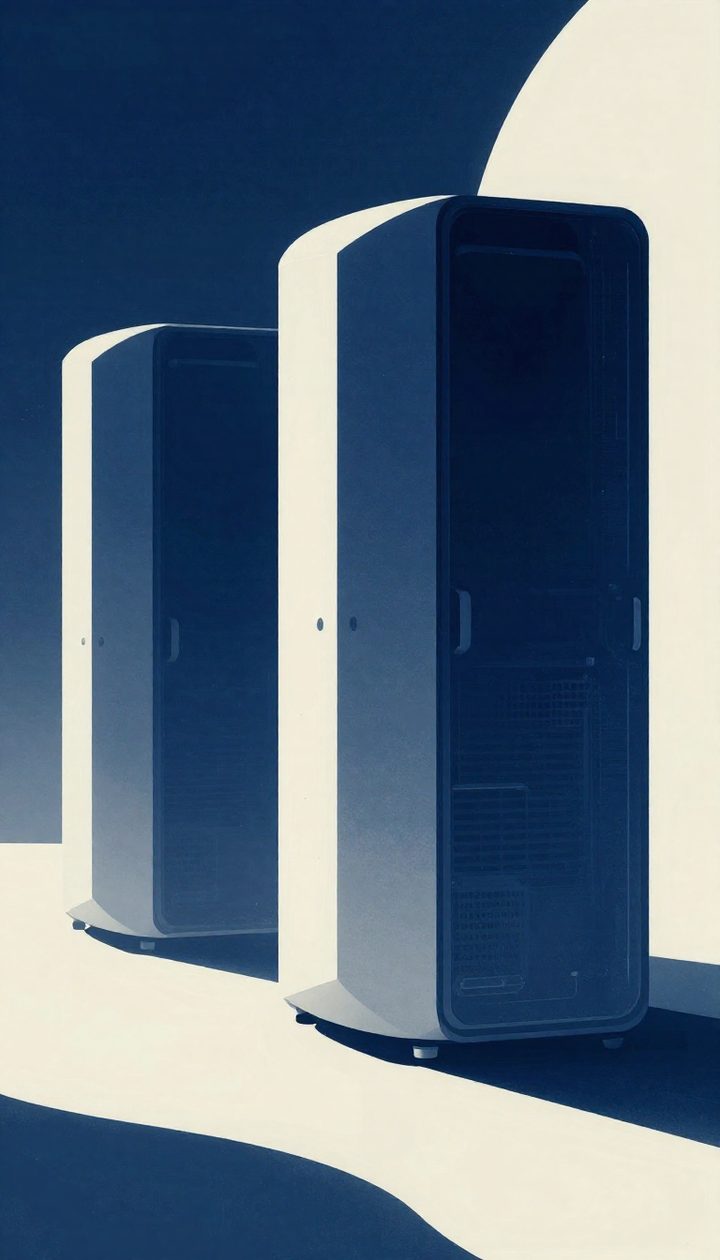
The second piece is Google's, with its Project Suncatcher, which in this case is not testing power transmission but how AI chips behave in orbit. The refrigerator-sized demonstration satellite, built with Planet Labs, carries four Trillium TPUs —roughly the computing capacity of one server— powered by around 1 kW of solar energy, running Gemini queries in short bursts. To coincide with the launch, Google published a peer-reviewed version of its Suncatcher study in the scientific journal Joule, outlining its long-term vision: constellations of satellites each able to host the computing capacity of a data center rack (between 50 and 100 kW), flying in very tight formations and connected by laser; one of the study's examples describes 81 satellites clustered within a one-kilometer radius.
The study itself acknowledges two major obstacles. First, radiation: in ground tests, the TPUs withstood a dose equivalent to five years in orbit, although occasional silent errors still occurred, roughly one per three million queries, a level Google considers manageable for answering questions but that could be problematic for model training. Second, heat: thermal management is described as a bigger challenge, and in fact the demonstration satellite's chips have to shut down every 15 or 20 minutes to avoid overheating, though Google says the two follow-up satellites planned for 2027 will run continuously.
The study also offers an economic projection: if launch costs fall to $200 per kilogram, Google calculates that putting a kilowatt of solar power in orbit would cost around $810 a year, a figure comparable to what data centers in the United States spend on electricity. By its learning-curve analysis, that price would be achievable by the mid-2030s, provided Starship ends up flying about 180 times a year, a condition that shows just how much plans of this kind still depend on the big reusable rockets meeting their timelines.
The third piece of the puzzle comes from Star Catcher with Protostar, its first end-to-end demonstration in space. The experiment will deploy a cubesat and beam measurable power to general-purpose commercial solar panels, with the aim of validating commercial spacecraft-to-spacecraft power transmission operations. Among the customers Star Catcher has already mentioned for this kind of service are other orbital computing companies.
Alongside these three hardware tests, another piece of news from the same day illustrates an alternative path to a similar goal: while several companies invest in solving the engineering challenges of physical ODCs, a startup based jointly in Nairobi and Sunnyvale has announced an $8 million seed round to expand its network of "virtual" orbital data centers, which the company says is already operational and growing, bringing its total funding above $10 million.
Taken together, these simultaneous tests —laser power transmission, AI chip resistance to radiation and heat, and spacecraft-to-spacecraft power transmission— suggest that the conversation around orbital data centers has moved from speculation to incremental technical validation. The coming weeks, with Cowboy Space's first laser transmission attempt and the in-orbit demonstrations from Google and Star Catcher, will provide the first real indication of how far off the leap from "whether" to "how" still is.
📚 Go deeper

The memoir of the creator of ImageNet, the scientist who made the deep learning revolution in vision possible.

Semiconductors as the oil of the 21st century: history, espionage, and why an island of 23 million people underpins the entire AI economy.
As an Amazon Associate, Zendoric earns from qualifying purchases; the price does not change for you. · all our recommended books →
🔗 Related on Zendoric
- SpaceX launches Google's first AI chips into space in the initial orbital test of Alphabet's Suncatcher project · 2026-10-03
- Meta assembles the entire AI stack: Spark, Compute and the two faces of Meta · 2026-07-17
- Anthropic's $40B compute deal with Musk: the safety lab now rents its future from a rival · 2026-07-31