70% of college students fear AI will sink their careers, but many are pointing at the wrong fear
🕒 Published on Zendoric: October 1, 2026 · 00:22
✨ AI-generated · how it's made
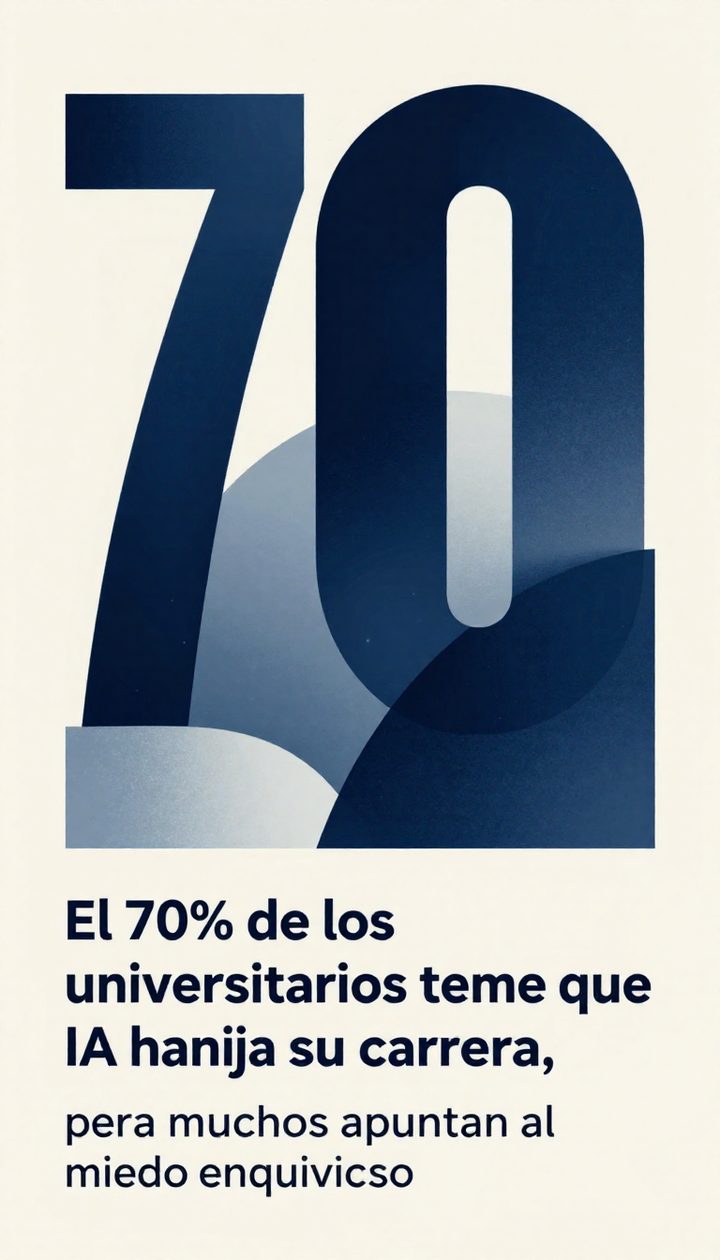
Seven in ten US college students fear AI will ruin their job prospects, and 16% have already changed majors because of it, according to a survey cited by WNEM. The figure is real, but the panic is aimed at the wrong sector: what AI replaces is the routine task, not the whole profession.
📚 Go deeper

The best starting book if you're not technical: a Wharton professor explains how to work WITH AI — when to delegate, when to supervise, when to keep i
As an Amazon Associate, Zendoric earns from qualifying purchases; the price does not change for you. · all our recommended books →
By Zendoric · October 1, 2026.
A survey reported by US broadcaster WNEM (Ivanhoe Newswire) puts at 70% the share of university students who fear artificial intelligence will harm their career prospects. The figure has concrete consequences: 42% of undergraduates say they have considered changing degree because of AI, and 16% have already done so, according to the same source. The report illustrates the shift with three simple comparisons: ten years ago you called customer service and today you talk to a chatbot; five years ago a graphic designer created your images and today AI generates them in seconds; two years ago a junior programmer wrote the basic code and today AI usually drafts the first version.
Not every field fits that story equally. Molly Kostenbauder, associate vice president of career and technical education at Seminole State College, points in the report to healthcare and the trades as the most resistant: "bedside care of a patient is something a machine cannot replace". The US Bureau of Labor Statistics (BLS, the federal agency that measures the labour market) projects 6% growth in nursing jobs through 2031, with physical therapy, occupational therapy and speech therapy also on the rise. Manual trades —plumbing, electrical work, HVAC— round out the list for an obvious reason: someone has to be physically present to run a cable or fix a burst pipe.
The report closes with a figure from the World Economic Forum that deserves to be read with caveats: according to that organization, AI could destroy 92 million jobs worldwide by 2030, but would generate 170 million new positions, for a net positive balance of 78 million. It is a projection, not an accomplished fact, and like any aggregate projection it conceals that destruction and creation do not happen to the same people or in the same places: someone who loses a customer service job does not automatically become an AI systems engineer.
This is where student panic deserves a finer reading. Changing degree out of fear of AI is usually an emotional answer to a badly framed question. AI is not wiping out entire professions; it is wiping out tasks within them. In our series on AI and employment by sector we have seen the same pattern again and again: in technology, those who design and govern the systems survive, not those who write repetitive code; in law, the base of the pyramid narrows but the value of expert judgement grows; in education, the teacher who orchestrates AI in the classroom comes out ahead of the one who merely transmits content. The common thread is not "AI destroys jobs", it is that AI devalues the routine and revalues judgement, human relationships and physical presence —exactly the traits Kostenbauder associates with healthcare and the trades.
Our reading is that the report's advice —don't choose a degree out of fear, choose one that builds skills AI does not replicate and then learn to use it as a tool— is sensible, but incomplete if it does not also say how hard it is to apply well at 18. Asking a student to identify which part of their future profession will be "irreplaceable judgement" a decade from now is asking for a bet that even the industry's own experts do not always get right. That is precisely the short-term cost that should not be papered over: an entire generation making far-reaching educational decisions with incomplete information, while the ground beneath their feet keeps shifting.
In the long run, however, the World Economic Forum's own figure points in the direction we have long defended: more jobs created than destroyed, not fewer. The transition will be uneven and painful for those who bet wrong, but the aggregate destination is not an empty labour market, but one reorganized around what a human being really contributes: caring, deciding with judgement, being present. If AI frees up computing capacity and time so that more people can devote themselves to healthcare, to caregiving and to a craft well done, abundance is not an empty promise: it is, literally, what is already starting to show up in the employment projections cited by this very report.
📚 Go deeper

How opaque algorithms decide who gets credit, a job or parole — and why they tend to punish the same people.

THE AI textbook: used by 1,500+ universities.
As an Amazon Associate, Zendoric earns from qualifying purchases; the price does not change for you. · all our recommended books →
🔗 Related on Zendoric
- Students are rethinking careers and majors as AI advances, according to a CNBC survey · 2026-09-03
- The AI agent doesn't fail because of the model, it fails because of the data: 57% of companies have already seen it · 2026-07-11
- 69% of the U.S. already wants to expropriate half of AI companies: layoffs have politicized abundance · 2026-07-13