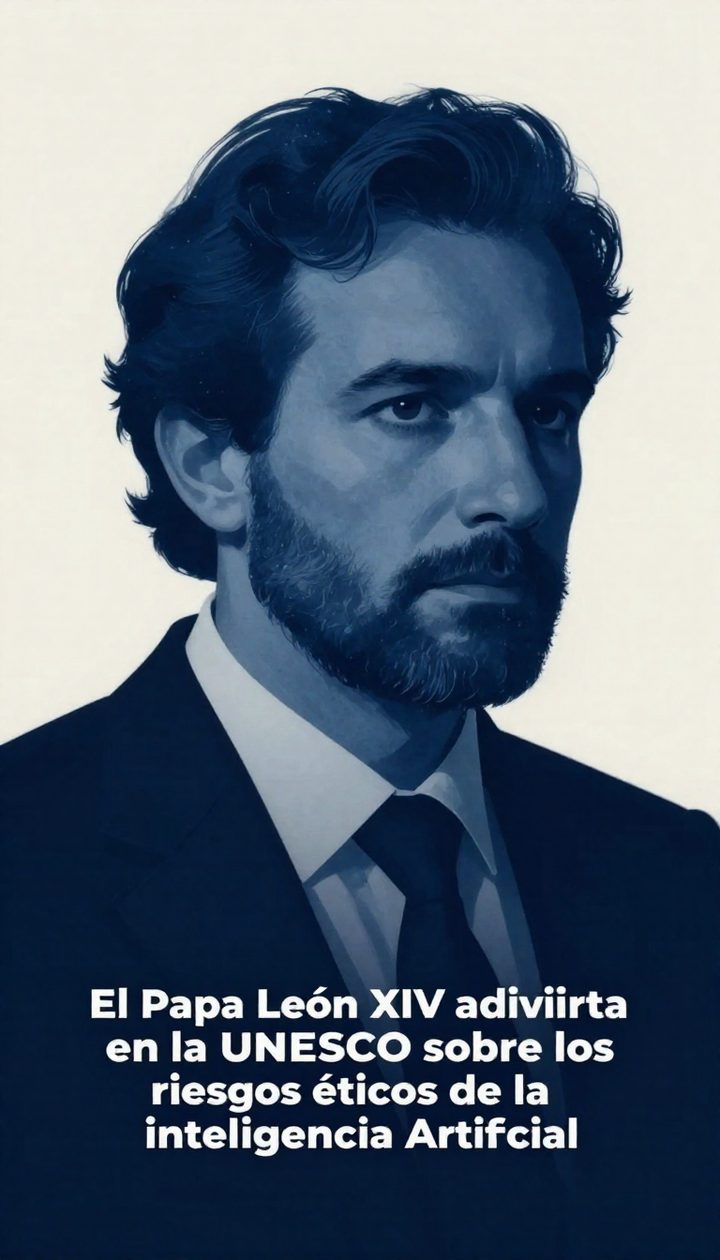
Pope Leo XIV warns at UNESCO about the ethical risks of artificial intelligence
🕒 Published on Zendoric: September 29, 2026 · 08:25
✨ AI-generated · how it's made
On the first day of his apostolic trip to France (September 25-28, 2026, which besides Paris includes Lourdes and Metz), Pope Leo XIV delivered a speech at UNESCO headquarters in Paris, 46 years after John Paul II became the first pontiff to address the organization, on…
📚 Go deeper

How opaque algorithms decide who gets credit, a job or parole — and why they tend to punish the same people.
As an Amazon Associate, Zendoric earns from qualifying purchases; the price does not change for you. · all our recommended books →
On the first day of his apostolic journey to France (25 to 28 September 2026, which besides Paris includes Lourdes and Metz), Pope Leo XIV delivered an address at UNESCO headquarters in Paris, 46 years after John Paul II became the first pontiff to speak before that body, on 2 June 1980. The Holy See has maintained a Permanent Observer Mission to UNESCO since 1952, a link that will mark its 75th anniversary next year, and which Leo XIV described as a "privileged partner" relationship in the service of the common good.
The core of the address was a question that, according to the Pope, every culture and every generation must face: "what does it mean to be human?". From there he argued that no education can be considered complete if it does not address the meaning of life, and that it cannot be reduced to the acquisition of skills or to material progress. He recalled that every human being is born vulnerable, dependent on others from birth —"we are born naked and needy", he said, dependent on "bread and words, on care and affection"— and warned that forgetting that shared experience risks turning human life into a commodity instead of recognizing it as a gift and a responsibility.
The passage most directly related to artificial intelligence pointed to a paradox of contemporary society: while increasingly sophisticated computational systems are credited with "intelligence", human beings themselves are increasingly judged by their efficiency and productivity. "While 'intelligence' is attributed to computational systems, we struggle to recognize the inalienable dignity of human persons", he said. According to the Pope, AI can process and correlate enormous amounts of information, but it cannot answer the questions about the meaning of human life, which are rooted in lived experience: "meaning is the oxygen of the mind", he said. Along the same lines, he praised UNESCO's Media and Information Literacy initiative, which promotes the responsible use of media and digital technologies, and called for special attention to children and young people: "in the digital age, their vulnerability must never become an opportunity for exploitation", urging that technology serve their education, their relationships and their freedom to think and discern.
The address also drew on UNESCO's founding Constitution of 1945 ("since wars begin in the minds of men, it is in the minds of men that the defences of peace must be constructed") to warn that scientific progress divorced from wisdom can become a weapon, that culture subjected to ideology can turn into propaganda, and that education detached from truth can become an instrument for manipulating consciences. Hence his central assertion: "peace cannot be built on treaties alone", but demands justice and an "upright will" capable of recognizing the other as "a brother or a sister, a person like oneself". To illustrate two opposing models of coexistence he turned to the biblical images of Babel —a unity imposed through domination— and Pentecost —a unity that does not erase diversity but allows it to flourish "in the harmony of voices and faces".
On the age of instant communication, the Pope observed that the ability to communicate instantly between continents has not necessarily made communication more truthful: "information is abundant, but it is not synonymous with wisdom", he warned, noting that without a shared ethical foundation communication technologies can multiply false information and hinder rather than foster dialogue. In that context he placed trust as the virtue that, he said, is "as desired as it is rarely found" in international institutions, today called on to respond to problems no single State can solve alone while their effectiveness is being questioned: trust that differences do not necessarily constitute a threat, and that honest dialogue can produce a greater good than individuals would achieve on their own.
The address fits within a concern the Holy See has been expressing publicly in recent years about the need to subject the development of artificial intelligence to ethical criteria, although this particular text does not go into specific regulatory proposals or cite cases, companies or specific rules: it stays at the level of principles about human dignity, meaning and truth. The Pope closed his intervention by explicitly linking education, science and culture with the building of peace, describing every child born as a sign of hope and every person devoted to the search for truth as someone performing "an act of hope": "if we are all firmly committed to the greatness of our common humanity, peace will finally be able to flourish", he concluded.
For an audience interested in AI news, the value of this intervention lies less in offering technical or regulatory novelties —the text contains none— than in the fact that one of the world's most far-reaching moral voices is once again putting the focus on a point that runs through much of the ethical debate on AI: the risk of inverting the terms, attributing "intelligence" to machines while the recognition of human dignity erodes, and the warning that no system capable of processing information on a large scale can replace the search for meaning that, according to the address, springs only from lived experience.
📚 Go deeper

Algorithms in justice, medicine, cars and art, explained with British humor and mathematical honesty.

The definitive piece of investigative journalism on OpenAI: 260+ interviews, the clash between safety and speed, and the attempted firing of Sam Altma
As an Amazon Associate, Zendoric earns from qualifying purchases; the price does not change for you. · all our recommended books →
🔗 Related on Zendoric
- 'Model fatigue' hits the AI sector: nonstop launches and Nvidia buys Hugging Face for $12.9 billion · 2026-09-09
- Anthropic warns its IPO investors that its AI could pose an existential risk to humanity · 2026-10-02
- Guterres warns that AI is advancing faster than the rules and calls for a global pact to protect children · 2026-07-07