Musk admits Grok is three years behind Anthropic, while touting an agent growing 100% a month
🕒 Published on Zendoric: September 27, 2026 · 00:23
✨ AI-generated · how it's made
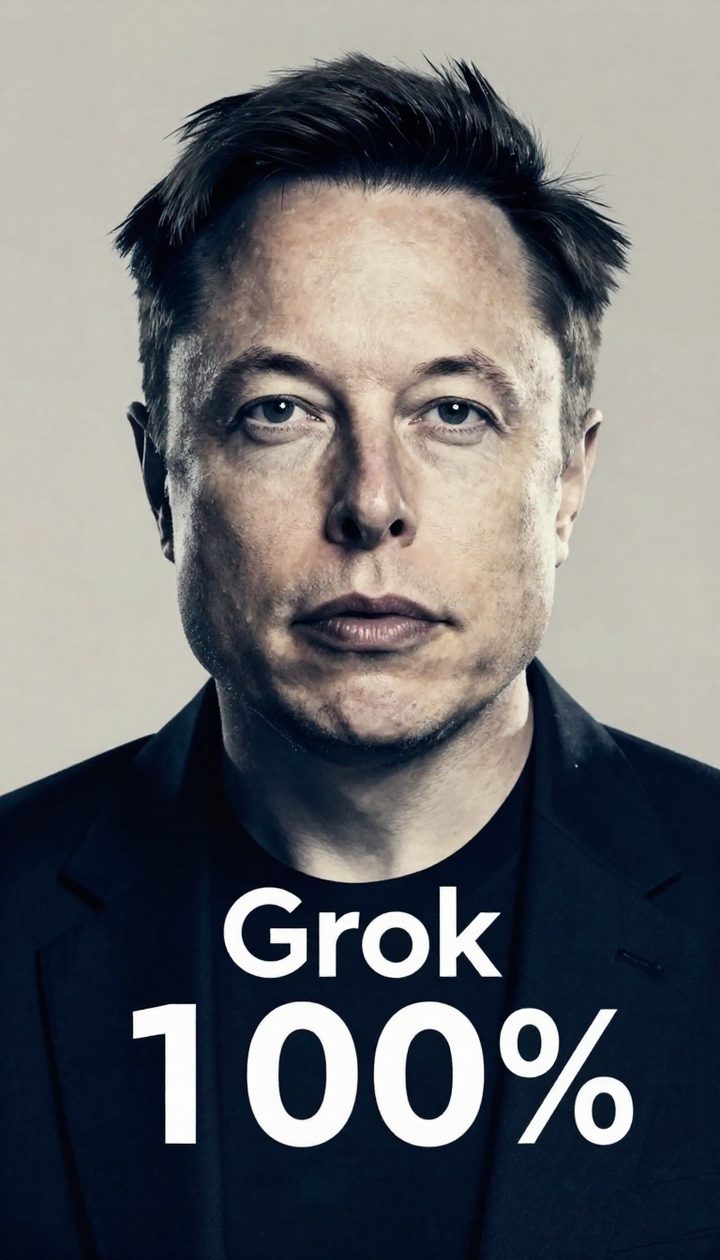
In an interview with Chinese state media, Elon Musk acknowledged that Grok 4.7 is not on a par with Anthropic's Opus 5.5, blaming the fact that xAI has been in the market half as long. Even so, he boasted that Grok Bot, its agentic assistant, doubles its users every month.
📚 Go deeper

Semiconductors as the oil of the 21st century: history, espionage, and why an island of 23 million people underpins the entire AI economy.
As an Amazon Associate, Zendoric earns from qualifying purchases; the price does not change for you. · all our recommended books →
By Zendoric · September 27, 2026.
Elon Musk has admitted, in an interview with China Media Group picked up by Wccftech, that xAI's most recent public model, Grok 4.7, is "a solid workhorse" but is not on a par with Opus 5.5, Anthropic's flagship model. The reason Musk himself gives: xAI has been around "about three years," compared with Anthropic's "six years." It is a blunt admission from a CEO who in the past has been generous when positioning his own models against the competition.
The company's next model, Grok 4.8, has still not been released and would rely on 2.5 trillion parameters (the scale of the model's internal connections), according to figures from Musk himself. But not even with that jump in size does he expect to catch up with Astra, OpenAI's benchmark model, or with Anthropic's Fable family: his forecast is to "probably" reach the frontier "next year," that is, in 2027. Meanwhile, Musk is putting the focus on Grok Bot, the company's agentic assistant (an AI system capable of carrying out multi-step tasks on its own, beyond answering questions), which in his own words is growing "close to 100% a month."
Musk also sketched out a differentiating strategy: he argues that Anthropic has built "an excellent AI at software engineering," but that no one has yet achieved an excellent AI at "real-world engineering," a gap he aims to fill by drawing on operational data from Tesla and SpaceX. It is a reasonable business thesis on paper, but for now it goes no further than that: there is no product or benchmark to back it up, only the promise that data from factories and rockets is a different asset from code.
In the same interview, Musk ventured onto other terrain: he calculated that China will solve its lithography and semiconductor manufacturing constraints "in about two or three years." The contrast comes in Wccftech's own article, which recalls that Frank Rohmund, chief executive of Zeiss's semiconductor division —maker of the precision optics used by extreme ultraviolet (EUV) lithography machines— estimated in a recent interview that China is some 15 years behind the West in that field. Two executives with different interests, two horizons that could not be more disparate.
Our take: the most valuable part of this piece is not that Grok is lagging behind —something that had already been flagged— but that it is Musk himself saying it out loud, to Chinese media, without needing to have it dragged out of him by a benchmark. When an executive who tends to inflate his own announcements lowers expectations for his flagship product, it is worth taking the point seriously precisely because it cuts against his habit.
At the same time, Grok Bot's 100% monthly growth —a figure we know only from Musk's own mouth, with no external verification— points to something that is on its way to becoming a pattern in the sector: the race for base model quality and the race for adoption of the agentic product are no longer the same race. You can lose the first and gain ground in the second if the assistant handles everyday tasks competently enough and at a competitive price. It is partial good news for the abundance thesis: the more access to useful agents is commoditized, the faster the productivity AI promises spreads, even if the model behind it is not the smartest on the market.
The contradiction over Chinese semiconductors is a reminder, more than a novelty, of a pattern we already know: separating geopolitical aspiration from verified technical progress requires comparing sources with opposing interests, rather than settling for the figure that best fits the narrative of the moment. Two or three years and fifteen years cannot both be true; reality, as almost always in this race, is probably closer to the skepticism of the engineer who builds the machinery than to the optimism of the businessman who needs to sell a narrative of imminent arrival.
📚 Go deeper

China vs.

The story of NVIDIA and Jensen Huang: how a video-game card company ended up making the most coveted resource on the planet.
As an Amazon Associate, Zendoric earns from qualifying purchases; the price does not change for you. · all our recommended books →
🔗 Related on Zendoric
- Musk concedes Grok trails Anthropic by years — while the 100%-a-month agent claim measures distribution, not capability · 2026-09-28
- Back-to-school 2026 reveals the true state of agentic AI: trusted assistant, not autonomous buyer · 2026-07-18
- Claude is the second AI assistant on South Korean phones, gaining ground in downloads though not in monthly use · 2026-09-26