Apple launches the new Mac mini and Mac Studio with M6, M5 Pro, M5 Max and M5 Ultra chips
🕒 Published on Zendoric: September 24, 2026 · 00:26
✨ AI-generated · how it's made
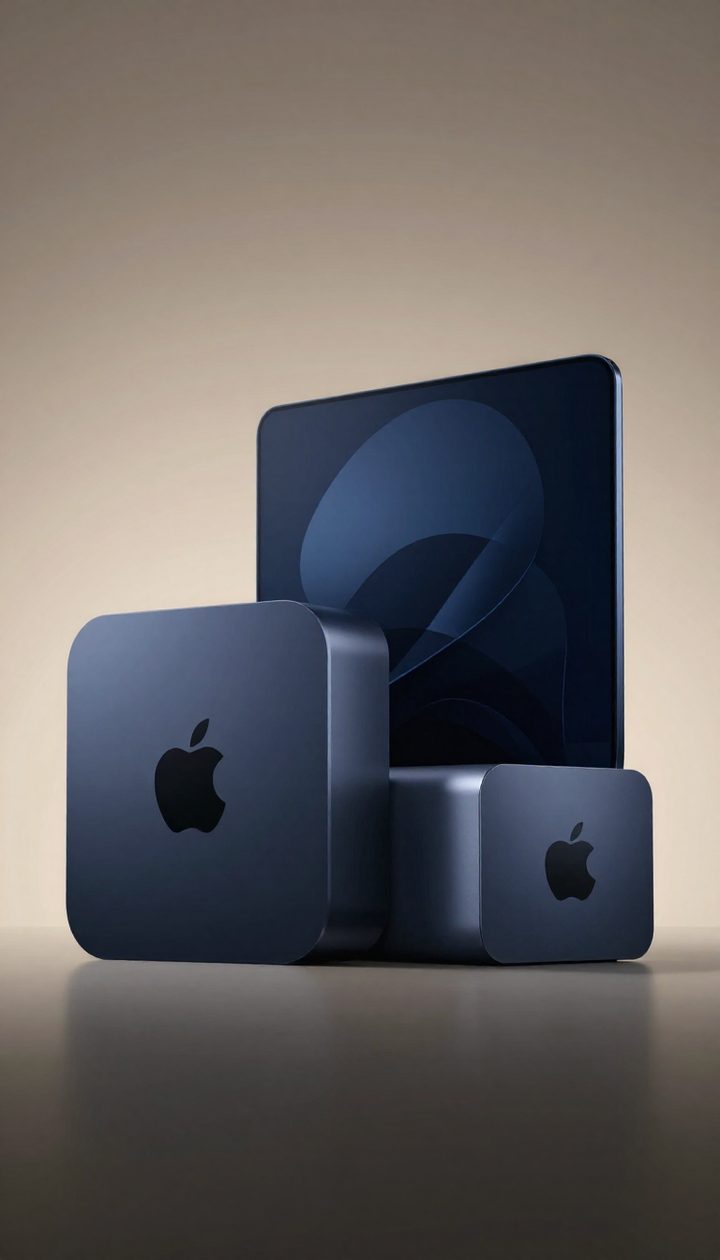
Apple has put its new desktop computers on sale, the Mac mini and the Mac Studio, available from September 22 at Apple Store locations, on Apple's website and in the Apple Store app.
📚 Go deeper

The story of NVIDIA and Jensen Huang: how a video-game card company ended up making the most coveted resource on the planet.
As an Amazon Associate, Zendoric earns from qualifying purchases; the price does not change for you. · all our recommended books →
Apple has put its new desktop computers on sale, the Mac mini and the Mac Studio, available from September 22 at Apple Store locations, on Apple's website and in the Apple Store app. This is the refresh of the desktop line-up with the company's latest chips: the Mac mini packs the new M6 or, in its most powerful version, the M5 Pro; the Mac Studio moves up to the M5 Max and a brand-new M5 Ultra. Starting prices are $899 for the Mac mini with M6, $1,699 for the Mac mini with M5 Pro, $2,499 for the Mac Studio with M5 Max and $5,499 for the Mac Studio with M5 Ultra.
The detail of most interest from an AI standpoint is how Apple is explicitly packaging these machines as computers for on-device artificial intelligence. The company claims the Mac mini with M6 delivers up to 4 times more AI performance, double the graphics and storage performance, and 40% more CPU performance. In the official pitch, those improvements translate into the ability to "run agentic AI workflows" smoothly, a term Apple repeats several times and one that positions the Mac mini as a machine designed for the continuous use of AI agents in the background, not just for occasional text or image generation tasks.
The Mac Studio, presented as "Apple's most powerful Mac", raises the stakes even further: up to 4.3 times more AI performance and up to 1.8 times more graphics performance, plus support for up to 512GB of unified memory (this maximum-capacity configuration will arrive in late October). Apple stresses that this amount of memory allows AI researchers to "run enormous language models entirely on the device", in other words, to run large LLMs locally without relying on the cloud. The Mac Studio with M5 Ultra packs up to 80 GPU cores and memory bandwidth of 1.2TB/s.
A technical detail relevant to those working in distributed AI computing is that both Mac Studio models include Thunderbolt 5 with support for RDMA (remote direct memory access), which makes it possible to connect several Mac Studio machines in a cluster. According to Apple, this cluster configuration delivers up to 3 times more distributed AI inference performance than a single system, a feature explicitly aimed at those who need to scale inference workloads without turning to cloud infrastructure.
As for the general specifications, the Mac mini with M6 packs a 12-core CPU, a 12-core GPU with "Neural Accelerators" in each core and a new 16-core dual Neural Engine, with 16GB of unified memory as standard (expandable to 32GB) and up to 170GB/s of bandwidth. The Mac mini with M5 Pro goes up to an 18-core CPU, a GPU with up to 20 cores and up to 64GB of unified memory with 307GB/s of bandwidth. Both include Wi-Fi 7, Bluetooth 6 and 2.5Gb Ethernet (with a 10Gb option). The Mac Studio with M5 Max offers an 18-core CPU, a GPU with up to 40 cores and up to 128GB of unified memory; the M5 Ultra reaches a CPU with up to 36 cores and a GPU with up to 80 cores. The Mac Studio, in general, supports up to eight displays.
The software that comes with these machines is macOS 27 (code-named "Golden Gate"), released previously, which introduces Siri AI as a redesigned assistant. According to Apple's description, this new Siri can draw on the user's personal context —messages, emails, photos— to answer questions and complete tasks inside apps, is integrated into Spotlight and the system's context menus, and allows Visual Intelligence to be used to ask about what appears on screen via a dedicated keyboard shortcut. Users can also "write with Siri" in almost any text field in the system. Apple Intelligence further adds features such as automatically organizing tabs by topic in Safari, alerts about changes on web pages (restocks, price drops), the creation of Safari extensions from a natural-language description, the generation of automations in the Shortcuts app simply by describing them, and advanced photo editing in Photos. macOS 27 also introduces a new slider in Settings to adjust the transparency of the Liquid Glass interface, from "ultra-transparent" to fully tinted.
On the commercial front, Apple is keeping its usual package of incentives: discounts for students and education staff (from $799 for the Mac mini and $5,099 for the Mac Studio), a program offering credit for trading in used equipment (Apple Trade In), monthly financing with Apple Card in the United States, and the "Apple Upgrade" leasing option for the Mac Studio, with payments from $48.99 a month for the M5 Max model and from $110.10 a month for the M5 Ultra, on 36-month contracts that allow an upgrade to a new machine at the end of the term.
Taken together, the launch confirms a clear trend in Apple's messaging: desktop hardware is no longer sold primarily on its multimedia or traditional productivity capabilities, but on its suitability for running AI locally —agents operating continuously, large language models loaded entirely into unified memory and clusters of several machines for distributed inference. It is worth remembering that the performance figures (4x, 4.3x, 1.8x, 3x, etc.) are data provided by Apple itself, referenced in footnotes in the press release, and not independent measurements verified in this text.
📚 Go deeper

DeepMind co-founder on the dilemma of containing technologies that do not want to be contained.

Semiconductors as the oil of the 21st century: history, espionage, and why an island of 23 million people underpins the entire AI economy.
As an Amazon Associate, Zendoric earns from qualifying purchases; the price does not change for you. · all our recommended books →
🔗 Related on Zendoric
- Apple reportedly preparing the M7 Ultra with up to 1.5 TB of RAM for on-device AI (rumor for 2029) · 2026-07-15
- Ternus takes over Apple from Cook, with AI as priority number one · 2026-09-02
- Microsoft launches the Surface Laptop Ultra: a 15" laptop with the NVIDIA RTX Spark superchip for $2,599 · 2026-10-11