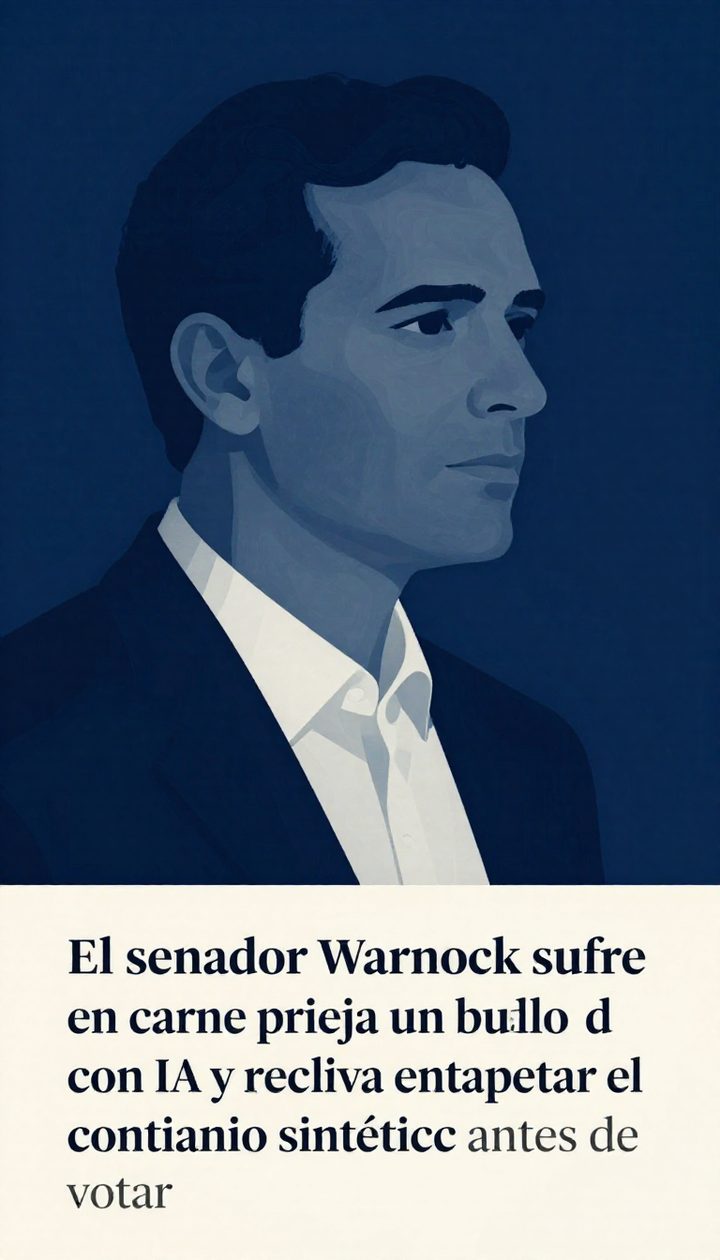
Senator Warnock experiences an AI health hoax firsthand and calls for labeling synthetic content before the vote
🕒 Published on Zendoric: September 17, 2026 · 08:28
✨ AI-generated · how it's made
A Facebook page used AI to claim Senator Raphael Warnock had collapsed on stage and was battling cancer. Thousands believed it; some even called him to wish him a speedy recovery. Warnock turns the scare into a warning: without rules, this same trick could decide an election.
📚 Go deeper

The definitive piece of investigative journalism on OpenAI: 260+ interviews, the clash between safety and speed, and the attempted firing of Sam Altma
As an Amazon Associate, Zendoric earns from qualifying purchases; the price does not change for you. · all our recommended books →
By Zendoric · September 17, 2026.
Georgia Democratic Senator Raphael Warnock posted a video on September 15 denouncing that he had been the victim of an AI-generated health hoax that circulated widely on Facebook. As Warnock himself tells it, a page spread AI-fabricated images and posts claiming he had collapsed on stage and was recovering from cancer surgery. Neither of those things happened.
The same page mixed that alarming content with absurd posts —an image that gave him back a head of hair he doesn't have, another announcing the birth of nonexistent twin grandchildren— alongside the posts about his supposed illness. Warnock says the entries racked up thousands of "likes" and views, and that some well-meaning constituents even called to wish him a speedy recovery, convinced the senator was gravely ill.
The case puts a name and a public office to a problem that until now was discussed mostly in the abstract: how easily AI image- and text-generation tools produce credible disinformation at almost zero cost, and how fast platforms amplify it before anyone can debunk it. "What if hours before an election someone created a page with AI-generated images, false stories about the candidates? How will voters know what's true and what isn't?" Warnock asks in the video. His answer: "Social media has to move fast to label this material. Congress has to act."
The complaint comes shortly after a recent visit by Warnock to Effingham County, in his own state, where OpenAI is planning a 3.2-gigawatt data center. After meeting with residents and members of the Protect Effingham Alliance, who are concerned about the project's impact on the area, the senator backed a statewide moratorium on data center construction. They are two separate fronts —energy infrastructure and synthetic disinformation— but together they sketch a lawmaker who, in one of the states where the AI industry is flexing the most physical muscle, has become a critical voice from inside the Democratic Party itself.
As industry context, the kind of page that went after Warnock is not necessarily a targeted political propaganda operation: Facebook has long hosted a business of "content farms" that manufacture death or illness hoaxes about celebrities and public figures using AI-generated images, precisely because that type of post produces the highest and fastest spike in engagement —and in ad revenue. The motive is usually economic, not ideological, which makes the underlying problem worse: it takes no state actor and no coordinated campaign to flood public debate with false material about an elected official. It just has to be profitable.
Here it is worth being honest about what this means in the short term, without dramatizing or downplaying: fabricating a plausible fake health crisis about a sitting senator, with thousands of interactions before anyone can debunk it, is no longer a laboratory scenario or a hypothesis in a report. It is a commercial tool, cheap and available today. And it is not solved merely by pointing at "bad actors": the platforms that monetize that virality have a structural incentive not to stop it entirely, however much they say they are tightening their policies on synthetic content.
Warnock's request —labeling of AI-generated content and a legislative response from Congress— is the kind of evidence-based governance we defend against regulatory panic: he is not asking to ban generative models or halt their development, but to require verifiable provenance. The industry already has standards such as C2PA, adopted by some camera and model makers, that pursue exactly that, along with accountability for the platforms that distribute and monetize the content, which is where it is really decided whether a hoax reaches a million people or stops at a hundred. The problem is not that AI can generate a fake image; it is that the distribution ecosystem has no friction to stop it and no obligation to label it.
Heading into the November 2026 midterm elections, the scenario Warnock lays out —a hoax page created hours before a vote about a set of candidates— stops being hypothetical as soon as it is shown, as in his own case, that electoral intent isn't even needed for the content to go viral and be believed by real voters. And the risk is not only that the false is believed: it is that, through a steady diet of hoaxes like this one, any real and inconvenient news about a candidate —an actual hospitalization, a genuine controversy— can be dismissed in advance as "just another deepfake," the so-called liar's dividend. Without provenance infrastructure and without clear rules for platforms, that erosion of public trust is not fixed with better models; it is fixed with governance, and that, unlike technical progress, is still years behind.
📚 Go deeper

The story of NVIDIA and Jensen Huang: how a video-game card company ended up making the most coveted resource on the planet.

How opaque algorithms decide who gets credit, a job or parole — and why they tend to punish the same people.
As an Amazon Associate, Zendoric earns from qualifying purchases; the price does not change for you. · all our recommended books →
🔗 Related on Zendoric
- UCLA Health bets on AI for cancer detection: another sign that precision medicine is no longer just a promise · 2026-06-26
- AI for the most technical pharmaceutical content: GW Health and VarsaAI cut the production of regulated materials from weeks to minutes · 2026-06-30
- The Trump administration partially reverses the ban on an Anthropic model called Mythos 5 · 2026-06-30