A maker builds a 100% local desktop AI assistant on a Raspberry Pi, with a jump to Claude if needed
🕒 Published on Zendoric: September 6, 2026 · 11:50
✨ AI-generated · how it's made
A developer has showcased PHNTM-One on Hacker News, an AI assistant that runs entirely on a Raspberry Pi 5 with the open model Gemma 3 (4B), with no cloud beyond an optional 'boost' to Claude: the other side of the market, the one betting on owning the hardware and the data.
📚 Go deeper

The story of NVIDIA and Jensen Huang: how a video-game card company ended up making the most coveted resource on the planet.
As an Amazon Associate, Zendoric earns from qualifying purchases; the price does not change for you. · all our recommended books →
By Zendoric · September 6, 2026.
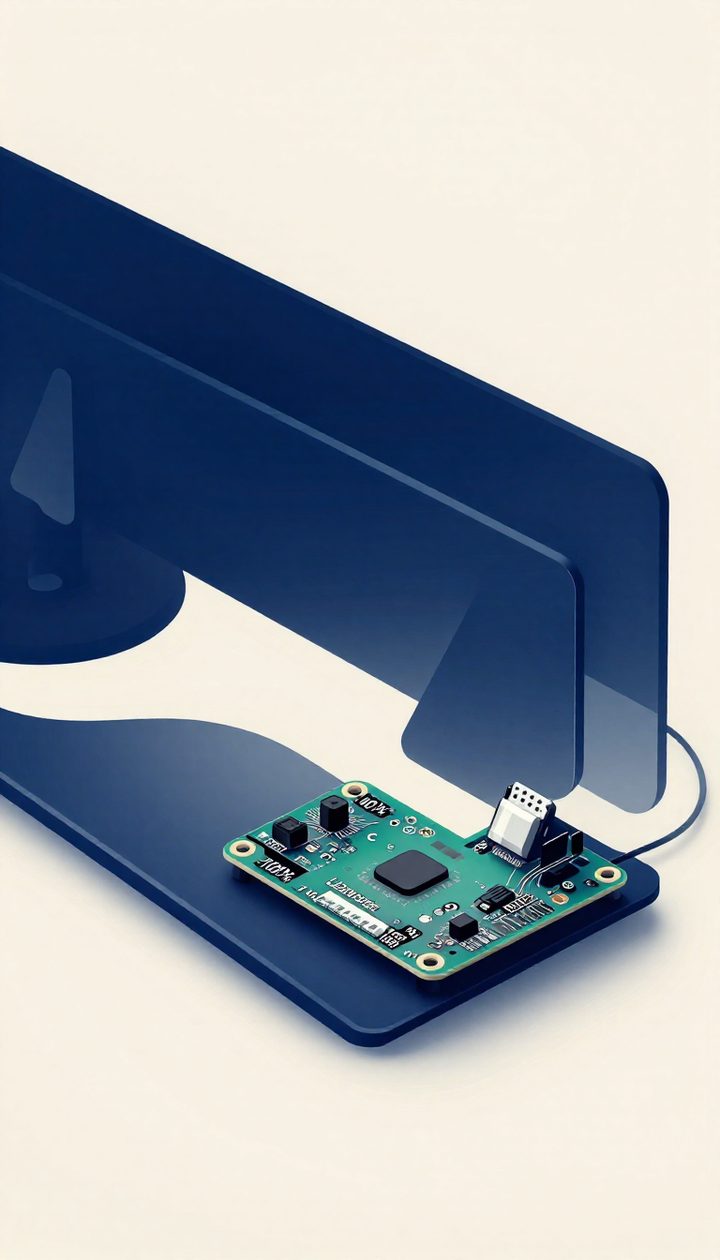
An independent developer has unveiled PHNTM-One on Hacker News, an artificial intelligence assistant designed to live permanently on a desk and run without relying on external servers. By his own description, the entire system — from speech recognition to persistent memory — runs on a Raspberry Pi 5 with 8 GB of RAM, built into a 10.1-inch touchscreen with its own fan and speaker. The language model doing the reasoning behind it is Gemma 3, with 4 billion parameters (Google's open family), run through Ollama, a tool that allows models of this kind to run on consumer hardware without going through the cloud.
The rest of the stack is local too: whisper.cpp turns speech into text, Piper generates the spoken response, and a RAG system (retrieval-augmented generation: the technique that lets the model consult the user's own documents before answering) allows the assistant to cite the user's files. Persistent memory is stored in a local SQLite database. The creator himself says the challenge was not getting the system to answer questions, but the details that separate a prototype from a product: making a "forget this" command actually delete the record in SQLite, ensuring document citations do not lie when memory and RAG contradict each other, and getting the device to survive service outages and state corruption without losing data or becoming unusable.
The author is explicit about the limit: a 4-billion-parameter model does not compete with the big cloud models on reasoning or knowledge, and does not try to. For tasks that require it, PHNTM-One offers an optional "boost mode" that hands off to Claude, Anthropic's model. It is essentially a two-speed design: local processing by default, with a route to the cloud only when the user authorizes it and needs it.
It is worth putting the announcement in its real context. This is a "Show HN" post — Hacker News's format for showing off personal projects — with barely a handful of points at the time of writing, no user numbers, no company behind it and no validation beyond the tests the creator says he ran: killing running services, forcing state corruption and repeating test after test in an attempt to break the system. It is therefore a very early-stage project by a single developer, not a proven product or an established market trend.
Broadly, it does fit a wider movement we have been tracking: increasingly capable open models fitting on modest hardware (Gemma, Qwen, Llama, gpt-oss…) and tools like Ollama that have lowered the barrier to running AI outside the big providers' data centers. The difference from AI gadgets with more marketing behind them — the Humane AI Pin or the Rabbit R1, both weighed down by their total dependence on the cloud and by a user experience that did not deliver on its promise — is precisely the opposite premise: here the user owns the hardware, the memory and the recovery path if something fails, and the cloud is the exception, not the rule.
Our read: projects like this matter less for what they are — a Raspberry Pi with a small model and a homemade enclosure — than for what they signal. The tension between capability and ownership that this developer resolves in favor of ownership is the same one running through much of the sector: the more relative power a small, open model gains, the more sense it makes to sacrifice some intelligence in exchange for total control over personal data. In the short term, the gap between a 4B model running on a Pi and a frontier model in the cloud will remain enormous, and these local assistants will keep looking — rightly — more limited than their cloud cousins. But the trajectory of small models — each generation doing at the edge what the previous one could manage only in a data center — points to a future in which owning your own assistant, with your memory and your documents under your control, is not a hobbyist oddity but the default option. That is, in miniature, the same abundance we argue for over the long run: not just more powerful models, but more accessible ones, and more yours.
📚 Go deeper

Semiconductors as the oil of the 21st century: history, espionage, and why an island of 23 million people underpins the entire AI economy.

The reference manual for building products on top of AI models: prompts, RAG, fine-tuning, agents, evaluation and deployment.
As an Amazon Associate, Zendoric earns from qualifying purchases; the price does not change for you. · all our recommended books →
🔗 Related on Zendoric
- Qubitz and the local-agent fever: when data sovereignty outweighs raw intelligence · 2026-07-03
- mlx-serve: frontier AI now fits on a Mac, with no cloud or subscription — the symptom of a deeper shift · 2026-07-04
- Teralexi: another open-source desktop agent for local AI joins an already saturated market · 2026-07-22