AI-generated 'Cat in the Hat' threats hit US schools: the hoax is already being investigated as a real threat
🕒 Published on Zendoric: September 4, 2026 · 09:12
✨ AI-generated · how it's made
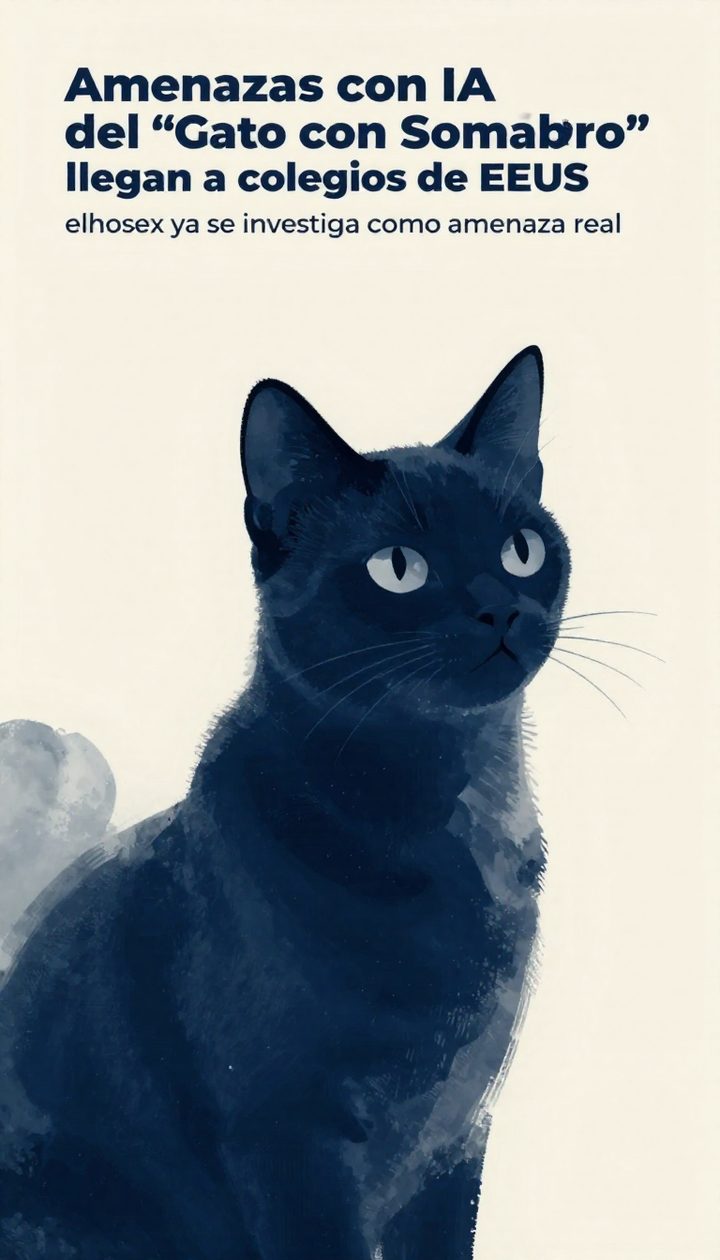
AI-generated images of Dr. Seuss's Cat in the Hat are threatening schools in Missouri, Alabama and North Carolina, according to local media. Kansas City police have received no similar reports, but districts are already investigating every alert, prank or not, as a real threat.
📚 Go deeper
How opaque algorithms decide who gets credit, a job or parole — and why they tend to punish the same people.
As an Amazon Associate, Zendoric earns from qualifying purchases; the price does not change for you. · all our recommended books →
By Zendoric · September 4, 2026.
Cameron Public Schools, a school district in Missouri, sent a statement to families and staff on Thursday after several students received threatening messages generated with artificial intelligence. The format: AI-created images of the Cat in the Hat, the Dr. Seuss character, accompanied by intimidating text. The district confirmed that it is reporting the cases to local police for investigation and that it takes every threat seriously.
"Any threat involving our school, students or staff will be reported to law enforcement and thoroughly investigated," the district said in its statement, as reported by FOX4KC. "Creating, sharing or communicating a threat as if it were a joke does not make it harmless." It is unknown where the trend originated, although media outlets place it mainly on TikTok. Kansas City police (KCPD) told FOX4 that it has not received similar reports. Equivalent cases, with the same character and the same pattern, have also been reported in Alabama (according to WBMA) and covered by WCNC (North Carolina): this is not an isolated incident, but a trend replicating almost simultaneously in districts across several states.
As sector context, this type of hoax fits a category we have been observing for months: fake threats manufactured with image-generation tools that a year ago demanded technical skill and today fit into a free phone app. The choice of character is no accident: a childlike, harmless and recognizable icon works better as viral bait on TikTok than an explicitly violent image, precisely because it disconcerts before it frightens, and that is why it spreads faster.
The problem for schools is not technical, it is procedural. In general, US districts treat every threat as credible until proven otherwise, regardless of whether the author "was only joking." That means an image generated in seconds with a free app can trigger the same deployment of resources -alerting the police, an investigation, communication to families, anxiety in the school community- as a real, premeditated threat. The trend does not need to be credible to be costly: it only needs to look real long enough to force a response.
It is our reading that this episode is a miniature illustration of a problem that will grow before it is solved: the speed at which threatening or disturbing content can be manufactured with generative AI has far outstripped the speed at which schools, police forces and platforms have developed protocols to distinguish a hoax from a real risk. It is not a flaw in the technology itself -generating an image of a cat in a hat is not, by definition, dangerous- but a mismatch between the democratization of creation tools and the absence of provenance mechanisms (verifiable watermarks, traceability of origin) that would allow a school or a police officer to rule out a hoax in minutes rather than days. We have already seen that same mismatch in other areas -from synthetic content that is starting to be judged by the same legal yardstick as real content, to automated fraud at scale- and the response that is working in those cases is not banning the tool, but investing in verification layers and in protocols that do not treat every generated image as a maximum-level threat by default. Until those layers exist, it is reasonable to expect more variations of this same hoax using other harmless characters as the vehicle, because the cost of producing it is practically zero and the effect -an entire school mobilized by an image- has already been demonstrated.
📚 Go deeper
Algorithms in justice, medicine, cars and art, explained with British humor and mathematical honesty.
The best starting book if you're not technical: a Wharton professor explains how to work WITH AI — when to delegate, when to supervise, when to keep i
As an Amazon Associate, Zendoric earns from qualifying purchases; the price does not change for you. · all our recommended books →
🔗 Related on Zendoric
- AI-generated CSAM at an Illinois school: the hardest abuse to detect no longer needs a hidden camera · 2026-07-04
- AI cameras to detect weapons in schools: a useful patch that doesn't solve the underlying question · 2026-07-17
- When generative AI becomes a weapon against minors: a case that demands a legal response, not just a technological one · 2026-07-18