India investigates AI deepfakes impersonating the Tamil Nadu leader for WhatsApp scams traced to Pakistan
🕒 Published on Zendoric: September 3, 2026 · 10:20
✨ AI-generated · how it's made
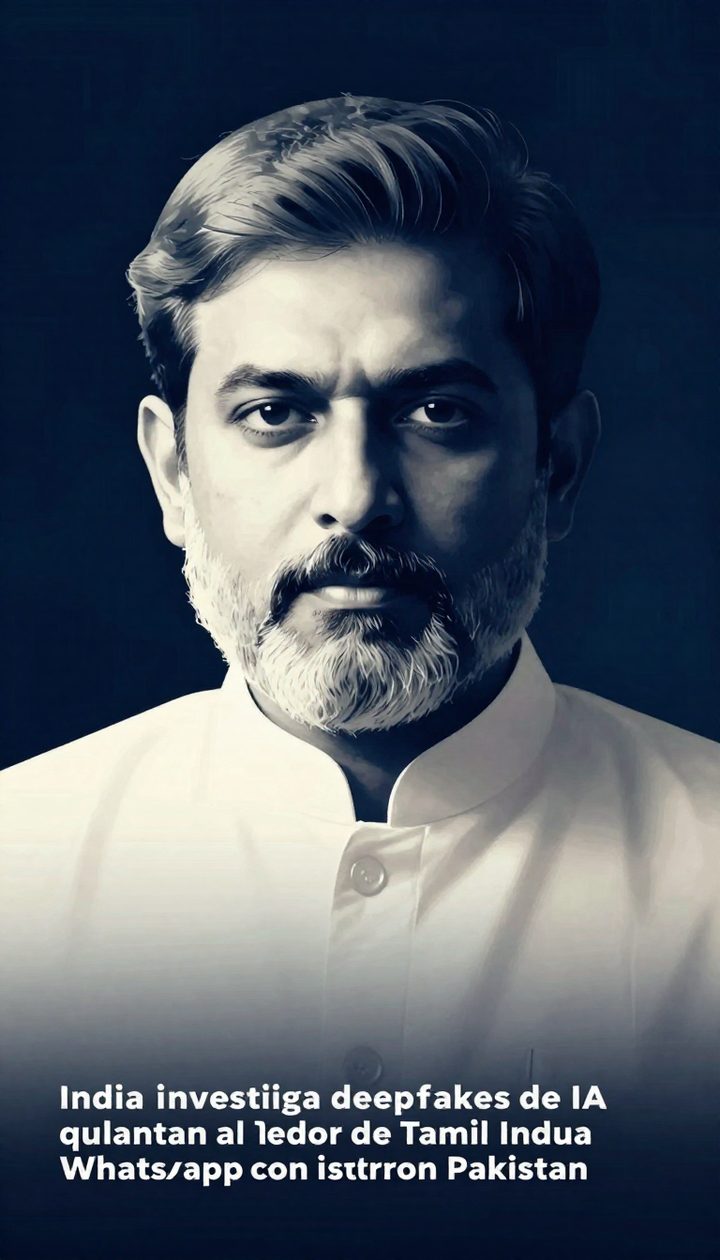
Tamil Nadu police (CB-CID) have opened a case over a deepfake with Hindi audio impersonating Chief Minister Vijay to steer victims to a WhatsApp number with the promise of financial aid. Several accounts traced in the case are said to originate in Pakistan.
📚 Go deeper
How opaque algorithms decide who gets credit, a job or parole — and why they tend to punish the same people.
As an Amazon Associate, Zendoric earns from qualifying purchases; the price does not change for you. · all our recommended books →
By Zendoric · September 3, 2026.
The Tamil Nadu police, through its Crime Branch Criminal Investigation Department (CB-CID, the state's serious crime and cybercrime division), opened a criminal case on September 1 over a deepfake video —audiovisual content generated or manipulated with artificial intelligence to impersonate the image and voice of a real person— that passes off the chief minister of Tamil Nadu, Vijay, as someone offering financial aid to the public. The clip, with audio dubbed into Hindi, asked viewers to contact a WhatsApp number to process the supposed aid. According to the police themselves, it is a lure: those who write end up as victims of a scam.
The case was detected by the CB-CID's cyber patrolling team during a routine sweep of Facebook, not through a citizen complaint. The preliminary investigation, according to the police force, has located several similar videos —same pattern, same "aid" hook— circulating not only on Facebook but on other networks, and has found that many of those videos were spread from Facebook profiles allegedly based in Pakistan. The CB-CID has asked Meta for the records of those accounts and for the content to be taken down, and has issued a public warning urging people not to contact the numbers or join the WhatsApp groups linked from these videos.
Two things are worth separating. The technology of the deception —the deepfake itself— is already trivial: cloning the face and voice of a recognizable public figure, with accessible tools and barely any technical knowledge, is now a matter of minutes. What remains handmade, and that is where the real crime lies, is the social engineering that comes after the click: the WhatsApp number, the group, the script for asking for bank details or an "advance" before the supposed payment. The video steals nothing on its own; it is the bait. That distinction matters because it marks where the defensive effort should go: not only into detecting the fake video, but into cutting the chain of contact that follows.
The case also illustrates a pattern that is starting to repeat in different countries: impersonating a public authority in order to exploit the trust people place in official social aid channels, all the more so where government assistance programs are real and well known. The more credible the promise —"the government is helping you"— the higher the fraud's response rate. And the fact that the CB-CID places part of the distribution in accounts allegedly outside India —an attribution that is preliminary for now and that the police themselves treat as such— adds a layer of complexity: pursuing the crime requires cooperation between platforms, jurisdictions and, in this case, between countries with a tense diplomatic relationship, which in practice lengthens takedown times and makes any real sanction against those responsible harder.
Broadly speaking, this type of episode —deepfakes of political leaders used as bait for financial scams— has become a recurring pattern in the sector: it has already been seen with heads of government, central bankers and business figures in different markets, almost always with the same "aid" or "guaranteed investment" script. It is the most mundane face of the malicious use of generative AI, but also the most widespread: not sophisticated cyberattacks against critical infrastructure, but volume fraud against the part of the population least prepared to tell a real video from a synthetic one.
Here it is worth being honest about the short term, which is the uncomfortable part of our thesis: generative AI has made fraud cheap on a scale that local police forces, with limited resources and jurisdictional borders, cannot keep pace with. Every month it gets cheaper to produce a convincing video and more expensive, in time and international cooperation, to take it down. That asymmetry is not corrected with a police statement urging caution: it is corrected with provenance verification built into the platforms themselves and with Meta and the other networks responding to these takedown requests in hours, not weeks. The CB-CID has done what was within its power —go to Meta, request records, warn the public— but that is the ceiling of what a state police force can achieve on its own.
The underlying reading is the one we have been making in similar cases of AI-assisted fraud: the real risk today is not a distant superintelligence, but the industrialization of scams that once required actors, scriptwriters and production, and that now anyone with an app can put together. The long-term answer is not banning the technology that generates these videos —the same capability that allows a voice to be cloned in seconds is the one that, well directed, will speed up medical diagnoses or dub educational content into any language at no cost— but building, at the same pace as the ability to generate synthetic content, the infrastructure to verify it. Until that race evens out, cases like Tamil Nadu's will keep multiplying.
📚 Go deeper

Algorithms in justice, medicine, cars and art, explained with British humor and mathematical honesty.
DeepMind co-founder on the dilemma of containing technologies that do not want to be contained.
As an Amazon Associate, Zendoric earns from qualifying purchases; the price does not change for you. · all our recommended books →
🔗 Related on Zendoric
- A Deepfake 'Prince' and Real Losses: Romance Scams Enter the Video-Call Era · 2026-07-04
- Piyush Goyal reports a deepfake of himself in India: the fraud is cheaper than the rebuttal · 2026-07-27
- India debunks a deepfake of its Finance Minister used to sell an investment scam with absurd returns · 2026-07-31