Xi accelerates China's military AI just as he purges the Defense leadership over corruption
🕒 Published on Zendoric: July 31, 2026 · 15:01
✨ AI-generated · how it's made
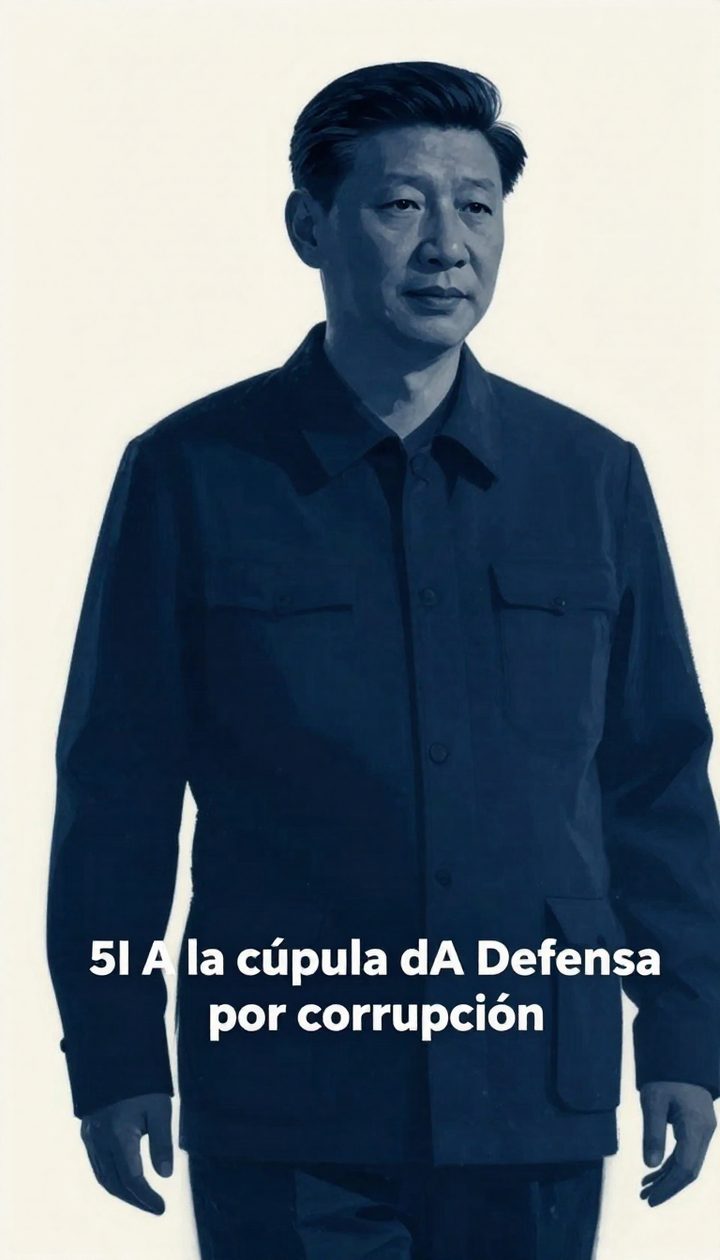
Xi Jinping ordered the Politburo to speed up the integration of AI and unmanned systems into the Chinese military to build an 'intelligent military system', while deepening the anti-corruption purge at the top of Defense. Modernization is advancing, but not without internal cracks.
📚 Go deeper
China vs.
As an Amazon Associate, Zendoric earns from qualifying purchases; the price does not change for you. · all our recommended books →
By EFE · July 31, 2026. Xi Jinping, president of China and of the Central Military Commission (the body that commands the armed forces), instructed the Communist Party's Politburo — its top executive body — to speed up the incorporation of artificial intelligence, unmanned systems and information networks into the People's Liberation Army (PLA). He did so during a study session held on the eve of the 99th anniversary of the PLA's founding, commemorated this Saturday, August 1, as reported by the state news agency Xinhua and relayed by EFE. Xi set combat capability as the yardstick for measuring progress on modernization and spoke of "gradually" building an intelligent military system.
So far, the predictable part: for years China has been repeating, almost as an anniversary ritual, that it wants a more technological military. What sets this intervention apart is what Xi said immediately afterward: he reaffirmed the Party's "absolute leadership" over the armed forces and ordered stronger oversight of major defense projects to "prevent irregularities." That instruction comes, according to EFE's own reporting, after several senior officers and former Defense Ministry officials have been investigated over alleged corruption.
That juxtaposition is, for us, the real news, rather than yet another call to "accelerate military AI." When a government asks in the same session for both more algorithms and more anti-corruption controls in defense contracts, it is acknowledging — however indirectly — that its modernization machinery is leaking. No AI model fixes that: what fixes it, or not, is a chain of command and procurement that works without bribes. An "intelligent military system" is not just well-trained compute; it is also internal governance, and that is where Beijing admits it has work left to do.
At Zendoric we have insisted that the military AI race between China and the United States is fought as much over the narrative as over real capabilities, and that "closing the gap" is usually more an exercise in political framing than a fact verified on the battlefield. This order from Xi fits that pattern: it is a top-down directive, timed for the army's anniversary, not an independent audit of how far the PLA actually is from operating AI-assisted command or drone swarms in real combat. The question worth following is not whether Beijing "ordered an acceleration of AI" — that gets repeated periodically — but what the new inspections of those major defense projects find, if the findings are ever published.
As background, it is worth keeping in mind that dual-use AI — the same kind that helps detect a tumor earlier or speed up drug design — is also the kind being militarized in Beijing, Washington or any capital with a defense budget. That tension is not going away in the short term: as long as the major powers compete to control the technology, there will be arms races, internal purges and opacity about real capabilities. That does not contradict the promise of a civilian AI that multiplies health and abundance over the long run; it simply reminds us that this horizon coexists, during the transition, with governments that see in the same technology a weapon before a cure. Telling one plane from the other — and watching who controls each use — matters more than counting how many times a leader calls for "acceleration."
📚 Go deeper
Semiconductors as the oil of the 21st century: history, espionage, and why an island of 23 million people underpins the entire AI economy.

The best starting book if you're not technical: a Wharton professor explains how to work WITH AI — when to delegate, when to supervise, when to keep i
As an Amazon Associate, Zendoric earns from qualifying purchases; the price does not change for you. · all our recommended books →
🔗 Related on Zendoric