The Pentagon centralizes command of its drones: military AI enters its industrial phase
🕒 Published on Zendoric: July 2, 2026 · 08:26
✨ AI-generated · how it's made
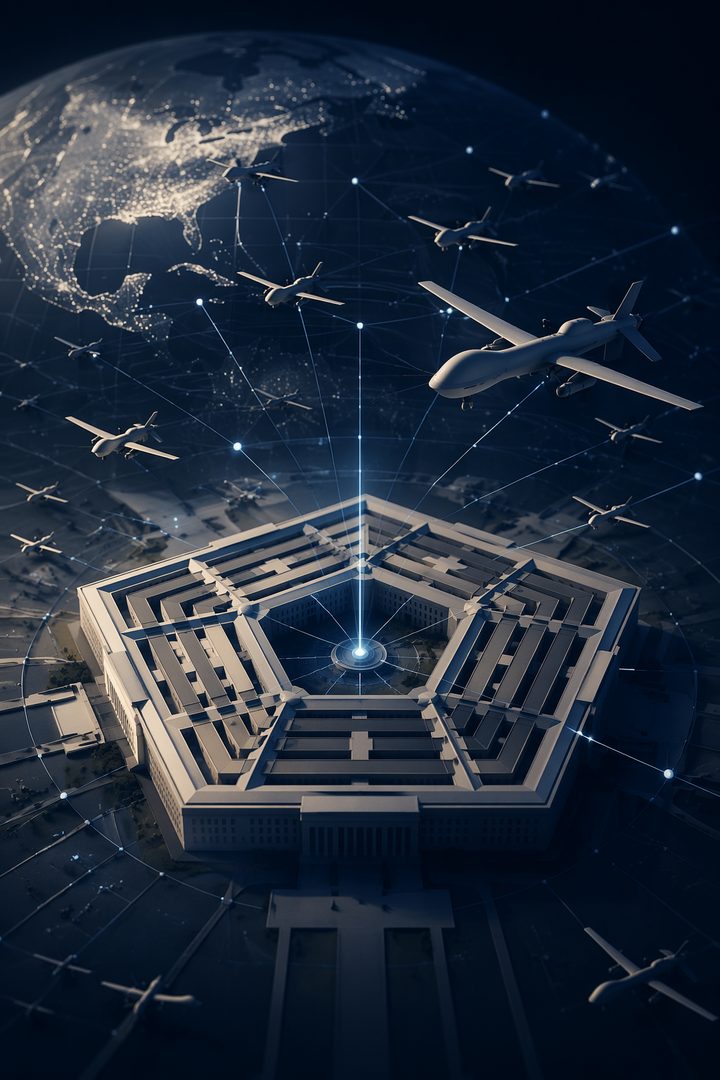
The U.S. Department of War creates a single office to oversee all its unmanned and autonomous systems, aiming to speed up their deployment against the mass production of adversaries like China. The consolidation accompanies a plan to deliver hundreds of thousands of drones within two years.
📚 Go deeper

The memoir of the creator of ImageNet, the scientist who made the deep learning revolution in vision possible.
As an Amazon Associate, Zendoric earns from qualifying purchases; the price does not change for you. · all our recommended books →
By Fox News · July 1, 2026.
The U.S. Department of War announced the creation of a new position, the Direct Reporting Portfolio Manager for Unmanned Systems, which will report directly to Deputy Secretary Stephen Feinberg and will centralize oversight of drones and autonomous systems on land, sea and air. Until now that responsibility was spread across the various military branches, the Defense Innovation Unit, the Joint Interagency Task Force 401 and the Defense Autonomous Warfare Group. The new office absorbs the funding, procurement and policy of all those programs under a single command.
The move is part of the 'Drone Dominance' initiative driven by Secretary Pete Hegseth, described as a billion-dollar program financed through the so-called 'Big Beautiful Bill.' The plan calls for delivering tens of thousands of small drones to U.S. forces in 2026 and hundreds of thousands more in 2027, as well as redesigning combat doctrine to integrate unmanned systems into frontline units. Pentagon spokesman Sean Parnell justified the urgency by noting that adversaries collectively produce millions of unmanned systems every year, and that Washington must move at that same speed to preserve its tactical and strategic advantage.
The article also mentions, in passing, specific systems that illustrate where this race is heading: the 'Bullfrog' from Allen Control Systems, an AI-powered autonomous interceptor capable of neutralizing drone swarms for barely $10 per kill, compared with the millions of dollars a conventional missile costs. It is the kind of economy of scale that explains why the Pentagon wants to stop relying on expensive weaponry to respond to cheap, mass-scale threats.
Our read is that this bureaucratic reorganization, although it may sound like administrative paperwork, is in fact a clear signal of where military spending is headed over the next decade: AI-driven autonomy is ceasing to be a pilot project scattered across agencies and becoming a structural priority with a single command, a dedicated budget and mass-production metrics. It is exactly the kind of short-term friction that our editorial line recognizes without mincing words: dual-use AI is being deployed first, and fastest, in the arena where the incentives to act quickly are greatest —geopolitical competition— and where human oversight, rules of engagement and the proliferation of lethal autonomous technology are open questions, not settled by decree.
This connects with a pattern we have been observing in the technological rivalry between the U.S. and China: the race is no longer being fought solely over the quality of the most advanced AI model, but over who manages to industrialize and deploy the technology at scale, with the institutional 'plumbing' needed to do it fast. Consolidating command of unmanned systems under a single office is, at bottom, the military equivalent of building the distribution infrastructure that decides who wins the game, beyond who has the most sophisticated algorithm.
In the long term, the abundance thesis we defend at Zendoric does not apply directly to spending on autonomous weaponry, and it would be naive to pretend otherwise. But its underlying premise does apply: humanity will only capture the civilian benefits of AI —health, longer healthy lifespans, shared prosperity— if it manages to seriously govern its double-edged uses, starting with the military one, which is the most urgent and the most dangerous to mismanage. Episodes like this show that governance is not an abstract debate for the future: it is already being decided, with concrete budgets and organizational charts, who controls lethal autonomy and under what rules. How that question is resolved will largely determine whether AI ends up being a force for stability or for systemic risk in the coming decades.
📚 Go deeper
China vs.

Semiconductors as the oil of the 21st century: history, espionage, and why an island of 23 million people underpins the entire AI economy.
As an Amazon Associate, Zendoric earns from qualifying purchases; the price does not change for you. · all our recommended books →
🔗 Related on Zendoric
- Xi accelerates China's military AI just as he purges the Defense leadership over corruption · 2026-07-31
- Xi accelerates China's military AI just as he purges the Defense leadership over corruption · 2026-08-31
- Egypt inaugurates 'The Octagon': AI enters the military headquarters as state infrastructure · 2026-07-06