Sabotage of weather data: a growing risk amid prediction markets and the AI boom

🕒 Published on Zendoric: July 21, 2026 · 00:20
✨ AI-generated · how it's made
Weather forecasts are not a trivial matter: airlines, grid operators and farmers make daily decisions based on them, from which crop variety to plant to where to build solar or wind farms and how to price wholesale electricity.
📚 Go deeper

The best starting book if you're not technical: a Wharton professor explains how to work WITH AI — when to delegate, when to supervise, when to keep i
As an Amazon Associate, Zendoric earns from qualifying purchases; the price does not change for you. · all our recommended books →
Weather forecasts are not a trivial matter: airlines, power grid operators and farmers make daily decisions based on them, from which crop variety to plant to where to build solar or wind farms and how to price electricity on the wholesale market. They are also used to trigger early warnings ahead of extreme events. The article warns that this forecasting infrastructure, seemingly technical and neutral, has become an asset with direct economic value due to the rise of so-called 'prediction markets,' markets where real money is wagered on world events, including weather.
The case that sparked the alarm occurred at Paris's Charles de Gaulle airport, where the weather station recorded suspicious temperature spikes on April 6 and April 15, 2026. Authorities speculate that something as simple as a hair dryer or a lighter may have been used near the sensor to falsify the reading. As a result, several people who had bet on prediction markets that the temperature would reach 22 °C (when the actual average hovered around 18 °C) collected substantial payouts; one person won $20,000. The manipulation was detected by chance by a French climate association monitoring the data, not by an automated system designed for that purpose.
The text explains that traditional forecasting systems, such as the WRF model or the European Centre for Medium-Range Weather Forecasts (ECMWF) system, incorporate their own safeguards: so-called 'data assimilation,' which checks every incoming measurement against what the physical model predicts and against readings from nearby stations, thereby filtering out anomalies. However, the authors note that these defenses were designed for isolated technical failures—faulty instruments or equipment updates—not for deliberate, coordinated manipulation. If someone were to remotely and simultaneously alter several stations with small, plausible changes at each one, current quality controls would have serious difficulty detecting it, especially since thorough verification of data and metadata takes hours or days, while forecasts must be published on a fixed schedule, whether or not there is time to check everything.
The shift toward artificial intelligence in meteorology raises the stakes, according to the article. So-called 'data-driven models' depend even more on reliable observations, precisely because they are fed by them more directly. ECMWF itself is exploring generating high-quality forecasts directly from raw observations, skipping the assimilation step that today acts as a quality filter. Other researchers go further, combining geospatial data (including data from weather stations) with large language models and agentic AI to support autonomous, real-time decisions during extreme events such as storms. This could improve accuracy, efficiency and response speed, but removing human oversight from the process also opens the door to new risks.
The authors describe a scale of increasing severity. At the lowest level is the individual speculator who manipulates a station for personal gain, as in the Charles de Gaulle case. One step up, a group of market operators could coordinate to skew renewable energy generation forecasts, move wholesale electricity prices and leave losses for whoever is on the other side of the trade. At the most serious extreme, a state actor or saboteur could manipulate one or several stations to falsely trigger an early warning system, or—worse—to silence it when it should sound, turning what starts as financial fraud into a disaster-preparedness problem and, ultimately, a national security issue.
As long as economic (or other) incentives exist to manipulate observational data, adversaries will keep looking for opportunities, which is why the authors propose three lines of action. The first is to 'watch the stations': strengthen the physical security of equipment, improve anomaly detection and correction, speed up data homogenization methods to catch problems in real time, and maintain human oversight, since it was precisely a human who detected the Paris case. The second is to 'protect the data to shield AI,' building defense mechanisms into every stage of the process, along with explainability tools and adversarial robustness that help understand both the data and the models' outputs. The third is to ensure 'continuous accountability throughout the entire chain': from station operators to national weather services and forecasting centers, no single link can protect data integrity on its own, so any detected anomaly must be communicated across the whole chain, all the way to those who ultimately act on the forecast.
The article's underlying message is that the Charles de Gaulle incident, though relatively minor in economic terms, should be read as an early warning sign. As the role of observational data in weather forecasting grows—and particularly as AI becomes more autonomous in interpreting it—the attack surface widens just as traditional human and statistical control mechanisms are starting to prove insufficient. The implicit conclusion is that climate infrastructure, traditionally seen as a scientific and public good, is beginning to behave like just another financial market, with all the perverse incentives that entails, and that defending it will require investment in security, persistent human oversight and institutional coordination, not just better algorithms.
📚 Go deeper
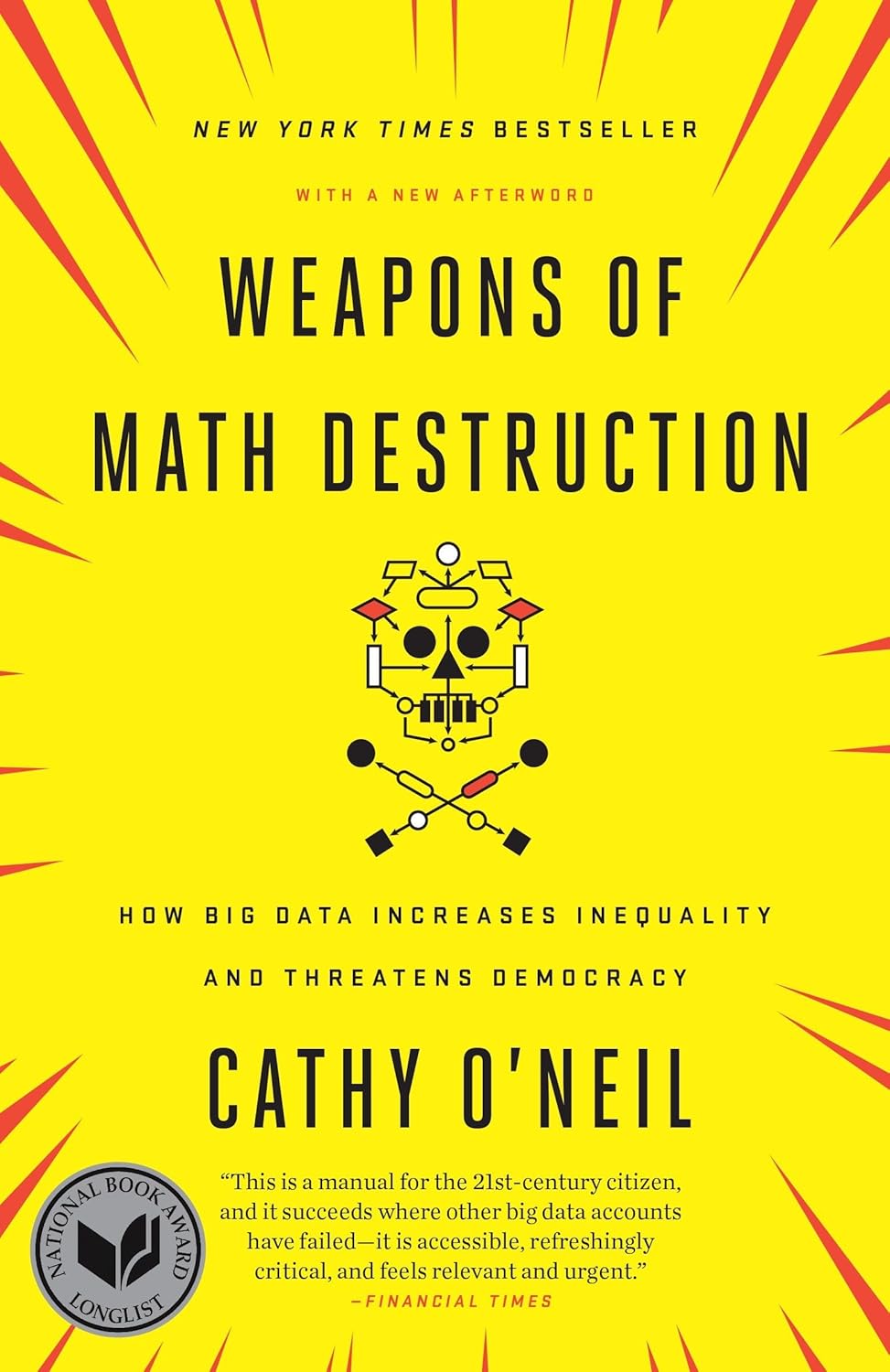
How opaque algorithms decide who gets credit, a job or parole — and why they tend to punish the same people.

The reference manual for building products on top of AI models: prompts, RAG, fine-tuning, agents, evaluation and deployment.
As an Amazon Associate, Zendoric earns from qualifying purchases; the price does not change for you. · all our recommended books →
🔗 Related on Zendoric
- Naira: when AI-powered irrigation reaches a Senegalese village before electric power does · 2026-07-12
- Anthropic takes AI distillation to the Senate: when copying agentic capabilities becomes a matter of state · 2026-06-26
- The home as a power plant: distributed energy enters the data center equation · 2026-06-27