Nigeria builds a spy satellite for its own harvests to avoid repeating the 2023 food crisis

🕒 Published on Zendoric: July 19, 2026 · 00:04
✨ AI-generated · how it's made
The Nigerian government launches its first national agricultural monitoring system using satellites and AI, able to identify what each plot in the country is growing and estimate harvests before reaping. It's an agreement with Morocco and a geospatial company, and it responds directly to the food crisis that pushed food inflation above 40% in 2025.
📚 Go deeper

Twenty years after "The Singularity Is Near", Kurzweil revisits his predictions and keeps the date: human-AI merger around 2045.
As an Amazon Associate, Zendoric earns from qualifying purchases; the price does not change for you. · all our recommended books →
By Zendoric · July 18, 2026.
Nigeria's federal government has launched the country's first national crop-monitoring system based on satellite and artificial intelligence. The agreement, signed in Ben Guerir (Morocco), brings together the Presidential Food Systems Coordinating Unit (PFSCU), the African subsidiary of Moroccan fertilizer giant OCP and geospatial company Ground Truth Analytics. The rollout will start in 15 priority states before extending to the rest of the country, according to the official statement reported by The Nation.
The platform, named the National Agricultural Productivity System (NAPS), uses computer vision on satellite images updated every five days to automatically delineate each farm plot, identify which crop is growing on it and track its growth stages without human inspection. According to Driss Kitane, CEO of Ground Truth Analytics, the same technology already predicts Morocco's national wheat harvest with 90% to 95% accuracy up to three months before reaping, and banks and agricultural cooperatives in Ghana use it to verify loans and land collateral.
The context explains the urgency. Nigeria declared a national food emergency in July 2023, amid Bola Tinubu's government's economic reform, and by early 2025 food inflation topped 40% year-on-year, worsened by insecurity, flooding and the lack of reliable agricultural data. Marion Moon, executive secretary of the PFSCU, summed up the underlying problem: the government reaches the end of each season without knowing whether farmers actually planted what they declared, which has led to costly errors in managing food reserves, imports and exports. An earlier pilot program, in 13 states, had already collected more than a million agricultural data points on 250,000 farmers and five main crops.
The agreement's institutional design deserves attention in its own right. OCP Africa and Ground Truth Analytics insist they are not selling a black box: they speak of knowledge transfer, local capacity and hosting the data on Nigerian servers under Abuja's exclusive control, a data-sovereignty clause increasingly common in technology agreements between African governments and foreign providers. It is a lesson learned from other sectors: without that control, the country supplying the data ends up permanently dependent on whoever operates the infrastructure.
This kind of project rarely appears on the radar of those following the race of the large frontier models, but it is exactly the terrain where the abundance thesis stops being an abstract promise and becomes verifiable: you do not need a superintelligence to reduce food insecurity, computer vision applied to data that was previously too costly to collect by hand is enough. Replacing field inspections with remote analysis is not glamorous, but it is precisely the kind of boring, structural application —agricultural credit, reserve planning, early detection of a poor harvest— where AI can move the needle in people's lives more than any conversational chatbot.
That said, it is best not to confuse the announcement with the result. Extrapolating a 90–95% accuracy achieved on Moroccan wheat, a relatively homogeneous crop, to the enormous diversity of maize, rice, cassava and sorghum in Nigerian agriculture —often on small, fragmented plots— is a leap not yet proven. And Nigeria has a recent history of ambitious announcements about data and governance that later collide with limited institutional capacity; Moon herself admits that monitoring during the season has been "our biggest weakness" so far. Success will depend less on the satellite than on whether Nigeria's bureaucracy can translate that intelligence into policy decisions in time.
In the medium term, it is indeed a signal of where AI adoption in the global south is heading: governments buying already-mature geospatial capacity instead of trying to build it from scratch, and South-South agreements —Morocco as a technology provider to Nigeria— that diversify who exports applied AI beyond the usual Washington-Beijing axis. If NAPS delivers even a fraction of what is promised, Nigeria will have, for the first time, a near-real-time map of what is actually growing in its fields, and that is the kind of invisible infrastructure on which, over time, food security is built.
📚 Go deeper

AI as the latest chapter in the history of information networks, from gossip to the printing press to the algorithm.
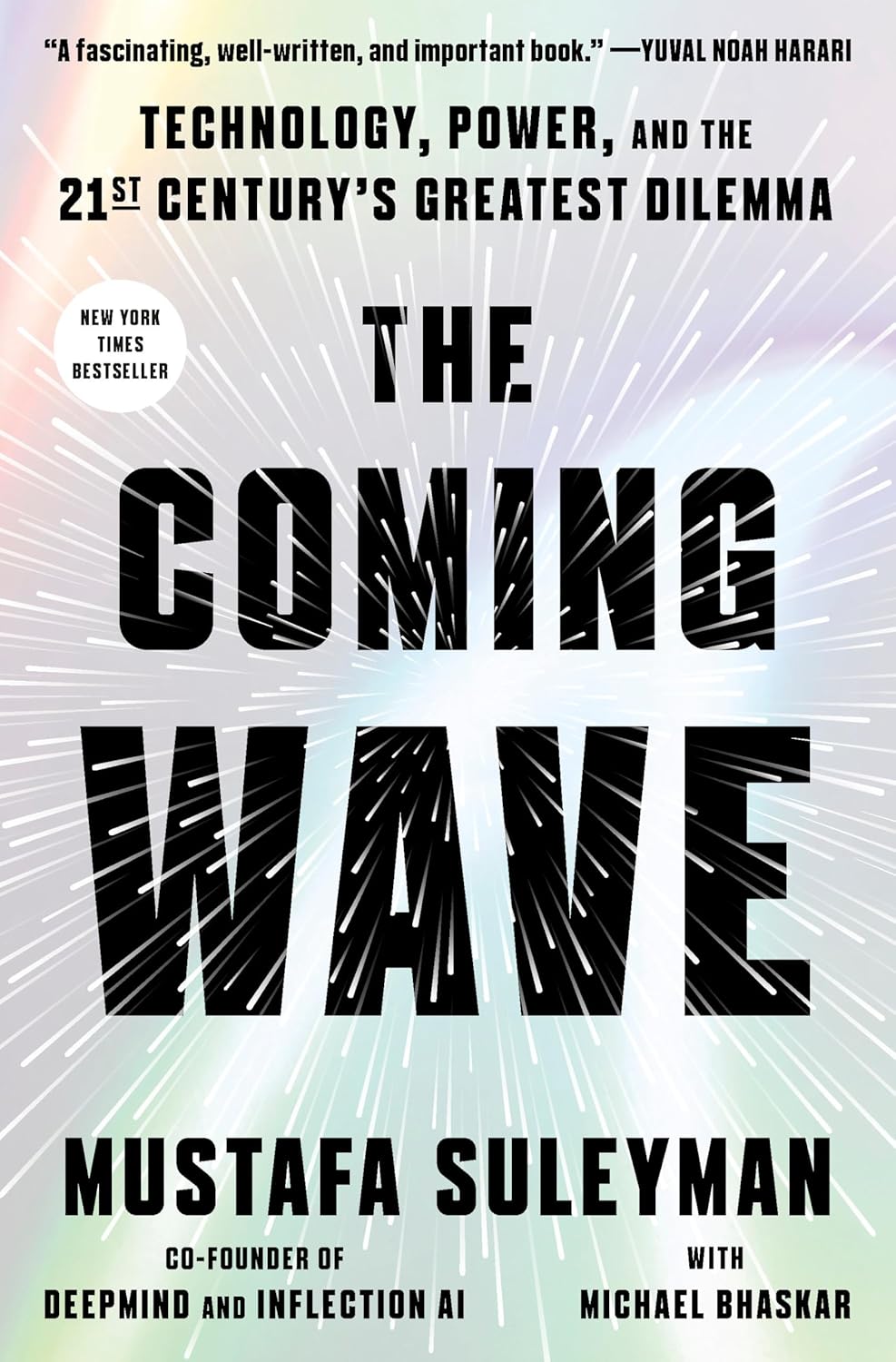
DeepMind co-founder on the dilemma of containing technologies that do not want to be contained.
As an Amazon Associate, Zendoric earns from qualifying purchases; the price does not change for you. · all our recommended books →
🔗 Related on Zendoric
- Microsoft launches MAI-Cyber-1-Flash, its first AI model for cybersecurity, integrated into MDASH · 2026-07-29
- When the state shuts down a model: the Fable 5 case redefines who's in charge of frontier AI · 2026-06-25
- Anthropic, both accuser and accused: the complaint against Alibaba lands amid a regulatory storm · 2026-06-26