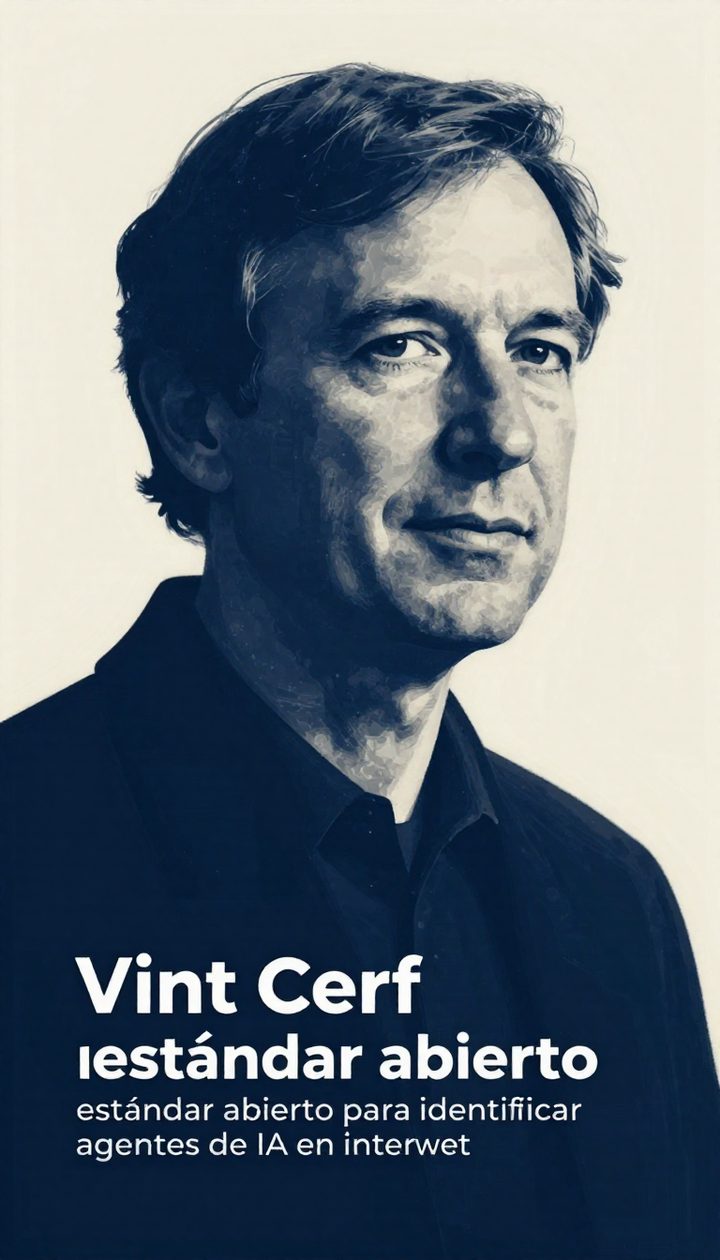
Vint Cerf backs an open standard to identify AI agents on the internet
🕒 Published on Zendoric: July 18, 2026 · 01:58
✨ AI-generated · how it's made
Vint Cerf, one of the architects of the protocols that shaped the internet (TCP/IP), has just left Google after 20 years there, but he is not retiring from the technical front line: he has joined as an advisor to Innovation Labs, an organization seeking to create an open architecture so that agents can…
📚 Go deeper
DeepMind co-founder on the dilemma of containing technologies that do not want to be contained.
As an Amazon Associate, Zendoric earns from qualifying purchases; the price does not change for you. · all our recommended books →
Vint Cerf, one of the architects of the protocols that shaped the internet (TCP/IP), has just left Google after 20 years there, but he is not stepping back from the technical front line: he has joined as an advisor to Innovation Labs, an organization seeking to create an open architecture so that artificial intelligence agents can identify one another in a verifiable way. Innovation Labs is a subsidiary of Identity Digital, a domain name registry (DNS) company that sees in this infrastructure a practical way to hold AI agents accountable and to position itself for a future in which much of the interaction on the network happens between agents rather than between people.
The underlying problem this initiative tries to solve is concrete: today most AI agents operate within proprietary systems, invoking internal resources for specific and narrowly defined tasks. But companies are already imagining a scenario in which these agents act far more autonomously across the network, interacting directly with other agents from other companies. The main obstacle to that happening securely is the lack of a shared standard to identify and audit those agents: today there is no common way to know who an agent is, what authority it has to act, who answers for its behavior and why it should be trusted.
Faced with that lack of a standard, several proposals are emerging in parallel, and the one from Innovation Labs is called DNSid. The idea is to create identities for agents and link each of them to an existing internet domain name, using cryptographic proofs to register and verify that identity over time. According to Allie Kline, the company's interim CEO, the standard is already being tested alongside several hyperscalers and digital identity companies, although their names have not been disclosed for now.
Cerf explains that he joined the project because he feels he can help at a moment when the question of identification and naming is becoming increasingly critical, precisely because of the rise of AI agents. The questions that need to be answered, he says, are fundamental: what authority an agent has, where that authority derives from, who is responsible for its behavior in a given context, how and where its identity is established, and why anyone should entrust it with a task. Cerf acknowledges that these questions will be thorny, because an AI agent is far more active than a simple web domain, and it is still unclear what kind of commitment an organization takes on when it registers one.
For Cerf, what is coming will be "a fascinating -and at the same time possibly exasperating- era in the evolution of the internet", precisely because the functionality these systems promise is enormous. As to which standard will end up prevailing among the various competing proposals, Cerf points to functionality as the deciding factor, and gives as an example the risk of fragmentation: that one company uses one agent's technology and another uses a different agent's, and that the two end up being incompatible with each other. His reading is that no single player can cover on its own everything an agent might be asked to do, so the pressure to converge toward a common standard will ultimately come from users themselves, just as -he recalls- happened historically with the adoption of TCP/IP.
One element Kline highlights as key to the Innovation Labs proposal is that the organization has no broader plans to enter other AI businesses or to keep ownership of the registration data. According to her, there is a certain "organ rejection" toward the idea that a large hyperscaler would publish a standard of this kind and end up controlling that data in a proprietary way; hence positioning the proposal from a domain infrastructure company, rather than from a tech giant, is part of the strategy to achieve broad and neutral adoption.
Asked whether the so-called "agentic economy" is an inevitable destiny for the internet, Cerf nuances: he does not believe it is inevitable in itself, but he does consider it inevitable that people will try. His argument is almost anthropological: we are, in his words, fundamentally lazy creatures, and if there is a chance that an agent will do something for us, we will very likely choose to delegate it simply because it is more convenient. That combination -economic incentive and user convenience- is, as follows from his remarks, the real force that will drive the adoption of these systems, regardless of whether a mature technical standard exists to support them with guarantees.
📚 Go deeper
The best starting book if you're not technical: a Wharton professor explains how to work WITH AI — when to delegate, when to supervise, when to keep i
The reference manual for building products on top of AI models: prompts, RAG, fine-tuning, agents, evaluation and deployment.
As an Amazon Associate, Zendoric earns from qualifying purchases; the price does not change for you. · all our recommended books →
🔗 Related on Zendoric
- Vint Cerf, 'father of the Internet', retires from Google after more than two decades · 2026-07-03
- Identity for machines: the Agent Name Service aims to be the DNS of AI agents · 2026-06-24
- Google fuses perception and action in Gemini 3.5 Flash: the agent that watches the screen is no longer a separate model · 2026-06-26