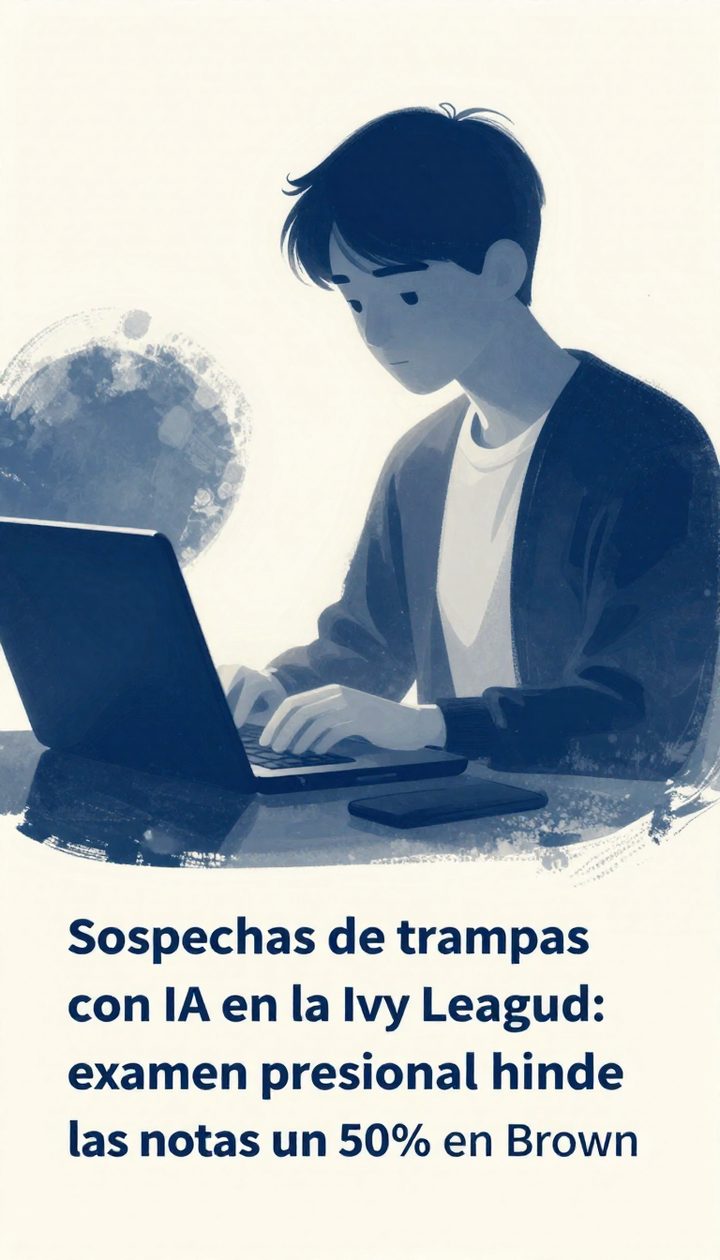
Suspicions of AI cheating in the Ivy League: an in-person exam sinks grades by 50% at Brown
🕒 Published on Zendoric: July 10, 2026 · 00:24
The case shaking Brown University these days sums up, better than any survey, the dilemma elite universities face with the arrival of generative AI in classrooms.
📚 Go deeper
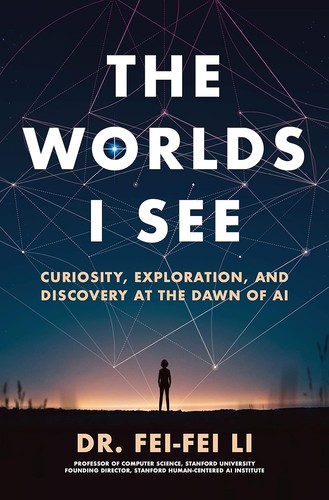
The memoir of the creator of ImageNet, the scientist who made the deep learning revolution in vision possible.
As an Amazon Associate, Zendoric earns from qualifying purchases; the price does not change for you. · all our recommended books →
We'll send you a confirmation email (double opt-in). Privacy.
The case shaking Brown University these days sums up, better than any survey, the dilemma facing elite universities with the arrival of generative AI in the classroom. The protagonist is Roberto Serrano, an economics professor born in Spain and blind since the age of 17 due to a retinal dystrophy, who teaches the course ECON 1170, a traditionally difficult subject with low enrollment (never more than 30 students, and sometimes only eight).
After the shooting that shook Brown's campus in December 2025, in which two people died —one of them someone who had just introduced himself to Serrano—, the professor decided to ease the pressure on his students and allow both the midterm and the final of spring 2026 to be taken in 'take-home' format, that is, to be completed at home and without direct supervision. The measure had an unexpected side effect: enrollment in the course soared to 86 students, far more than usual, probably drawn by the new assessment system.
The results of the midterm, held on March 5, were extraordinary: an average of 96 out of 100, with 40 students obtaining a perfect score. Serrano stresses that historically the average on that exam had ranged between 65 and 80 percent, and that on this occasion the exam was moreover harder than in previous years, precisely because the at-home, untimed format allowed for more demanding questions. Beyond the figures, something didn't add up: many answers, though correct, had a 'very convoluted' style, as the professor himself described it. When he and his graduate assistants entered the exam questions into ChatGPT, they got results very similar to those handed in by the students.
Faced with the suspicion of massive use of AI to cheat, Serrano decided to turn the final exam into an in-person test, as a way to check whether the performance held up. He sent an email to the class warning that he would not void the midterm immediately: he would give students 'the opportunity to prove me wrong.' If the grade distribution of the final was similar to that of the midterm, he would keep the grade; otherwise —which is 'of course what I hope happens,' he wrote— he would void the midterm and reweight the final.
The result was revealing: eighteen students dropped the course immediately after the warning, and another nine did not even show up for the final exam. Of those 27 students who disappeared, 22 had obtained a perfect 100 on the midterm. Among those who did take the in-person exam, the average plummeted from 96 to 48 points, a drop of exactly 50 percent that gives the news story its title.
Serrano has not limited himself to handling the case behind closed doors: in the past week he has told his story to the media outlets El País and Inside Higher Ed, in what he describes as a rather lukewarm response on the part of Brown's administration. His statements go beyond the purely academic. The professor, who learned Braille after going blind and who thanks to his record was able to study at Harvard, holds a view of life as a series of constraints that one must optimize, and applies that same logic to his diagnosis of AI in education: 'We cannot afford to have a society in which a significant fraction of our best young minds think cheating is fine. That leads to a society in decline, to a failed society. We cannot choose to become idiots.'
The case is not an isolated incident. The article recalls that a recent survey among Princeton students found that 29.9 percent admitted to having cheated with AI on at least one exam or paper. And Brown itself, as an institution, is grappling with this dilemma more broadly: a recent report led by the provost's office on 'generative AI in teaching and learning' revealed that 56 percent of undergraduate students and 67 percent of graduate and medical students acknowledge using generative AI tools daily or weekly. However, that same report notes that large majorities of students express concern about the impact of that use on their own learning, as well as 'fear of negative consequences for their cognitive capacity.'
What makes this episode especially uncomfortable is that it contradicts the idea that only struggling students turn to AI to get by. These are students at an Ivy League university, presumably capable of passing without help, but subjected to a combination of ambition, competitiveness and schedule overload that turns the technological shortcut into a temptation hard to resist when supervision disappears. Serrano's experiment, with its direct comparison between an at-home exam and an in-person exam on the same material, offers one of the most compelling pieces of evidence to date on the real magnitude of that phenomenon within a specific course, beyond the figures from self-perception surveys.
📚 Go deeper
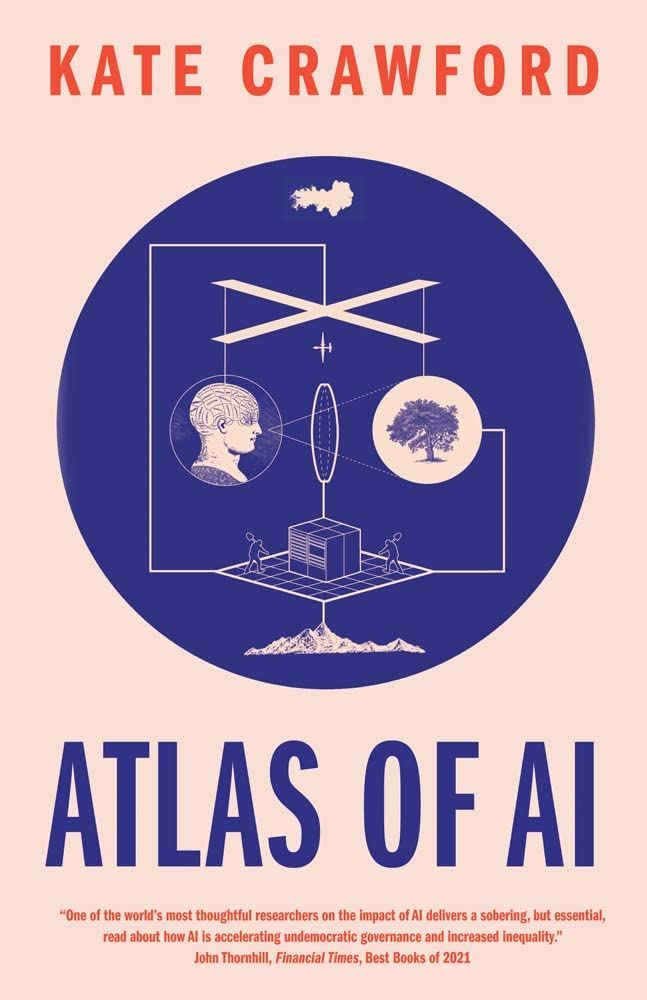
AI as an extractive industry: the lithium, the energy, the underpaid data-labeling work and the bodies behind the cloud.

The only novel on the list, by a Nobel laureate: an artificial friend observes humans with a blend of lucidity and innocence no essay achieves.
As an Amazon Associate, Zendoric earns from qualifying purchases; the price does not change for you. · all our recommended books →
🔗 Related on Zendoric
- AI cheating reaches the Ivy League: the problem isn't the chatbot, it's what we measure as learning · 2026-07-10
- Chatbots to teach empathy: the paradox of using AI to save what is human · 2026-07-03
- AI fraud forces digital identity to stop being a formality and become permanent surveillance · 2026-07-03
Sources & references
Get the analysis by email · free
One email a day analysing the AI essentials. Free, no spam, unsubscribe anytime.
We'll send you a confirmation email (double opt-in). Privacy.