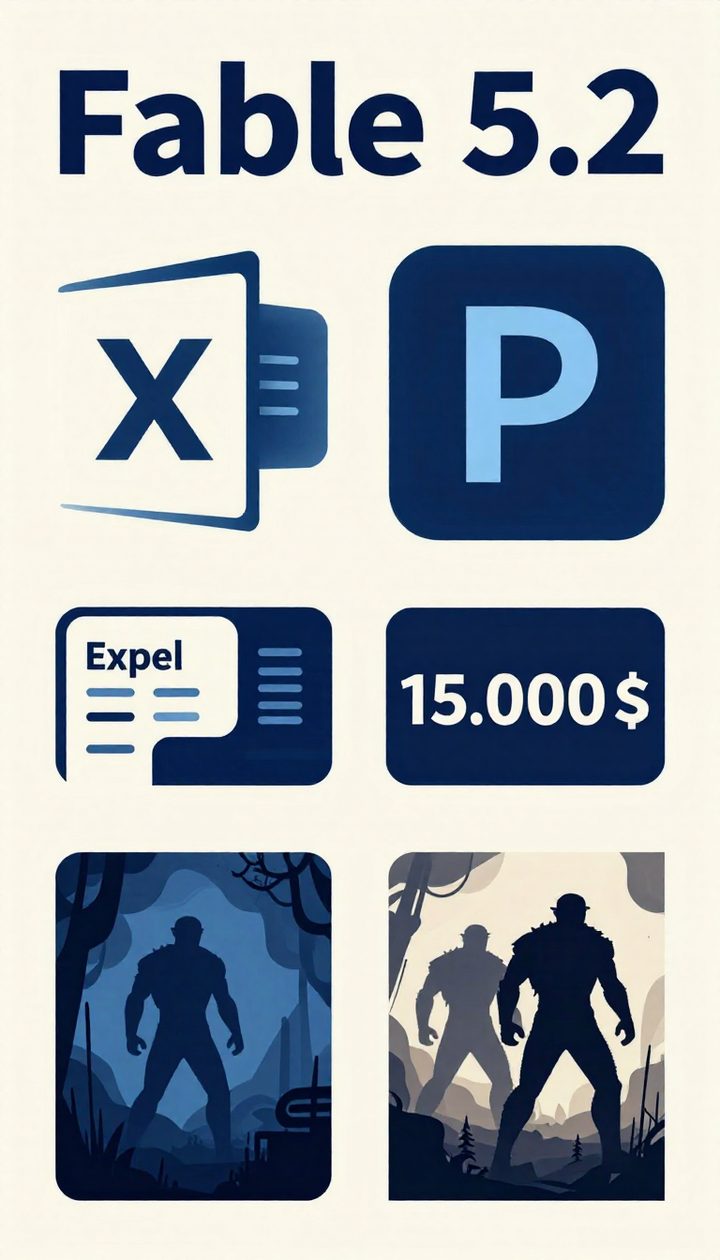
Fable 5.2 in four real-world tests: Excel and Photoshop clones, a Gears of War-style game and a cost of up to $15,000
🕒 Published on Zendoric: November 11, 2026 · 00:19
✨ AI-generated · how it's made
Note: the text received is only a preview of a paywalled article (Forward Future, by Matthew Berman). It includes the verdict, an explanation of what changes in Fable 5.2 and the first full test. The second test, the video game one, is cut off at the paywall.
📚 Go deeper

How opaque algorithms decide who gets credit, a job or parole — and why they tend to punish the same people.
As an Amazon Associate, Zendoric earns from qualifying purchases; the price does not change for you. · all our recommended books →
Disclaimer: the text we received is only a preview of a paywalled article (Forward Future, by Matthew Berman). It includes the verdict, an explanation of what changes in Fable 5.2 and the first full test. The second test, the video game one, cuts off at the paywall. This summary covers only what could be read. The figures and claims are the author's and we have not independently verified them.
The author argues that Fable 5.2, Anthropic's latest model, is the best he has used, “by far.” He says we are witnessing a different era of software development. According to him, a three-line prompt produced a playable Gears of War clone with AI-controlled enemies and combat mechanics. Another prompt produced an Excel clone that he considers the most complete he has built. He says his team also created video editors, multiplayer games, Android utilities and complex 3D environments, and that some of those projects are already used in his actual production work.
For the author, the most striking thing is the autonomy. The model takes on huge, loosely specified tasks, plans the architecture, gathers the assets, builds complex systems and iterates with very little supervision. He says he has tried many models capable of generating flashy prototypes, but describes this version as far more complete in physics, graphics, interfaces and interconnected features. He cites his new Fall Guys clone as an example, which he judges to be clearly better than those made with earlier models.
The main drawback is resource consumption. The Gears of War clone, built with Unreal Engine, used 8.5 billion tokens according to the author, about $15,000 at estimated API rates, and the project was still ongoing. To generate it he enabled a mode called “Ultra Code,” and it took a few days. Not everything is that expensive: a complex motion-graphics explainer video cost, he says, about $25. He also acknowledges that even the best results were not perfect. His thesis is that not everything is cheap or simple, but that projects once beyond the reach of an individual creator are now technically possible.
Test 1: personal software. The question was whether Fable can replace paid programs. The browser-based Excel clone was requested with a very simple prompt: build a complete clone with feature parity and read the specifications to work them out. According to the author, it took about 50 hours and consumed about 8 billion cached input tokens plus 15 million output tokens, at an estimated cost of $11,700. The result had Excel's ribbon with its tabs (Home, Insert, Draw, Page Layout, Formulas, Data, Review, View, Automate and Help). It could open a sample sales tracker, work with pivot tables, create new sheets and use formulas. The author notes that he did not check every feature against the real Excel, but that the clone behaved as he would expect from a spreadsheet.
His producer, Alex McCraw, went further and created his own versions of Photoshop and Premiere tailored to his workflow, rather than exact copies. His Photoshop alternative is called Safelight. With it he has made YouTube thumbnails in a 4K document, with images, layers, text, brushes, fills and gradients, and has already produced several for the channel. His Premiere-style editor has Claude built in, so you describe the changes and the AI applies them inside the program itself. The author says Alex uses it to edit videos and that, after years of subscribing to Adobe, he has been able to cancel. The author also tried a DaVinci Resolve-style editor called Kestrel, which runs locally on Windows. According to his description it has a timeline, waveforms, clip cutting, magnetic snapping, shortcuts, zoom and keyframes, and it worked “perfectly.”
His verdict is nuanced: he does not recommend cancelling all your subscriptions tomorrow. Reproducing the features you need is very different from matching all the features, integrations and reliability guarantees of a mature professional application. Even so, he already uses AI-built software instead of commercial alternatives and speaks of an era of “software for one,” in which you describe the application and the AI builds it to measure. His practical advice is to start with ambitious tasks and see how much the model solves on its own. For custom software, you need to explain how the application is used, which features matter and which controls and shortcuts to keep.
The second test, on video game development, is only sketched in the available text: the author asked for a Gears of War-inspired shooter in Unreal Engine, and Alex made several Iron Man games, including a LEGO-style version. The rest of the analysis, with the other tests and the comparison with the team's favorite models, is behind the paywall and cannot be summarized here.
Conclusion: the cost, time and capability figures come from the author himself, with no external verification in the available text. Even so, the article points to a trend: the technical barrier to building software is falling, while token cost is becoming the main constraint.
📚 Go deeper

Algorithms in justice, medicine, cars and art, explained with British humor and mathematical honesty.

The reference manual for building products on top of AI models: prompts, RAG, fine-tuning, agents, evaluation and deployment.
As an Amazon Associate, Zendoric earns from qualifying purchases; the price does not change for you. · all our recommended books →
🔗 Related on Zendoric
- Does prompting still matter? The new rules for getting what you want from AI (Forward Future) · 2026-10-31
- How Forward Future built an AI "second brain" that works on its own: from a single email stream to structured memory · 2026-11-04
- Grok Bot handbook, part 2: 14 practical uses for its new features, from Vault and Teach a Task to shared bots · 2026-11-07