AI glasses reach Korea's college entrance exam: fear of being accused is already changing how students prepare
🕒 Published on Zendoric: November 10, 2026 · 02:47
✨ AI-generated · how it's made
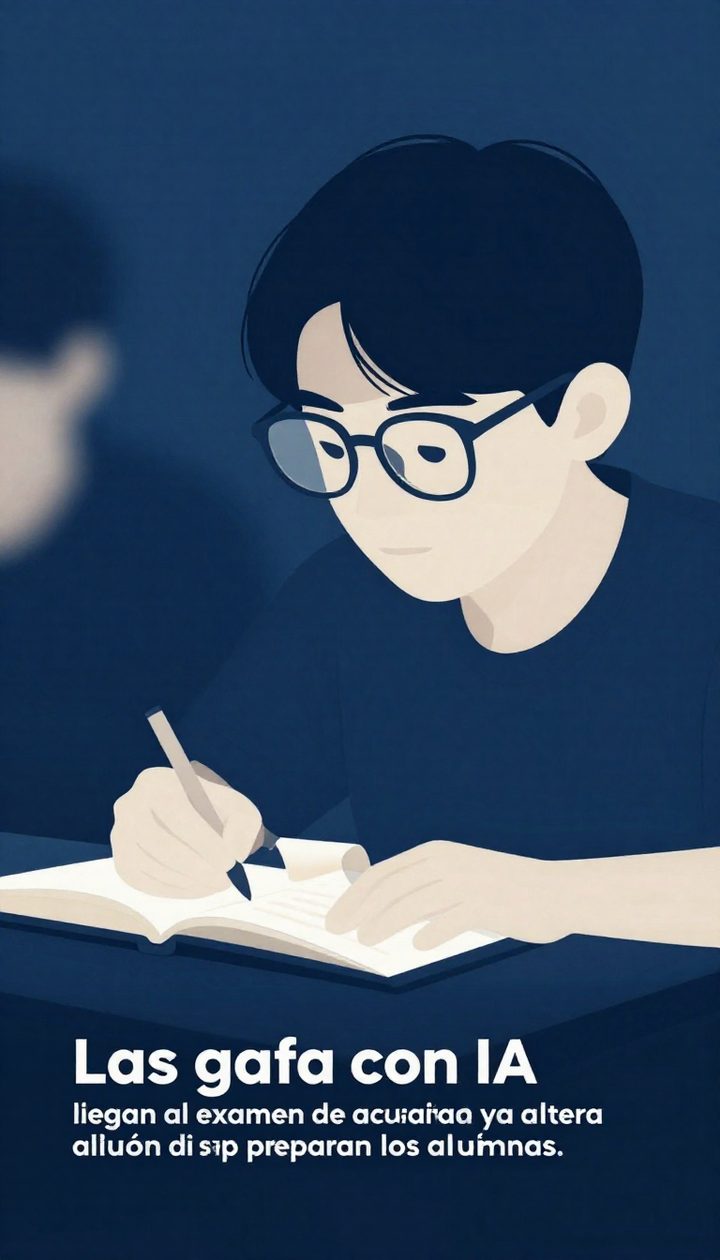
Ten days before the suneung, South Korea's university entrance exam, dozens of families are asking whether they should change their glasses for fear they will be mistaken for smart ones. The episode shows that policing AI cheating also carries a cost for those who don't cheat.
📚 Go deeper

The memoir of the creator of ImageNet, the scientist who made the deep learning revolution in vision possible.
As an Amazon Associate, Zendoric earns from qualifying purchases; the price does not change for you. · all our recommended books →
By Korea JoongAng Daily · November 10, 2026.
Ten days before South Korea's college entrance exam, the College Scholastic Ability Test (CSAT, known as the suneung), the Busan education office received dozens of calls from students on Monday. They wanted to know whether they should swap their thick-framed glasses for fear of having them mistaken for AI-powered smart glasses. According to the paper, they also asked what would happen if a proctor told them to take them off in the middle of the exam.
The rules are strict. According to the paper, wearing smart glasses at an exam site will be treated as cheating even if they are not used. The penalty is cancellation of the student's results and a ban from sitting the exam the following year. The same penalty applies to anyone who wears them without declaring them or refuses to have their frames checked. The Ministry of Education has also warned that it will refer anyone who cheats with them to law enforcement.
The monitoring operation is extensive. At least one official responsible for identifying smart glasses will be stationed at each of the country's 1,312 exam sites, and the test will be held in more than 20,000 classrooms. If a proctor is suspicious, the student will finish the session and then be asked to have the glasses examined. The authorities are putting avoiding disruption to the exam ahead of on-the-spot inspection. Specialists trained on these devices will handle queries from the coordination headquarters.
The events behind this fear are concrete. A Ministry of Education survey of high schools found four cases of cheating with smart glasses this year. In one, a student who did not normally wear glasses kept touching the frame. In another, a green light on the lenses gave the student away. Those involved received a zero in the subject and penalties ranging from a five-day suspension to no further sanction. In a separate case, some 170 students at a Seoul high school are suspected of having used AI on an assessment, which will be retaken.
The teachers who will serve as proctors admit that most of them have barely seen these devices. According to a teachers' union cited by the paper, proctoring assignments are announced the day before, and a single day of training is not enough to spot them. A Busan teacher sums up the dilemma: looking too closely distracts students, while looking too little exposes the proctor to liability if a cheater slips through. According to the experts cited, smart glasses can be identified up close by their camera, buttons and charging ports, and an optometry professor consulted adds that wearers often give themselves away through behavior such as touching the frame.
Our take: the episode exposes a problem that will only grow. When a consumer technology becomes invisible, fraud prevention shifts from watching an object to watching people. That shift comes at a cost to honest students. A student wearing the same frames as always now carries a cloud of suspicion, and some families have already swapped their child's glasses just before the most important test of their lives, with all the added stress that entails.
It is also a race that oversight will not win through inspections alone. Glasses with built-in cameras and assistants are generally becoming a mass-market product, and the Korean press reports that Samsung and Google are preparing their own for December. Each new model will be more discreet and harder to recognize at a glance. Toughening penalties and training proctors in a single day is a short-term fix with an expiration date.
That is why the deeper proposal in the article, attributed to Professor Leem Hyun-sung, matters more: develop detection tools and, in the long run, replace memorization-based exams with assessments that measure the ability to solve problems creatively. We agree with that direction. An exam that can be beaten with a discreet assistant in a pair of frames largely measures what AI already does better than we do. In the short term, an uncomfortable transition lies ahead, with more surveillance, false positives and mistrust. In the long term, the same AI that threatens the exam today could force us to assess what really matters: judgment, understanding and the ability to learn, in an education system less obsessed with a single day.
📚 Go deeper

AI as an extractive industry: the lithium, the energy, the underpaid data-labeling work and the bodies behind the cloud.

The only novel on the list, by a Nobel laureate: an artificial friend observes humans with a blend of lucidity and innocence no essay achieves.
As an Amazon Associate, Zendoric earns from qualifying purchases; the price does not change for you. · all our recommended books →
🔗 Related on Zendoric
- AI glasses in exams: when cheating beats the top 5 of the class, the assessment system has a bigger problem · 2026-06-28
- Metal-framed glasses for the exam: Korea answers AI cheating with visual inspections, leaving families to improvise · 2026-11-02
- AI abuse case shows the harm arriving now, not in some distant future · 2026-07-10