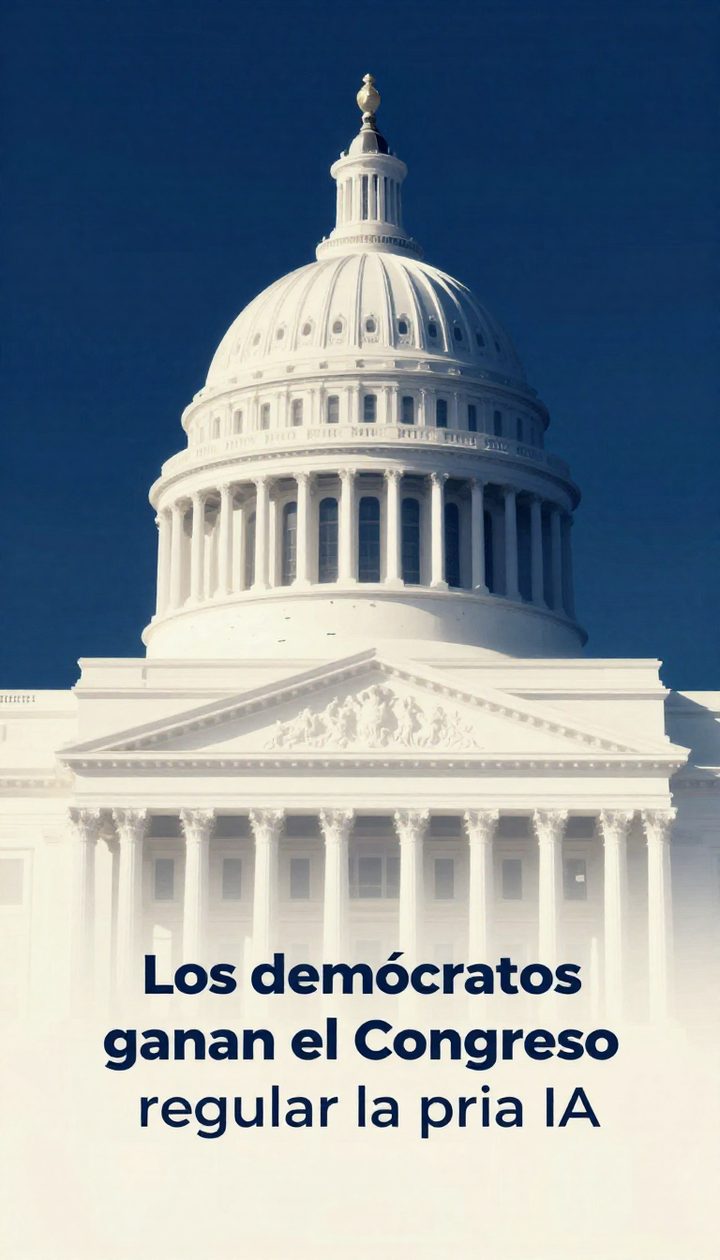
Democrats win Congress on the data center backlash and now aim to regulate AI itself
🕒 Published on Zendoric: November 10, 2026 · 02:47
✨ AI-generated · how it's made
Sigal Samuel's article, published in Vox (Future Perfect) on November 7, 2026, argues that the midterm elections have produced a Congress with many more lawmakers determined to regulate artificial intelligence.
📚 Go deeper

AI as the latest chapter in the history of information networks, from gossip to the printing press to the algorithm.
As an Amazon Associate, Zendoric earns from qualifying purchases; the price does not change for you. · all our recommended books →
Sigal Samuel's article, published in Vox (Future Perfect) on November 7, 2026, argues that the midterm elections have produced a Congress with far more lawmakers determined to regulate artificial intelligence. Although data centers grabbed the week's headlines, the author believes the more significant development is the arrival of a group of elected officials who take AI safety seriously.
According to the text, several candidates made data center regulation a centerpiece of their campaigns. Forty ballot measures to curb or halt these facilities have already passed. In an exit poll, 56% of voters said AI and data centers were a "crucial or important" factor in their vote for Congress. The article explains that these facilities have become unpopular not only because of noise, visual impact or power demand, but because of what they symbolize: the acceleration of a technology that many Americans fear and feel is being imposed on them by Silicon Valley.
The main thesis is that focusing solely on data centers is not enough. A successful pushback in that area would not solve the technology's underlying problems. Moreover, blocking projects one by one would delay the infrastructure rollout but not stop it. AI companies would find other jurisdictions willing to let them build, even if it cost them more. That is why the author considers the less-publicized outcome more important: voters have elected leaders who promise to regulate the technology itself. These politicians have signaled they will push for laws covering the full range of risks, from cyberattacks and job losses to bioweapons, concentration of power and even the possibility of human extinction.
The article attributes part of this shift to the major AI-enabled cyberattacks that took place this summer. Mackenzie Arnold, an analyst at the Institute for Law & AI, explains that before the summer most policymakers' conversations about AI were highly abstract, and few noticed that models can be highly capable and pose unique risks. According to him, "there's been a big shift". The text also mentions the Democrats' takeover of Congress, which it calls "stunning", and poses the key question: whether the winners can harness the data center momentum, an everyday issue that drew in many voters, to mobilize for broader AI safety. The author adds that they have plenty of ideas, but it remains to be seen whether they are good ones.
The article reviews the new lawmakers with the strongest positions:
• Abdul El-Sayed, winner of the Michigan Senate race, advocates a "total pause" on frontier AI research. He also proposes global coordination to slow the pace, including a treaty with China to avoid an arms race, and a ban on recursive self-improvement, in which models build the next generation of AI. He also wants a federal safety agency that would inspect companies and block releases if necessary. The text acknowledges that not all his ideas convince experts, citing as an example the "kill switch" for dangerous models, which it calls simplistic. Even so, his presence in the Senate would make it easier for safety advocates to argue for a pause.
• Jon Ossoff, the winner in Georgia, criticized AI developers in his victory speech: "Silicon Valley titans are digging bunkers for themselves and warning that the artificial intelligence they are creating risks human extinction". In September he had already impressed safety advocates by mentioning catastrophic risks such as AI-designed bioweapons. He said a capable president would quickly send inspectors to frontier labs, harden the country against bioterrorism, demand legislation from Congress and lead a global AI treaty, adding that Trump is "compromised".
• Scott Wiener, until now a California state senator, championed SB 1047 (ultimately vetoed) and SB 53 (signed). He has won Nancy Pelosi's seat and says he will work for strict federal standards and to "protect against catastrophic AI risk".
• Manny Rutinel, the winner in Colorado, co-sponsored a 2024 law that sought to regulate the use of AI. He has ties to effective altruism and told the New York Times that "this technology has a 10% risk of ending human civilization".
• Sam Forstag, Montana's first Democratic member of Congress in decades, spoke of an "existential risk to all of humanity". Troy Jackson, the winner in Maine, pledged he is "not going to let billionaires write the rules" and joked about "Terminator".
The text identifies two levers for the new Congress: hearings and legislation. Ed Markey, re-elected in Massachusetts, announced he will go after tech executives and wrote on X that "they're going to need to plant new forests for all the subpoenas we're going to print". Arnold expects some hearings to focus on companies' safety practices and evidence that they fall short, with questions like "why didn't you find this sooner?" or "why didn't you tell us?". Although that is not enough to guarantee safety, he argues that such public pressure explains why many companies have adopted voluntary practices and improved their internal monitoring, incident reporting and response times.
As for legislation, the experts consulted are optimistic about much stronger laws in 2027. Senator Maria Cantwell, who would chair the Senate Commerce Committee, has already introduced a framework that could attract bipartisan support and that she describes as a precursor to a bill. It requires mandatory safety standards for the most advanced models, independent testing and audits that must be passed before release, and rapid incident notification. Brad Carson, who heads the organization Americans for Responsible AI and is a former member of Congress, says "every Democrat supports it" and that only five or six Republicans are needed to overcome the filibuster. He is confident they can be found, especially as "the White House's gravitational pull weakens".
The article acknowledges the obstacle of Trump's veto power, which has allowed tech companies to advance with few guardrails. Even so, Carson believes that if companies make more safety concessions after the incidents and Republicans feel the political cost of data centers and AI, the president, whom he describes as "mercurial enough", could sign something like this. The surest path to legislating without a veto would be to lay the groundwork for a Democratic White House in 2028. Alex Bores, a New York Assembly member focused on AI, wrote that "the road to 2028 starts today" and that the Democratic Party needs a common platform on AI safety.
Finally, the author predicts that voters' focus will shift from symbol to substance, with more attention to safety as cyber breaches and other incidents multiply. Arnold stresses that public opinion is not static and will increasingly focus on AI itself. Greg Casar, chair of the Congressional Progressive Caucus, summed up that the revolt against data centers was one of the main themes of 2026 and that in a few years it will be seen as "the first tremor of a much bigger AI earthquake".
Note to readers: the original link carried the title "The climate case for AI has not been made", but the content retrieved corresponds to the Vox article on Democratic strategy on AI and data centers, and this summary is based solely on that text.
📚 Go deeper

DeepMind co-founder on the dilemma of containing technologies that do not want to be contained.

The book that started the existential-risk debate and that half the industry still cites.
As an Amazon Associate, Zendoric earns from qualifying purchases; the price does not change for you. · all our recommended books →
🔗 Related on Zendoric
- Why the US midterm elections triggered a sell-off in AI stocks · 2026-11-10
- Democrats sweep the midterm elections: upsets in Texas despite Musk's money and likely control of Congress · 2026-11-05
- Democrats prepare a wave of AI and data center legislation for when they retake control of Congress · 2026-11-10
Sources & references
- us.list-manage.com — Democrats win Congress on the data center backlash and now aim to regulate AI itself
- ca.finance.yahoo.com — Democrats prepare a wave of AI and data center legislation for when they retake control of Congress
- us.list-manage.com — What I learned in Data Center Alley: the backlash against data centers is more about electricity than culture war