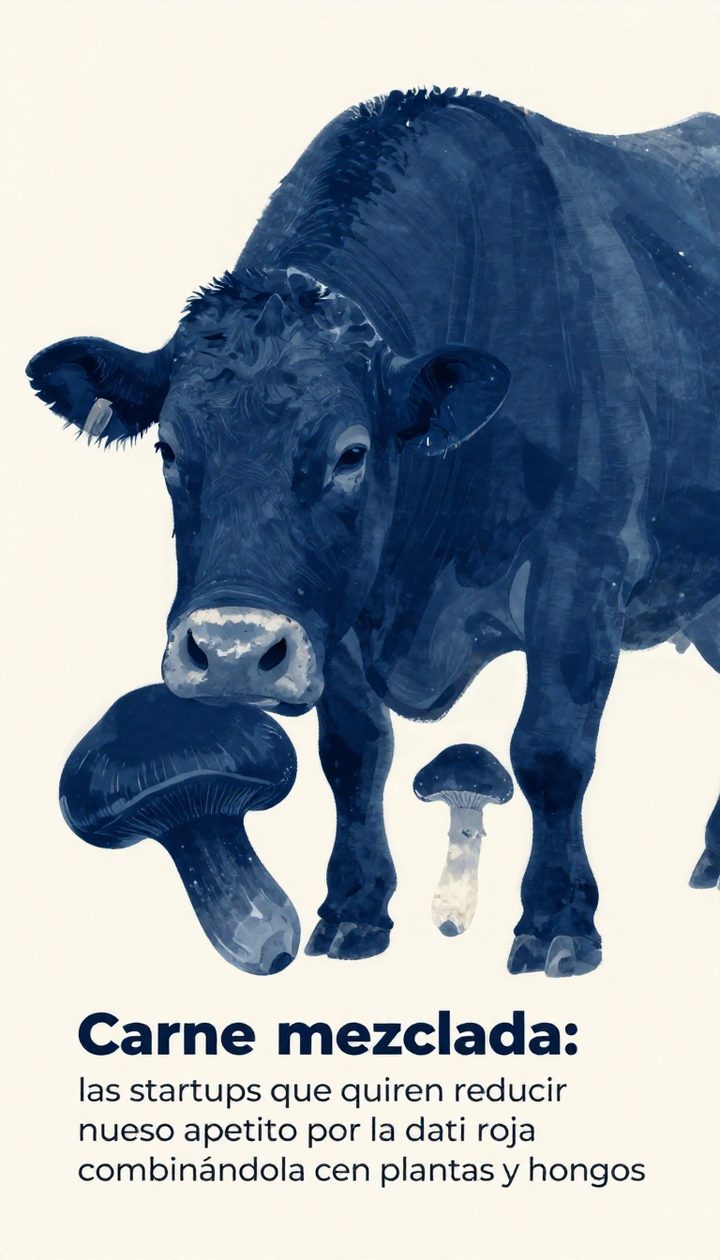
"Blended" meat: the startups that want to curb our appetite for red meat by mixing it with plants and fungi
🕒 Published on Zendoric: November 5, 2026 · 00:16
✨ AI-generated · how it's made
The MIT Technology Review article by Meghan McCarron looks at an alternative approach to beef's climate impact. Rather than asking consumers to give it up, several startups propose blending it with plant or fungal ingredients.
📚 Go deeper

The memoir of the creator of ImageNet, the scientist who made the deep learning revolution in vision possible.
As an Amazon Associate, Zendoric earns from qualifying purchases; the price does not change for you. · all our recommended books →
The MIT Technology Review article by Meghan McCarron looks at another way to tackle beef's climate impact. Instead of asking consumers to give it up, several startups want to blend it with plant or fungal ingredients. Their argument is that the best meat substitute is simply better meat: meat that keeps the flavor and juiciness but contains less animal product.
The opening scene takes place at Cane Bay High School in Summerville, South Carolina. In fall 2025, Jeff Dodge of the consultancy K–12 Food Solutions ran a taste test there with about 150 students in the first round. They tried meatballs in marinara sauce made with 50/Cut, a product from the company Joyn that combines beef with roasted mushrooms and cultivated mycelium. Few could guess which vegetable was in them. According to the survey, 92% of those who tried them wanted them on the menu. That cleared the threshold for adding them in the 2026–2027 school year.
The article sets out the climate context. Livestock accounts for between 10% and 20% of human-caused greenhouse gas emissions, and about two-thirds of that comes from ruminants. Beef herds produce four times more emissions than dairy herds per kilogram of food produced. Ruminants produce about 30% of human-related methane, a gas with 28 times the warming potential of CO₂. Unlike electricity or transportation, cattle farming offers little room for a big technical fix. Fredrik Hedenus, a professor at Chalmers University of Technology in Sweden, says there is no technical solution for changing a ruminant's stomach. Technologies to cut emissions from cattle burps have been in development for some time but have yet to scale. They also solve only part of the problem, because cattle need large amounts of land for pasture and feed and are a driver of deforestation in the Amazon and other regions.
Hedenus's research shows that even if the world stopped burning fossil fuels tomorrow, agricultural emissions would push the planet past 2°C above preindustrial levels by around 2070. Even with more efficient livestock farming, agriculture would still use up more than half of humanity's carbon budget by then. His model reaches a winning scenario only when dietary change is added. A 2024 Harvard survey of more than 200 climate scientists found that the vast majority consider it important to cut livestock emissions. As Hedenus puts it, what is needed is cultural change.
That change has proved hard to achieve, though. People like the taste of meat, and in most of the world eating it is tied to status and rises with wealth. A UN report cited in the article shows that global meat production quadrupled between 1961 and 2022. Over the same period, vegetarians have made up about 4% of the US population since 1999. Lab-grown meat has made headlines for decades but is still not commercially available at scale or at an affordable price. Plant-based meats from companies such as Impossible Foods and Beyond Meat have also lost some of their early excitement.
The article traces the rise and fall of those plant-based meats. Impossible launched its burger in 2016 with the heme molecule, which let the product "bleed" like beef. In 2019 its founder told the New Yorker he aimed to end all animal farming by 2035. Beyond's IPO that same year was the most successful since the 2008 crisis. But by 2023 the value of Impossible's employee shares had fallen 89% from their 2021 peak, Beyond had laid off 20% of its staff, and a Businessweek feature called the sector a fad. Sales have been falling for years, with a 10% year-on-year drop in 2025 according to the Good Food Institute. Meanwhile, Americans spent $45 billion on beef in 2025, and consumption rose 4.3% from the previous year, according to an industry report.
The article points to several causes. An Impossible spokesperson calls it a "correction, not a crisis" after a spike in demand between 2020 and 2022, and says the flood of products hurt the category's reputation. Nectar, an organization that studies meat alternatives, finds that taste and texture are among the main barriers. According to its director, Caroline Cotto, consumers report off-flavors and strange tastes five to six times more often than with the animal-based versions. Then there is the debate over ultra-processed foods. It was fueled from 2019 by a campaign from the now-defunct Center for Consumer Freedom, which was backed by the meat industry, and has since been turned into a political weapon by the MAHA movement and Health Secretary Robert F. Kennedy Jr.
Blended meat grew up in the shadow of the plant-based stars, without magazine covers or IPOs. Companies such as Tyson and Perdue launched hybrid products, and cultivated-meat companies explored mixing their product with plants. Blended meat has one advantage: many "flexitarian" consumers are curious about it and like it once they try it. A 2022 blind taste test co-funded by the USDA found that diners preferred blended burgers to fully plant-based ones. An ADM report found that large shares of every generation wanted to try blended meats, including 75% of millennials. Tim Dale of Food Systems Innovations, the organization that oversees Nectar, says blended meat is a solution that can be deployed today and that consumers will accept today. Even Peter McGuinness, whom the article describes as Impossible's former CEO, suggested in the Wall Street Journal in 2025 that a hybrid burger could serve as a bridge.
Paul Shapiro, co-founder of BMC Ingredients, lays out the math. If Impossible Whoppers make up around 2% of Burger King's sales, meat is reduced by only 2%. If a regular Whopper contained 20% plants, the cut would be 20% from the start. A 2022 study in Nature cited in the article estimates that replacing 20% of beef worldwide could halve the annual rate of deforestation.
New players include Fable Foods from Australia, whose beef-and-shiitake burgers are sold in restaurants and at the gourmet store Central Market in Austin. Los Angeles-based 50/50 Foods makes the Both Burger, which is available at some stores and restaurants in California and is even on the menu at Disneyland. New York's Spare Food signed a deal with Premier, one of the largest buyers in the US healthcare sector, for its blend of surplus farm produce and ground meat. Blended products also appear in the catalogs of major distributors such as Sysco.
One common lesson is that marketing works best when it focuses on enjoyment rather than environmental or health benefits, even though many of these blends have a better nutritional profile, with more fiber and less saturated fat. Meat and mushrooms share complementary flavor compounds, such as the glutamates that provide umami. That is why they are combined in dishes like beef Wellington and stroganoff.
BMC Ingredients, which worked with Perdue on blended nuggets, grows mycelium through fermentation. The fungus Neurospora crassa digests starch and produces a protein with a dense network of fibers that gives it a meat-like chew. Shapiro compares his factory to a brewery. Mycelium is also the basis of alternatives such as Quorn. Joyn focuses on away-from-home food service, which accounts for more than half of US consumers' food spending according to the USDA. Its customers include school and university cafeterias and large suppliers such as stadiums. According to Padraic Doherty, its chief growth officer, these organizations have sustainability targets and face pressure to offer nutritious, affordable options. The 50/Cut that Joyn sells to cafeterias is 5% to 15% cheaper than beef.
Can a blended burger bring about cultural change? Its backers see it as a bridge. Cotto compares it to a hybrid car. In her view, pushing blended products creates demand for fully plant-based ingredients that do not yet scale, which helps bring their cost down, so blends help in both the short and long term. Nil Zacharias of Plantega is skeptical. He thinks too many people assume it is enough to make a product that tastes like meat and costs the same, and says the backlash against ultra-processed foods shows it is not that simple. He expects blended meat's main impact to be in institutional food service, such as schools and healthcare facilities. Clemens Driessen, a cultural geographer at Wageningen University, notes that when people are offered something very new, such as cultivated meat, they also start to question how industrialized their current food already is. Hybrids could therefore open minds to other alternatives.
The article does not hide the limitations. A life-cycle analysis commissioned by Joyn confirms that 50/Cut has half the greenhouse gas footprint of a beef burger. Going by the companies' own claims, that is still about five times the impact of an Impossible or Beyond burger. Hedenus admits that blended products cut impact less than plant-based ones. Given how hard it is to change the way we eat, though, he argues for exploring any approach that works.
Meanwhile, the products are reaching more plates in cafeterias, gourmet stores and small burger chains. The 50/Cut meatball is on school menus in seven states this year. At Cane Bay High it will be served as a sandwich, and the school will buy 200 cases per order, each holding 150 meatballs. Jason Ciaccia, the district's child nutrition director, does not plan to use the word "mushroom" when describing it, because students who hear it will skip the dish. He asked an AI for help with branding and likes the name "Marvelous Meatball Sub."
Note that the feature relies on data and claims from companies with a stake in the outcome, such as the life-cycle analysis commissioned by Joyn and the pricing figures. The article itself also acknowledges that blends have a smaller climate benefit than the fully plant-based alternative.
📚 Go deeper

AI as an extractive industry: the lithium, the energy, the underpaid data-labeling work and the bodies behind the cloud.

The only novel on the list, by a Nobel laureate: an artificial friend observes humans with a blend of lucidity and innocence no essay achieves.
As an Amazon Associate, Zendoric earns from qualifying purchases; the price does not change for you. · all our recommended books →
🔗 Related on Zendoric