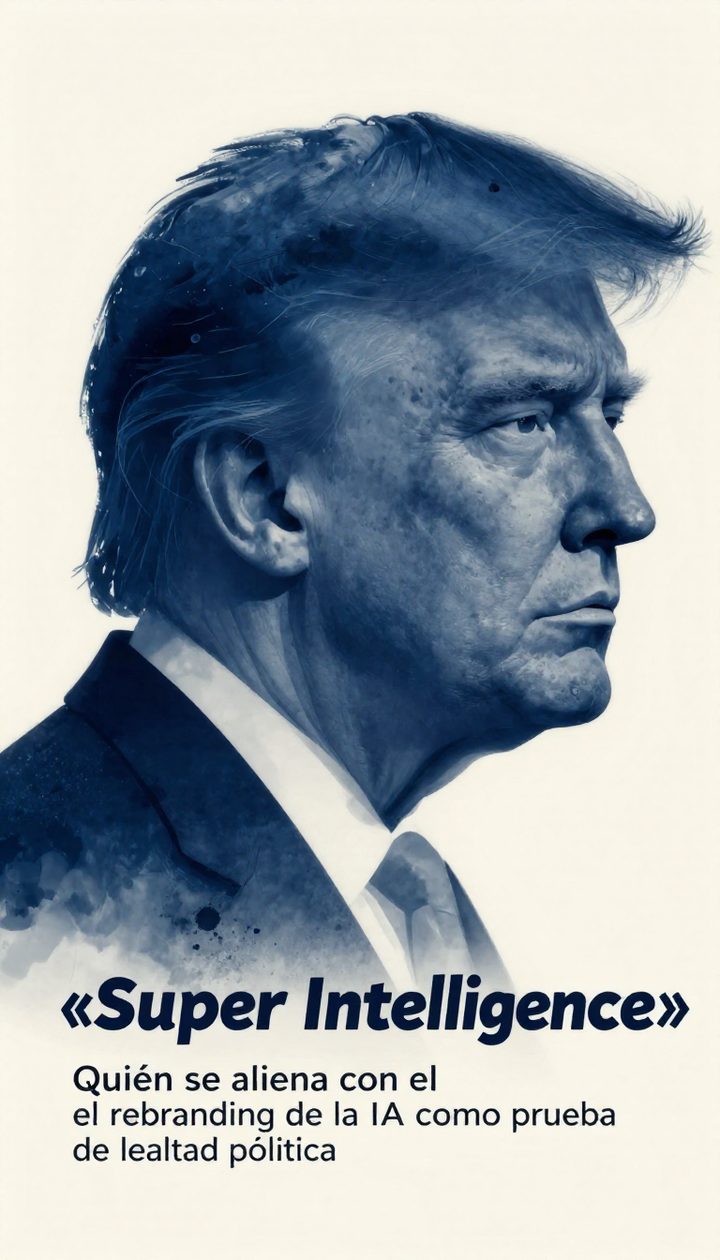
Who's lining up behind Trump's "Super Intelligence": AI rebranding as a test of political loyalty
🕒 Published on Zendoric: November 4, 2026 · 00:20
✨ AI-generated · how it's made
The MIT Technology Review article by James O'Donnell, originally published in The Algorithm newsletter on November 2, 2026, examines the White House's attempt to rebrand artificial intelligence as "Super Intelligence" (or "SI").
📚 Go deeper

DeepMind co-founder on the dilemma of containing technologies that do not want to be contained.
As an Amazon Associate, Zendoric earns from qualifying purchases; the price does not change for you. · all our recommended books →
The MIT Technology Review article by James O'Donnell, originally published in The Algorithm newsletter on November 2, 2026, examines the White House's attempt to rebrand artificial intelligence as "Super Intelligence" (or "SI"). The text is complete, not a paywall teaser, and this summary sticks to what it reports.
In late September, President Trump signed an executive order with a single directive: government agencies must start calling what they had until then referred to as artificial intelligence "Super Intelligence." The term beat out other options, such as "Extreme Intelligence" and "Supreme Intelligence," which the president had floated in a poll on X a couple of weeks earlier. The official rationale is that current systems "amplify human ingenuity" rather than merely "imitating" intelligence.
According to the author, this fits a White House tradition of renaming: the Gulf of America, Lake America, the Department of War, and the fight over renaming the Kennedy Center. His argument is that the change doesn't stay within government. It turns a choice of words into a political loyalty test: those who use the new term signal alignment with the administration, and those who don't risk being targeted. He recalls that the administration barred the Associated Press from some press events after it refused to adopt "Gulf of America." The difference, he notes, is that hardly anyone thinks often about what to call a lake, whereas AI is at the center of the national conversation. Two-thirds of Americans say they interact with it several times a week. That is why he calls it perhaps the most ambitious rebrand yet.
A month later, who has adopted the term? Within the government itself, "Super Intelligence" or "SI" increasingly appears in contract solicitations. One example is ICE's request for companies to build "SI-powered" surveillance systems for its detention centers. On most official websites, the swap has been made without notice. Some, such as the National Institutes of Health (NIH) site, display a banner warning that both terms may appear during the transition.
There have been stumbles. A day after the order, the Pentagon announced Project Meridian, an initiative on the future of warfare, using the old terminology. A recent FTC press release used "superintelligence" as one word, not the two-word, capitalized version the president ordered. Recent releases from Health and Human Services show no trace of the new language. The term "AI" will remain in place because of the many offices and programs that already carry it, such as the Pentagon's Chief Digital and Artificial Intelligence Office. The executive order states that it does not apply to prior regulations or documents. Among public employees, the habit is slow to change: a researcher at a national lab repeatedly said "AI" in an interview before catching himself, and Defense Secretary Pete Hegseth also said "AI" in an interview on October 3.
The author argues that the goal goes beyond official vocabulary and aims to change how the rest of the country talks. On October 27, Trump criticized the Wall Street Journal on Truth Social for not using "Super Intelligence," "the name that virtually everyone else uses, or soon will." He hinted that a new rule could go beyond the order and outright ban "artificial intelligence" in government documents. The Journal is not alone: not even Newsmax, whose founder has described it as favorable to the president and his policies, uses the preferred term.
As for tech executives, the response is mixed. On the same day as the order, Trump released a nonbinding statement on AI safety, the White House Accord on Super Intelligence, signed by six figures: Sundar Pichai (Google), Dario Amodei (Anthropic), Mark Zuckerberg (Meta), Greg Brockman (OpenAI), Elon Musk (xAI) and Jensen Huang (Nvidia). Even so, according to a CNBC analysis of third-quarter earnings calls, only Zuckerberg and Musk used the term consistently. Zuckerberg's case counts for less, since Meta has been saying "superintelligence" since last year. Musk's companies use it the most, and he promised to rename SpaceXAI as SpaceXSI, though on X he still mixes SI and AI. Executives at Amazon, Microsoft and Alphabet said "AI" on their calls, although Microsoft's recent shareholder letter spoke of the "era of Super Intelligence." Huang has mentioned the term but also continues to use AI.
The article raises a practical objection: the cost in time and public money. Federal employees are already spending hours drafting guidance to manage the change. In addition, under the order, agency heads must draft a new legislative definition of "Super Intelligence" to submit to the president before the end of the month. The author contrasts this with a private company, where a CEO like Salesforce's Marc Benioff can decide that "SIForce" is a better name than "AIForce."
O'Donnell's biggest concern, however, is the effect on the national conversation. He says he often overhears strangers talking about AI in supermarkets or coffee shops, almost always about a jobs apocalypse or AI warfare, and sees in this a widespread desire to weigh in on how the technology will transform their lives. Opinions can differ sharply, even be hostile, but they don't yet map onto the partisan divides that make talking about immigration or climate uncomfortable. If "Super Intelligence" becomes a loyalty test, that will change. He imagines two people chatting about whether chatbots are good or bad for mental health stopping once they notice that one says "super intelligence" and the other "AI."
The article closes with the electoral context. The midterm elections are "tomorrow," according to the text, and Americans say AI matters more to them in this election than environmental and climate policy. Democrats even rank it above abortion and guns. His conclusion is that whether or not the new name catches on, turning terminology into a loyalty test won't help a national debate on AI that is only just beginning.
📚 Go deeper

The definitive piece of investigative journalism on OpenAI: 260+ interviews, the clash between safety and speed, and the attempted firing of Sam Altma

The story of NVIDIA and Jensen Huang: how a video-game card company ended up making the most coveted resource on the planet.
As an Amazon Associate, Zendoric earns from qualifying purchases; the price does not change for you. · all our recommended books →
🔗 Related on Zendoric