Renesas launches RX74M and RX74N: the first 32-bit RX-family MCUs on 22 nm with embedded MRAM
🕒 Published on Zendoric: October 29, 2026 · 00:15
✨ AI-generated · how it's made
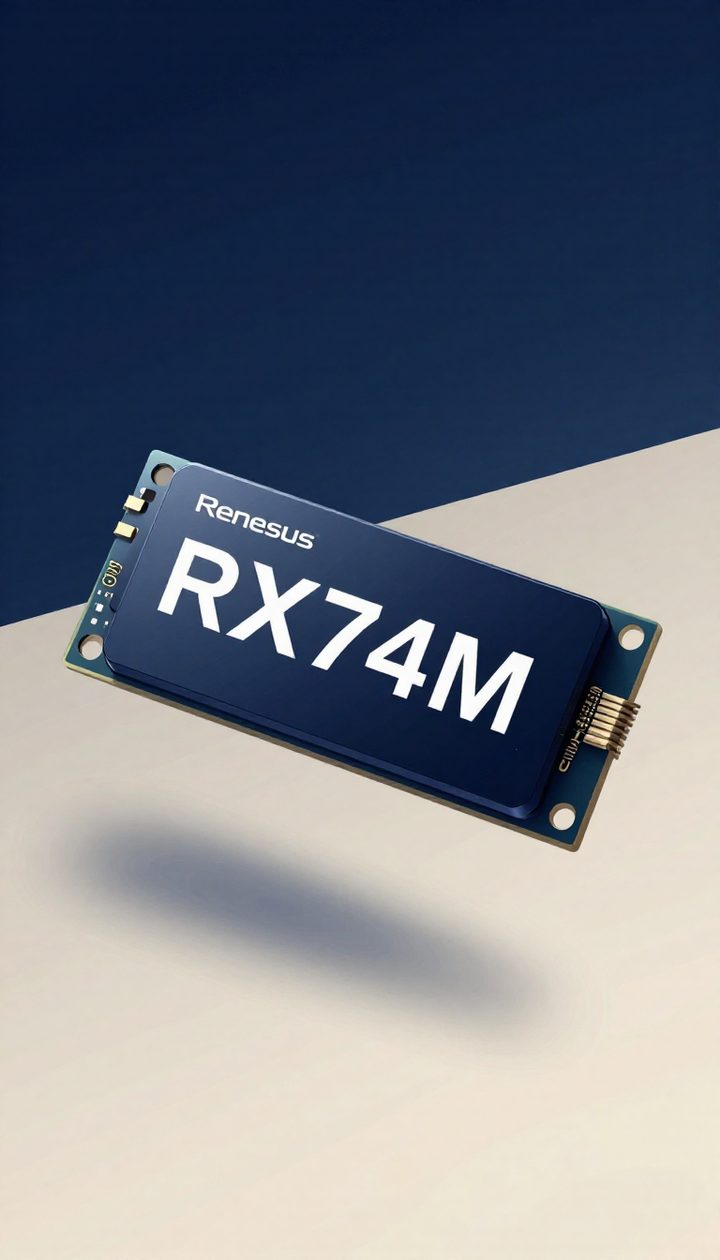
Renesas Electronics has introduced the RX74M and RX74N, new high-end 32-bit microcontrollers that reach up to 600 MHz. They are the first in the RX family built on a 22 nm process with embedded MRAM.
📚 Go deeper

The story of NVIDIA and Jensen Huang: how a video-game card company ended up making the most coveted resource on the planet.
As an Amazon Associate, Zendoric earns from qualifying purchases; the price does not change for you. · all our recommended books →
Renesas Electronics has unveiled the RX74M and RX74N, new high-end 32-bit microcontrollers that reach up to 600 MHz. They are the first in the RX family built on a 22 nm process and with embedded MRAM. According to the company, they deliver more than twice the performance of their predecessors, the RX72M and RX72N, which ran at 240 MHz.
The RX74M is designed for industrial and factory automation, with examples such as AC drives, industrial robots and PLCs. The RX74N targets a broader range of industrial equipment, including smart meters, power conditioners and HVAC systems.
22 nm process and MRAM: the chips integrate a 600 MHz RXv3e core with 1 MB of MRAM, 256 KB of zero-wait-state TCM and 1.5 MB of SRAM. According to Renesas, this enables fast, low-jitter real-time processing, even with frequent interrupts and branches. Unlike conventional embedded flash, MRAM can write data without a prior erase operation. According to the company, this translates into faster code and data updates, shorter programming times and less system downtime. It is useful in applications that frequently store parameters and logs.
Industrial connectivity: the RX74M integrates an EtherCAT slave controller, a TSN-compatible Gigabit Ethernet switch and CAN FD on a single chip. This allows it to support industrial networks such as EtherCAT, PROFINET and EtherNet/IP, including deterministic communication via TSN. It also supports redundant network configurations such as EtherNet/IP DLR, which were not supported in previous generations. Renesas presents it as an IIoT-ready industrial networking foundation that connects field devices with higher-level systems.
Hardware security: the MCUs integrate ProtectZone in the RX CPU, allowing secure and non-secure regions to be separated within the same chip. In addition, the new Renesas Secure IP (RSIP) expands public-key cryptography compared with the previous TSIP. It supports authenticated encryption and a wider range of hash algorithms. The company says this enables advanced implementations, including post-quantum cryptography (PQC), on a single MCU. It is positioned as a response to regulations such as the CRA, which are driving security measures across the entire device lifecycle.
Ecosystem and other features: Renesas is working with partners to shorten development. In software it cites Codewerk and RT-Labs, in development tools IAR, and in real-time operating systems eForce and Zephyr RTOS. There are also 300 MHz versions with more than 20% lower power consumption. Packages include 176-, 224- and 320-pin LFBGA and 100-, 144- and 176-pin LFQFP. Supply voltage ranges from 1.62 V to 3.6 V and operating temperature from −40 °C to +125 °C (Tj). They support XiP from external Octa Flash with on-the-fly decryption, and a common FSP environment across the RX, RA and RZ families.
Availability: according to the company, the RX74M and RX74N are available now; details on both and their evaluation boards can be found on the Renesas website. Renesas also offers reference combinations with other devices in its portfolio, such as a maglev conveyor system and a smart HVAC control with an integrated slave actuator.
It is worth noting that the performance data and advantages come from the manufacturer's announcement, and the article does not include independent measurements.
📚 Go deeper

Semiconductors as the oil of the 21st century: history, espionage, and why an island of 23 million people underpins the entire AI economy.

The reference manual for building products on top of AI models: prompts, RAG, fine-tuning, agents, evaluation and deployment.
As an Amazon Associate, Zendoric earns from qualifying purchases; the price does not change for you. · all our recommended books →
🔗 Related on Zendoric
- Demios launches a 'digital twin' that distributes your work among agents: the promise is ambitious, the proof not yet · 2026-07-25
- When the State asks for a pause: the era of staggered AI launches begins to take shape · 2026-06-27
- Claude Science: Anthropic takes aim at the heart of science and health with a dedicated product · 2026-07-01