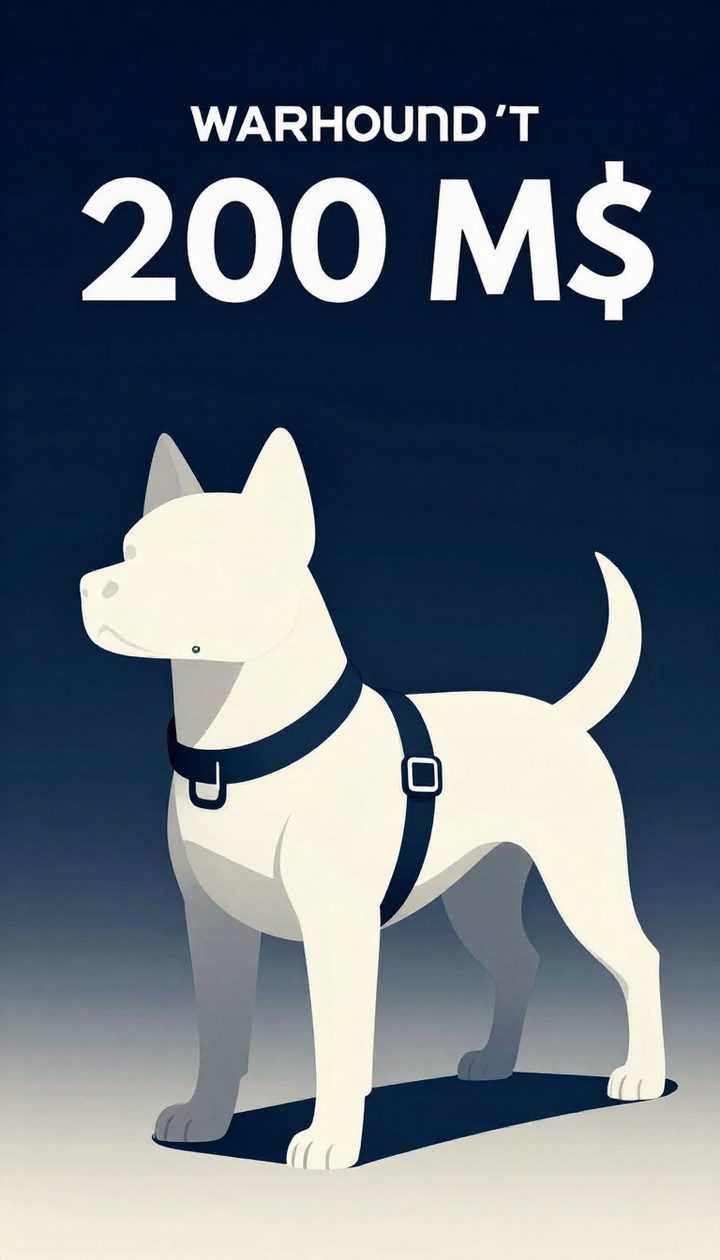
Warhound raises $200M at a $1.2B valuation to design genetically enhanced military dogs with a team from Anduril
🕒 Published on Zendoric: October 27, 2026 · 00:16
✨ AI-generated · how it's made
Warhound, a new company just out of stealth mode, has announced a $200 million round valuing it at $1.2 billion. Investors include Sequoia, 8VC, Corner Ventures and In-Q-Tel, the venture capital fund backed by the CIA and other US intelligence agencies.
📚 Go deeper

How opaque algorithms decide who gets credit, a job or parole — and why they tend to punish the same people.
As an Amazon Associate, Zendoric earns from qualifying purchases; the price does not change for you. · all our recommended books →
Warhound, a new company that has just come out of stealth mode, has announced a $200 million funding round that values it at $1.2 billion. Investors include Sequoia, 8VC, Corner Ventures and In-Q-Tel, the venture capital fund backed by the CIA and other US intelligence agencies. The idea came from Ben Lamm of Colossal Biosciences and Palmer Luckey of Anduril: to use genetic engineering to create working dogs for the US military, law enforcement and other emergency teams.
Warhound's dogs do not exist yet. According to the company, they would be used for tasks that are dangerous for people or difficult for machines, such as bomb detection, search operations and other specialized work. In its announcement, the company says more than 80% of US military working dogs come from Europe and fewer than half are fit for service. It argues that supply is increasingly scarce and that the United States is growing more dependent on other countries for an important resource in military and police work.
Lamm told TechCrunch that he met Luckey about a year ago at a conference, where Luckey remarked that more should be done for military working dogs. After staying in touch, Lamm looked into how these animals are bred and concluded that many fail training because of inherited predispositions, such as poor eyesight or a high likelihood of cancer, hip dysplasia or muscle atrophy. His thesis is that dogs can be improved in health, longevity, speed, agility and sense of smell, for example to detect explosives.
The method described starts with the best-performing breeds, the Belgian Malinois and the German Shepherd. Colossal's team has taken cell lines from these animals, meaning living cells grown in the lab, and stored them in a biobank. From there, the idea is to edit the dogs' genes, adding those that boost performance and removing those that don't, to create "a new kind of dog." Colossal, known for its de-extinction projects for animals such as the dodo and the mammoth, uses artificial intelligence and proprietary technology to clone genes and to identify and copy animal genes.
Anduril will supply software and hardware, such as protective vests and goggles, to improve situational awareness and coordination between the dogs and their handlers. Lamm gave the example of bulletproof vests fitted with data sensors that send information to handlers so they can better understand what is happening. He said these add-ons will improve the animals' safety and health beyond genetics, "on top of the dog, not inside the dog," and will also protect the human handlers.
As for the company's structure, Luckey is a partner in the project but holds no equity, according to Lamm. Colossal does hold equity in the company and supports it by licensing its technology. Viagen, another Colossal-owned company, will partner with Warhound to clone the dogs. Lamm says its technology has a high cloning success rate and that Colossal already uses it in its endangered species protection program.
The planned timeline is ambitious: the first batch of dogs is about to be cloned and incubated, births are expected early next year, and service should ideally begin within two years. Warhound does not yet know how much it will charge for the animals, but it hopes to sell to first responders, the Department of Defense, military service groups and police forces.
On government approval, Lamm said only that the company has briefed numerous public agencies. Asked about safety for the civilian population, he replied that each dog will be trained like any other military working dog and managed by whoever buys it. The company says it is working under the guidance of the American Humane Society to certify its training program, and hopes that on retirement the animals will enter that organization's Military Working Dog Reunification Program, which finds homes for retired military dogs, or another of its programs. The organization said it applauds Warhound and Colossal for inviting the country's first national humane organization to take part, and that it looks forward to working with them to ensure the animals are treated humanely.
It is worth stressing that almost all of the above consists of the company's own statements and plans: there are no edited animals yet, no prices and no detailed public approvals, and the birth and service timelines are aspirations. Questions about animal welfare, the reliability of the genetic modifications and oversight remain, for now, without concrete answers beyond mentions of conventional training and certification with a humane organization.
📚 Go deeper

Algorithms in justice, medicine, cars and art, explained with British humor and mathematical honesty.

AI as the latest chapter in the history of information networks, from gossip to the printing press to the algorithm.
As an Amazon Associate, Zendoric earns from qualifying purchases; the price does not change for you. · all our recommended books →
🔗 Related on Zendoric
- Inforcer raises 50 million dollars to shield small businesses from AI and cybersecurity risks · 2026-07-31
- Inforcer raises 50 million dollars to shield small businesses from AI and cybersecurity risks · 2026-08-31
- Socure raises a growth round at a $5.2 billion valuation and acquires Fravity · 2026-09-01