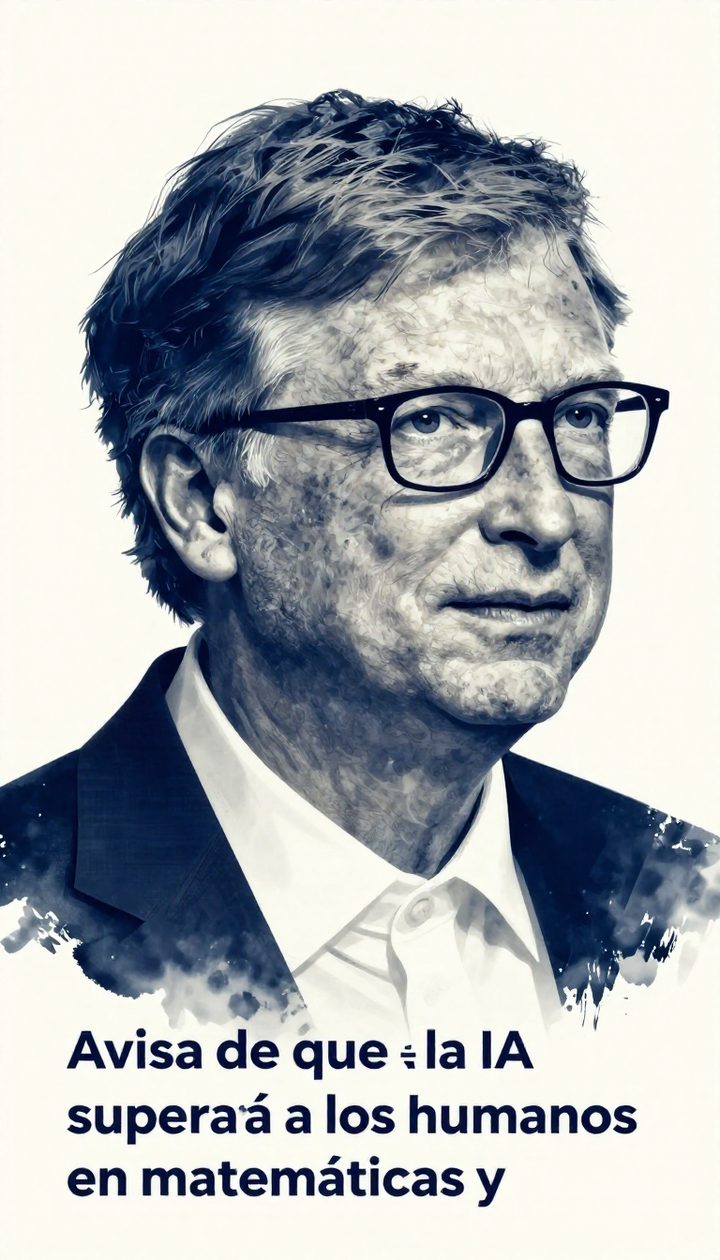
Gates warns AI will surpass humans in math and other fields, and sets the decisive window at 20 years
🕒 Published on Zendoric: October 26, 2026 · 08:28
✨ AI-generated · how it's made
Bill Gates says AI will surpass people in math and other areas, and that the next 20 years will be a "critical moment." The remark matters more as a signal about timing than as a technical prediction.
📚 Go deeper

The best starting book if you're not technical: a Wharton professor explains how to work WITH AI — when to delegate, when to supervise, when to keep i
As an Amazon Associate, Zendoric earns from qualifying purchases; the price does not change for you. · all our recommended books →
By Financial News (fnnews) · October 25, 2026.
Microsoft co-founder Bill Gates says artificial intelligence "will surpass humans in mathematics and other fields" and that the next 20 years will be "a critical moment," according to a headline from South Korean outlet Financial News. We only have the headline and the feed description. We have not been able to verify the context of the remarks, the setting or any nuances Gates added, so we have not filled them in.
What we can say is what the statement adds. The part about mathematics is the least controversial. Results in math can be verified objectively, which is why it is where AI can demonstrate its capabilities most clearly. Progress in formal reasoning is generally measured with proofs and competition problems, which are harder to dress up with marketing than other benchmarks.
Our take is that the key part of the statement is the 20-year horizon, not the word "surpass." A two-decade window fits a long transition, not a sudden leap. That is consistent with our view. In the short term there will be real friction: changing jobs, inequality and gaps between those who adopt AI and those who do not. In the long term, the same capabilities point toward eradicating diseases and creating an abundance that frees people to work on what they are passionate about.
A note of caution is also in order. When a figure of Gates' stature talks about a "critical moment," it is worth separating demonstrated capability from aspiration. "Surpassing humans in mathematics" can mean very different things, from solving competition problems to discovering new theorems. Without the full statement, we cannot know which he means. Until we have it, the prudent approach is to read the remark as a sign of the tone of the debate, not as a technical data point.
What should stay with readers is the underlying question. If the decisive window is 20 years, the work on governance, education and safety nets has to start now. Waiting until the capability has been demonstrated in every field would mean arriving too late.
📚 Go deeper

How opaque algorithms decide who gets credit, a job or parole — and why they tend to punish the same people.

The definitive piece of investigative journalism on OpenAI: 260+ interviews, the clash between safety and speed, and the attempted firing of Sam Altma
As an Amazon Associate, Zendoric earns from qualifying purchases; the price does not change for you. · all our recommended books →
🔗 Related on Zendoric
- ChatGPT-4o's age bias is not a technical glitch: it's society reflected at industrial scale (KAIST quantifies it) · 2026-06-28
- The real risk of superintelligence isn't that it dominates us, it's that we stop understanding it · 2026-07-06
- An unverified rumor of a cheaper, smarter Anthropic model reveals how AI races are now priced · 2026-07-12